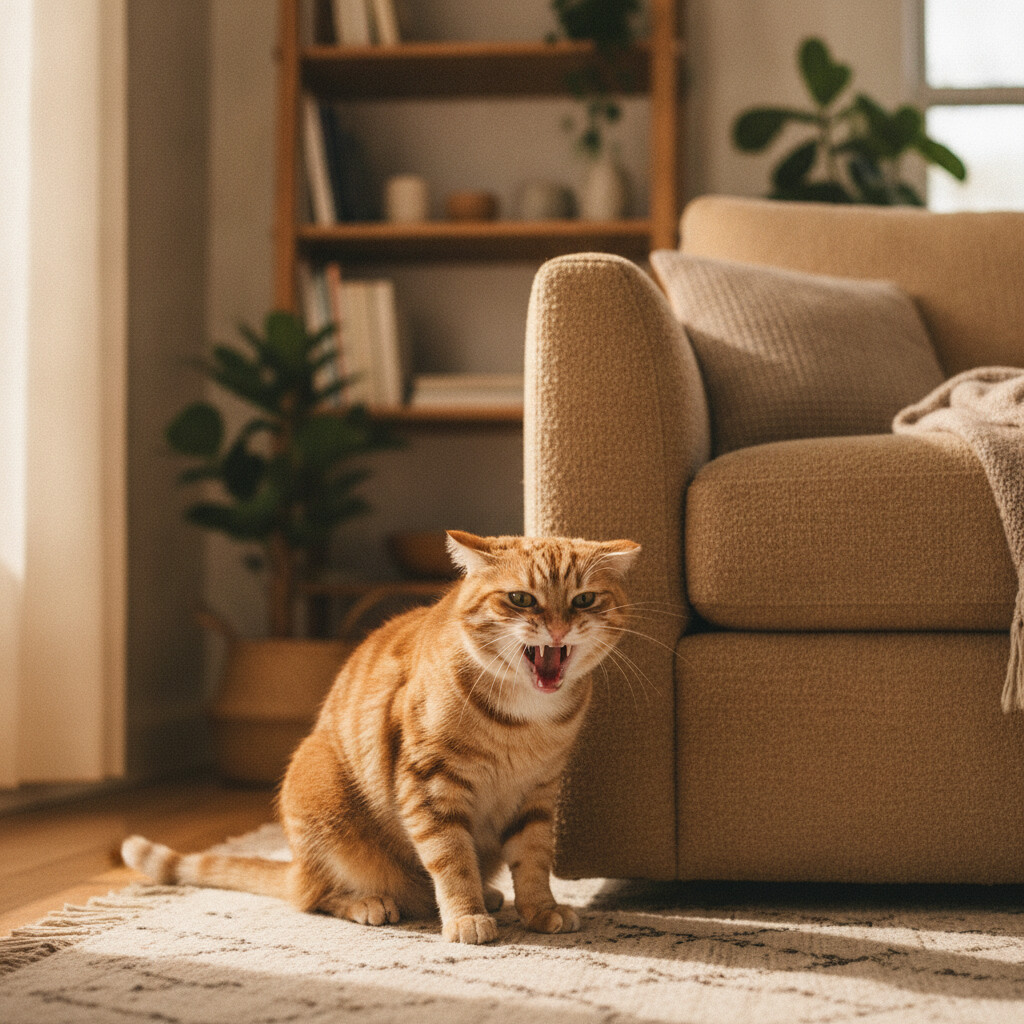
A cat hisses at you because they feel threatened and want more space — not because they hate you or are “being mean.” Hissing is a defensive warning, and it’s actually a polite one: it’s the signal cats use instead of scratching or biting. The useful question isn’t “why is my cat being nasty?” but “what is my cat afraid of, or what hurts?” Here’s how to work that out.
What Does It Mean When a Cat Hisses?
Hissing is what behaviourists call a distance-increasing signal. It means “back off” — and it’s almost always driven by fear, discomfort or uncertainty rather than offensive aggression. The cat-handling guidelines published by the American Association of Feline Practitioners (AAFP) and the International Society of Feline Medicine (ISFM) group hissing with flattened ears, dilated pupils, a crouched body and a tucked or lashing tail as signs of a frightened, defensive cat.
That matters, because a defensive cat who isn’t given space will escalate. A hiss is the cat telling you exactly where the line is before anyone gets hurt. If you respect it, you’ve just had a successful conversation.
You’ll sometimes read that cats hiss to imitate snakes. It’s a popular theory and it’s plausible, but nobody has actually demonstrated it. Treat it as a fun idea, not a fact.
Hissing usually comes with other body language. For a full breakdown of ears, tails and postures, see our cat body language guide.
Why Is My Cat Suddenly Hissing at Me?
Context is everything. These are the most common causes, roughly in order of how often vets and behaviourists see them.
1. Pain or illness
This is the one to rule out first, especially if the hissing is new. A cat who hisses when you touch a particular spot — the back, hips, belly or mouth — may be protecting something that hurts. Arthritis is far more common in cats than most owners realise: one radiographic study published in the Journal of the American Veterinary Medical Association (Hardie et al., 2002) found signs of degenerative joint disease in around 90% of cats over 12. Dental pain, urinary problems and injuries can all make a normally friendly cat defensive.
Cats are very good at hiding pain. Our guide to how to tell if your cat is in pain covers the subtler signs, including the Feline Grimace Scale developed by researchers at the Université de Montréal (Evangelista et al., Scientific Reports, 2019).
2. Fear or being startled
Waking a sleeping cat, reaching for them suddenly, picking them up when they didn’t expect it, or cornering them under the bed all trigger a fear response. Visitors, children, loud noises and new furniture can do it too. Some cats are simply more sensitive than others — genetics and early socialisation (the window between roughly 2 and 7 weeks of age) shape how easily a cat is frightened for the rest of their life.
3. Redirected aggression
Your cat sees a strange cat through the window, gets wound up, can’t reach the intruder — and hisses (or swats) at the nearest available target, which is often you or another pet. Veterinary behaviourists describe this pattern regularly, and it can be confusing because the cat seems to “turn on” someone for no reason. The giveaway is a cat who’s puffed up, tail fluffed and staring at something outside just before the outburst. Give them time — sometimes an hour or more — to calm down before interacting.
4. You smell wrong
Cats identify each other and their people largely by scent. If you come home smelling of another cat, a dog, or the vet clinic, your cat may hiss at you until you smell familiar again. This is the same reason one cat sometimes hisses at another who has just come back from the vet — it’s known as non-recognition aggression. Washing your hands and changing your clothes usually solves it for you; for a returning cat, keeping them apart briefly and rubbing both with the same cloth can help.
5. Overstimulation during petting
Some cats tolerate petting up to a point, then suddenly hiss or nip. The warning signs are usually there — a twitching tail, skin rippling along the back, ears rotating sideways. We go deeper on this in why does my cat bite me when I pet them.
6. Stress and changes at home
A house move, a new partner, a new baby, building work or a new pet can leave a cat chronically on edge, and a cat on edge has a shorter fuse. If the hissing comes alongside hiding, over-grooming or litter box changes, check our list of signs your cat is stressed.
Why Does My Cat Hiss at My Other Cat (or New Kitten)?
Hissing between cats is common, especially in the first weeks after an introduction. On its own, it isn’t a sign that things are failing — it’s cats negotiating boundaries. What matters is the trend. If the hissing slowly fades and the cats start sharing space, you’re on track. If it escalates to chasing, blocking access to food or litter boxes, or actual fights, slow everything down.
For the practical side, see how to introduce two cats and how to stop cats from fighting. If you’d like a reminder that it can work out, Two Cats, Six Months of Hissing is one household’s story.
What Should You Do When Your Cat Hisses?
The short version: stop, step back, and let the cat choose what happens next.
- Give space immediately. Stop touching the cat, back away, and don’t loom over them. Make sure they have an escape route — a cornered cat is far more likely to scratch.
- Don’t punish or hiss back. Shouting, spraying water or “showing them who’s boss” teaches the cat that you’re unpredictable, which increases fear and makes hissing more likely. The AAFP/ISFM guidelines are clear that punishment has no place in managing fearful cats.
- Avoid eye contact and sudden movements. A slow blink and turning slightly sideways reads as non-threatening in cat language.
- Let the cat come to you. Sit quietly, offer a treat at arm’s length or toss it near them, and let them approach on their own terms.
- Identify the trigger. Keep a quick note of when the hissing happens — what time, who was there, what you were doing. Patterns tend to jump out within a week or two.
- Build positive associations. If a specific thing triggers hissing (being picked up, the carrier, a visitor), pair gentle, short exposures with high-value treats, always stopping before the cat gets upset.
The good news is that most hissing fades once the cause is dealt with. Cats who feel safe and pain-free simply don’t need to hiss very often.
When to See a Vet
Book a vet appointment if:
- The hissing is new or sudden in a cat who has always been friendly.
- Your cat hisses when touched in one specific area — a strong hint at pain.
- It comes with other changes: hiding, reduced appetite, weight loss, limping, reluctance to jump, changes in litter box habits, or excessive grooming of one spot.
- Your cat is senior (over about 10) and has become grumpier or less tolerant of handling. Arthritis and dental disease are common and very treatable causes.
- Hissing is escalating to biting or scratching that breaks skin, or a conflict between your cats is getting worse despite your efforts.
If your vet rules out a medical cause and the problem persists, ask about a referral to a veterinary behaviourist (a vet with specialist training in behaviour, such as a Diplomate of the American College of Veterinary Behaviorists). Fear-based behaviour responds well to the right plan — and sometimes, to short-term anti-anxiety medication alongside it.
The Bottom Line
A hiss is information, not an insult. Your cat is telling you they’re scared, hurting or overwhelmed, and they’re giving you the chance to fix it before things escalate. Back off, look for the trigger, rule out pain — and most cats will be back to their usual selves sooner than you’d expect.