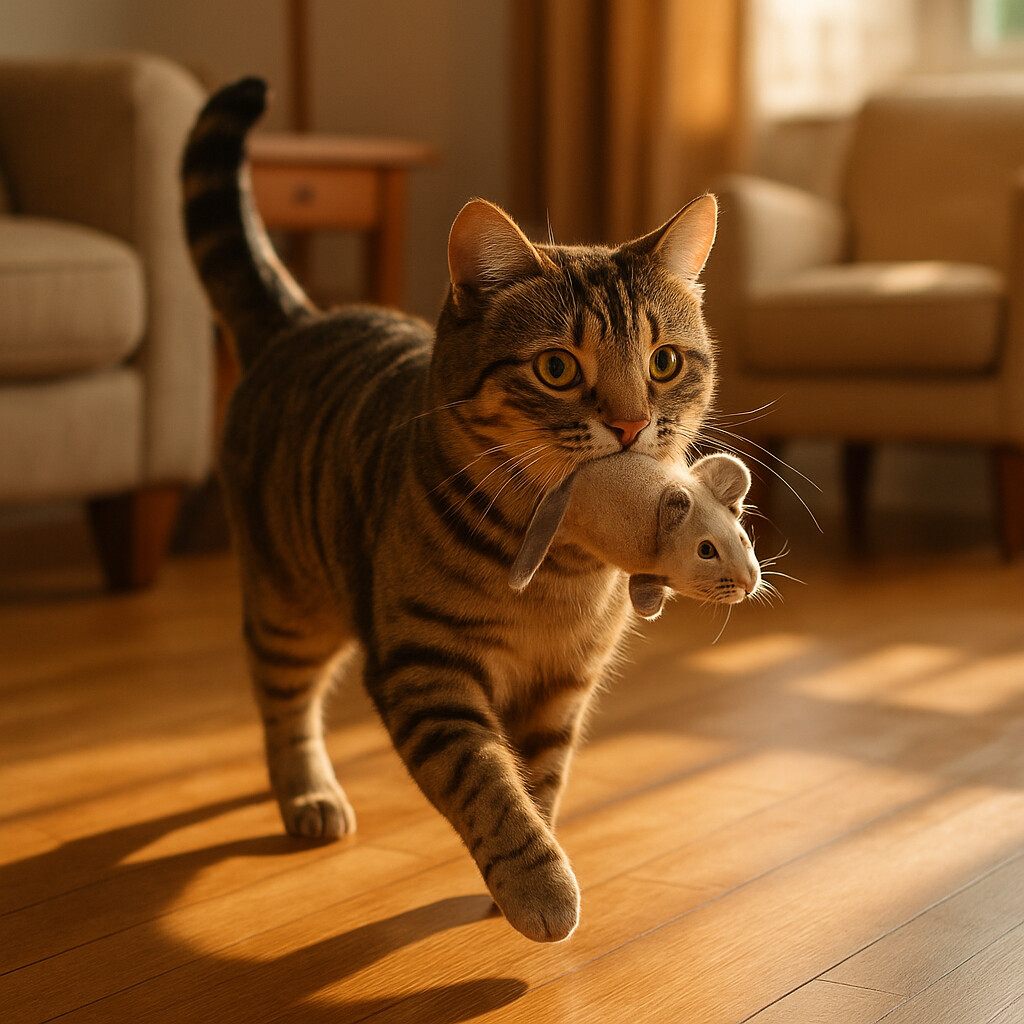
If you’ve ever woken up to find a crinkle ball deposited on your pillow, or had your cat parade a catnip mouse into the bathroom while you’re in the shower — you’re not alone, and you’re definitely not imagining the triumphant look on their face.
Cats bringing toys to their owners is one of the most common behaviors that leaves pet parents genuinely baffled. Is it a gift? A demand for playtime? A performance review on your lifestyle choices? The answer is more nuanced — and more interesting — than you might expect.
The Short Answer: Your Cat Is Teaching You to Hunt
The most widely supported explanation comes from studying how mother cats raise their kittens. Mother cats bring prey back to their litters in stages: first fully dead prey, then stunned-but-alive prey, and eventually live prey — progressively teaching their young how to hunt and finish a kill.
When your cat brings you a toy (or, if they go outdoors, an actual mouse), many animal behaviorists believe they’re performing a variation of this behavior. In their mind, you’re a member of their social group who has demonstrated zero hunting competence. You’ve never once caught a bird. You can’t even locate the treat bag without help. They’re helping you out.
Dr. John Bradshaw, a cat behavior researcher at the University of Bristol, notes in his work that the social group dynamic for domestic cats includes humans as honorary members — and the maternal instinct to provision those members can persist in both spayed females and neutered males.
Not All Cats Do This Equally — Here’s Why
The behavior varies considerably between individual cats, and the patterns tell you something useful:
More common in: Spayed females, high-prey-drive breeds (Bengals, Abyssinians, Siamese, Maine Coons), cats that were taken from their mothers relatively early (before 12 weeks), and cats who have limited opportunity for actual hunting.
Less common in: Low-energy cats, heavily indoor cats who don’t play much, and cats who’ve lived with highly interactive owners from kittenhood (they may direct the behavior through active play instead).
Timing matters: Many cats bring toys specifically at dusk and dawn — the crepuscular hunting hours when their prey drive naturally peaks. If your cat yowls and deposits a toy near you at 5:30 AM, that’s not random. That’s hardwired biology.
The Four Reasons Behind the Behavior (And What Each One Needs)
1. The Hunt-and-Share Instinct
As described above, this is the “I caught something for the family” motivation. Your cat genuinely believes they’re doing you a favor.
What it needs: Acknowledgment. Seriously — even saying “good job” in a warm tone validates the behavior in a way your cat understands. If you recoil or ignore it, you’re dismissing something they put effort into. You don’t have to be thrilled about 4 AM toy deliveries, but a brief warm response matters.
2. Invitation to Play
Cats sometimes bring toys not to share a kill but to initiate a game. This is particularly common in younger cats and in cats whose owners are frequently distracted (screens, work-from-home, etc.). The toy is essentially a “hey, you, look at me” signal.
What it needs: A genuine play session. Laser pointers, wand toys like the Da Bird or Cat Dancer, or anything that mimics erratic prey movement. The goal isn’t just moving an object — it’s mimicking the hunt arc: stalk, pounce, catch, kill. Without the “kill” (letting them actually grab and bite the toy at the end), many cats stay frustrated. At least 2 sessions of 10–15 minutes per day is the ASPCA-recommended baseline for indoor cats.
3. Resource Display (Multi-Cat Homes)
In households with multiple cats, toy-bringing can have a territorial dimension. A cat who deposits toys near you may be demonstrating resource control — essentially saying “I have access to the human, and I’m demonstrating that by bringing them stuff.”
What it needs: Monitor for resource-guarding behavior (blocking pathways to you, hissing at other cats near “their” toy pile). If you see that, make sure each cat gets individual attention time and that play sessions aren’t competitive.
4. Boredom or Excess Predatory Energy
An indoor cat with no outlet for prey drive will sometimes redirect it compulsively. If your cat is bringing toys constantly, yowling while carrying them, or seems restless and anxious, the behavior has shifted from instinct to coping mechanism.
What it needs: Environmental enrichment. Puzzle feeders, rotating toy variety, window bird feeders for visual stimulation, and — if your setup allows — controlled outdoor time. Safe outdoor access lets cats exercise genuine prey behaviors (stalking, investigating, watching wildlife) without the risks of free roaming. The Oscillot Spring Energy Burst guide has some genuinely good ideas for this if you’re trying to give your cat more stimulation.
The “Yowling While Carrying Toys” Variation
Some cats don’t just bring toys silently — they yowl loudly while transporting them, sometimes walking around the house wailing with the toy in their mouth before dropping it at your feet. This is particularly alarming at 3 AM.
This specific variant is more associated with the hunting-call behavior: cats in the wild will often vocalize after making a kill. The yowl is essentially the cat announcing a successful hunt. For some cats, especially older spayed females, it can also be associated with phantom maternal behavior — the toy becomes a substitute “kitten” they’re retrieving.
This is typically harmless. If it’s severe, the most effective response is genuinely engaging when they bring the toy during your waking hours, which reduces the compulsion to escalate the behavior to get your attention.
When Should You Worry?
The toy-bringing behavior itself is almost never a sign of a problem. But watch for:
- Sudden increase in intensity or frequency: Could signal anxiety, cognitive dysfunction in older cats, or thyroid issues (hyperthyroidism in cats over 10 is common and causes restlessness)
- Guarding the toys aggressively: Unusual possessiveness can indicate anxiety or pain
- Only bringing actual prey (outdoor cats): Fine biologically, but worth having an honest conversation about outdoor risk management — cars, predators, and disease are real
What You Can Do to Redirect or Encourage It
- Respond warmly every time. Even a brief “thank you, I see you” in a gentle tone reinforces the social bond your cat is trying to strengthen.
- Store toys in a basket at ground level so your cat has easy “prey” access whenever the urge strikes.
- Rotate toy types every few days. Cats habituate fast — novelty keeps prey drive appropriately channeled.
- Schedule morning play. Intercepting the prey drive at 6 AM with an active wand session before your cat decides to wake you at 3 AM with a stuffed mouse can significantly reduce nighttime delivery service.
The next time your cat drops a crinkle ball at your feet with the gravity of someone delivering a quarterly report, take a moment to appreciate what they’re actually doing: treating you as family, sharing what they have, and trying — in the only language they’ve got — to take care of you.
They could stand to work on their timing. But the impulse is genuinely sweet.
Posted by CatLady6