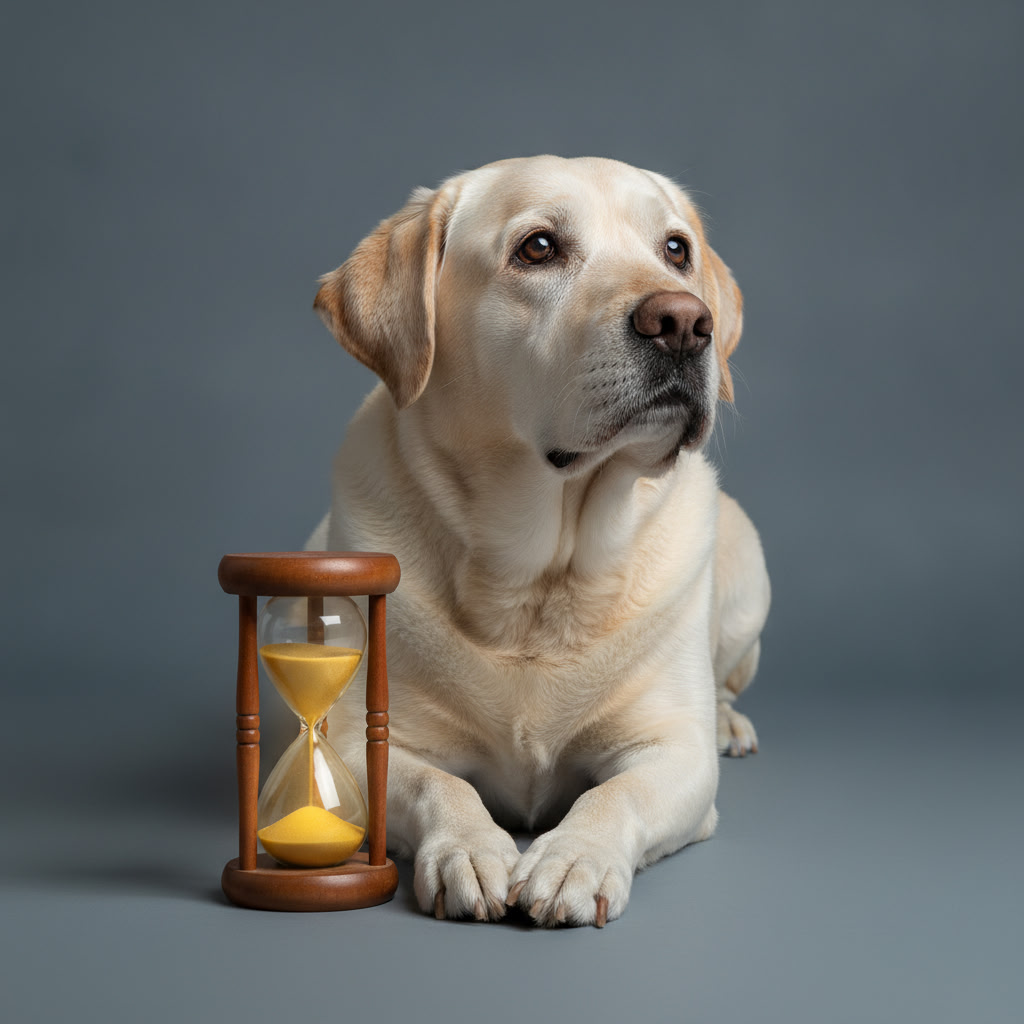
There’s no single birthday when a dog becomes a senior. It depends mostly on size: as a rough guide, giant breeds are seniors from about 5 or 6, large dogs from about 7 or 8, medium dogs from about 8 to 10, and small dogs from about 10 to 12. Vets don’t actually go by a fixed age, though. They go by how long your dog is likely to live, and that shift is what decides when checkups, food and exercise should start to change.
How Vets Define a Senior Dog
The American Animal Hospital Association (AAHA), whose guidelines many US vets follow, dropped fixed age cut-offs in its 2019 Canine Life Stage Guidelines. Instead it defines a dog as senior from the last 25% of its expected lifespan onward, with “end of life” as a separate final stage.
That sounds abstract, but it’s practical. A dog whose breed and size suggest a lifespan of around 14 years becomes a senior at about 10 or 11. A dog expected to live around 8 years is a senior at 6. The point of the label isn’t the number. It’s that from this stage, problems like arthritis, dental disease, kidney disease and cancer become common enough that it pays to look for them before they cause obvious signs.
Why Big Dogs Age Faster
Across most of the animal kingdom, bigger species live longer: elephants outlive mice. Within dogs it’s the opposite. Small dogs tend to live years longer than large and giant breeds.
Researchers are still working out exactly why, but the pattern is well documented. A 2013 study in The American Naturalist (Kraus, Pavard and Promislow) analysed age at death across dozens of breeds and concluded that large dogs appear to age at a faster rate, not simply start ageing earlier. In 2024 a UK study of more than half a million dogs (McMillan and colleagues, published in Scientific Reports) put the median lifespan of all dogs at about 12.5 years and found that small breeds generally lived longest, while flat-faced breeds of all sizes were among the shortest-lived.
Breed and individual health matter too, which is why mixed-breed dogs and dogs within one breed vary so much.
Senior Age by Size: A Rough Guide
This table applies the AAHA “last 25%” idea to typical lifespans. Treat it as a starting point, not a rule. Your vet can give a better estimate for your dog’s breed and health.
| Size (adult weight) | Typical examples | Roughly senior from |
|---|---|---|
| Small (under about 20 lb) | Chihuahua, Miniature Dachshund, Shih Tzu | 10–12 years |
| Medium (about 20–50 lb) | Beagle, Border Collie, Cocker Spaniel | 8–10 years |
| Large (about 50–90 lb) | Labrador, German Shepherd, Golden Retriever | 7–8 years |
| Giant (over about 90 lb) | Great Dane, Mastiff, Irish Wolfhound | 5–6 years |
Mixed-breed dogs usually follow their adult size. If your dog belongs to a breed with a known short lifespan, or has a chronic condition, the senior stage may start earlier.
What About “Dog Years”?
The “one dog year equals seven human years” rule is a myth, and a fairly old one. Dogs grow up much faster than that at the start: a one-year-old dog is physically closer to a human teenager than to a seven-year-old child. After that, the pace slows, and it varies with size.
A 2020 study from the University of California San Diego (Wang and colleagues, in Cell Systems) compared age-related chemical changes in DNA in dogs and people and came up with a logarithmic formula instead: human age ≈ 16 × ln(dog age) + 31. It’s an interesting result, but it was based on Labrador Retrievers, so it doesn’t apply neatly to a Chihuahua or a Great Dane. The life-stage approach above is more useful for day-to-day care.
Signs Your Dog Is Getting Older
Some changes are normal ageing. Others look like ageing but are really treatable problems, and those are the ones worth catching early.
Usually normal on their own:
- A greying muzzle and face (some dogs start greying early, so this says little about age by itself).
- Sleeping more and slowing down a little on walks.
- A faint bluish-grey haze in the eyes called nuclear (or lenticular) sclerosis. It’s a normal change in the lens and usually doesn’t affect sight much. A cataract looks whiter and more opaque and does affect vision, so let your vet tell the two apart.
- Some loss of hearing.
Worth a vet check, even if they seem like “just age”:
- Stiffness getting up, reluctance to use stairs or jump in the car, or lagging behind on walks. These are often arthritis, which is treatable. See why dogs limp and signs your dog is in pain.
- Weight gain or weight loss without a change in food.
- Bad breath, dropping food or chewing on one side, which often mean dental disease.
- Drinking or peeing more, or accidents in the house. Our guide to why a dog drinks so much water explains the causes vets look for.
- New lumps, or lumps that change.
- Getting lost in familiar places, staring at walls, pacing at night or changes in sleep. These can be signs of canine cognitive dysfunction, covered in dog dementia: signs and how to help.
What Changes When Your Dog Becomes a Senior
Checkups. Many vets recommend checkups every six months for senior dogs rather than once a year, often with blood and urine tests. A dog ages several “human years” in a single year, so a lot can change between annual visits. AAHA’s 2023 Senior Care Guidelines for dogs and cats also stress tracking weight, muscle and mobility over time, because gradual changes are easy to miss at home.
Food. Not every older dog needs a “senior” food. In the US, AAFCO (the body whose nutrient profiles pet food labels refer to) has no separate senior life stage, so foods labelled “senior” vary widely in calories, protein and everything else. Base the choice on your dog’s weight, muscle condition and any medical problems, with your vet’s input, rather than the label. Keeping a senior dog lean is one of the most useful things you can do for their joints. Our guide to whether your dog is overweight shows how to check.
Exercise. Keep them moving, but adjust. Two or three shorter walks usually suit an older dog better than one long one, and gentle, regular exercise helps maintain muscle and joint mobility. Slow down further if your dog is lagging, panting heavily or stiff the next day.
Home comfort. Rugs or runners on slippery floors, a supportive bed away from drafts, a ramp for the car or the couch, and raised bowls for some dogs can make a big difference to a stiff senior.
Mental exercise. Sniffing walks, food puzzles and short training sessions keep an older dog’s brain busy, and a long-term study of ageing Beagles (Milgram and colleagues, 2005, in Neurobiology of Aging) found that an enriched environment helped preserve cognitive function.
When to See a Vet
Book a vet visit if you notice any of the changes in the “worth a vet check” list above, and plan regular senior checkups even if your dog seems well.
Go the same day or to an emergency vet if your senior dog:
- collapses, has a seizure, or suddenly can’t stand or walk;
- has a swollen, hard belly, especially with retching that brings nothing up (a possible sign of bloat in large, deep-chested dogs);
- has trouble breathing or pale gums;
- strains to pee with little or nothing coming out;
- stops eating for more than a day, or vomits repeatedly;
- suddenly tilts their head, circles or loses their balance.
Getting older isn’t a disease, and many senior dogs stay happy and active for years. Recognising the senior stage just means you start looking for problems while they’re still easy to treat.
How old is your dog, and what’s the first thing that made you think “they’re getting older”?