Planning a trip with an older cat takes more prep than tossing them in a carrier and hoping for the best — but it’s very doable if you plan around what actually changes with age. The short version: minimize sedation, protect their routine as much as possible, and pack for the health conditions they already have, not just the trip itself.
Most travel advice online is written for cats in general, not cats with arthritis, kidney disease, or a thyroid condition that needs medication on a strict schedule. Senior cats can travel safely — they just need a different playbook.
Should You Even Bring Your Senior Cat?
The first question isn’t “how” — it’s “should.” A cat who’s frail, has advanced kidney disease, severe arthritis, or a heart condition may do better boarded with a trusted sitter or a vet-affiliated boarding facility than dragged across time zones. The American Association of Feline Practitioners (AAFP) Cat Friendly guidelines note that travel and unfamiliar environments are among the most common stressors for cats, and stress hits senior cats harder because their bodies have less physiological reserve to absorb it.
Ask your vet directly: “Is my cat medically stable enough to travel?” Cats with recently adjusted medication doses (thyroid, blood pressure, insulin) are usually better off staying home until their treatment is settled. A vet who knows your cat’s chart is a better judge of this than any blog post, including this one.
If the trip is optional and your cat is medically fragile, the safest option is often the boring one: leave them home with a sitter who can follow their routine exactly.
Skip the Sedatives (Usually)
This is the biggest change from how people used to travel with pets. Veterinary consensus has shifted firmly away from routine sedation for travel. The AVMA specifically advises against tranquilizing pets for air travel because sedatives can affect balance, temperature regulation, and cardiovascular and respiratory function — all of which are already under more strain in an older cat. A sedated cat also can’t reposition themselves if the carrier tips or the cabin gets too warm, and airlines increasingly refuse sedated animals for exactly this reason.
If your cat has severe anxiety, talk to your vet about non-sedating anti-anxiety options (like gabapentin, which is commonly used off-label for situational feline stress and has a wide safety margin) rather than a sedative. Feline pheromone products (Feliway) sprayed in the carrier a few hours before travel — not directly on the cat — can also take the edge off for some cats, though the evidence is mixed and it works better as one piece of a calming routine than a fix on its own.
Pack for the Conditions They Already Have
A senior cat’s travel kit needs to cover their existing health issues, not just food and litter.
Medications, with buffer. Bring at least a week more than you think you’ll need, in the original labeled containers. If your cat is on thyroid medication or insulin, keep dosing times as close to their normal schedule as time zones allow — talk to your vet in advance about how to handle a time zone shift for insulin specifically, since this is where dosing errors most often happen.
Prescription diet, not a substitute. If your cat eats a kidney or urinary prescription diet, bring enough for the whole trip. Don’t assume you’ll find it locally — specialty vet diets aren’t stocked at every pet store, and switching food abruptly during a stressful trip is a good way to trigger GI upset on top of everything else.
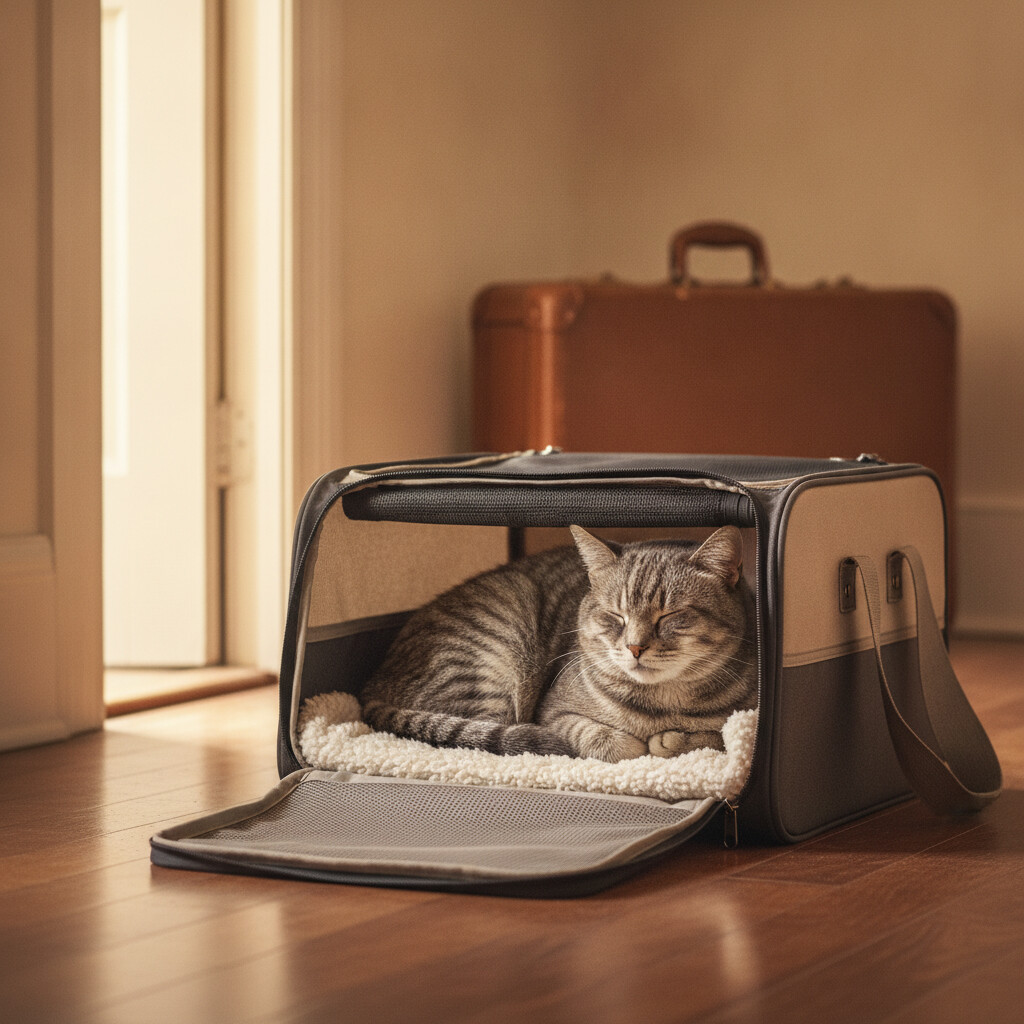
A carrier that accommodates arthritis. Senior cats with joint pain do better in a carrier with a low, wide entry (top-loading or with a removable top) rather than one they have to duck into. Add extra padding — a folded towel with their scent on it helps more than a stiff carrier mat.
Litter access on long drives. Stop every 2-3 hours on road trips so your cat can use a litter box in a safe, enclosed space (a bathroom, not the parking lot). Older cats with kidney disease often drink and urinate more, and holding it for a full day of driving isn’t good for anyone’s bladder, let alone one that’s already compromised.
Temperature Control Matters More Than You’d Think
Senior cats are worse at regulating their body temperature than younger cats, particularly if they have reduced muscle mass or a thyroid condition. Never leave a senior cat in a parked car, even briefly, even with windows cracked — this applies at any age but the margin for error is smaller for an older cat. In carriers, avoid direct AC vents blowing straight onto them and avoid direct sun through a car window, which can heat a carrier faster than the rest of the cabin suggests.
Health Paperwork You’ll Actually Need
For air travel or crossing state lines, most airlines and some states require a health certificate (a Certificate of Veterinary Inspection) issued by an accredited vet within 10 days of travel — check your airline and destination state’s specific window, since it varies. Bring a written medication list with dosages, your vet’s contact information, and if your cat has a chronic condition like CKD or hyperthyroidism, a one-page summary of their diagnosis and current treatment. If something goes wrong away from home, an unfamiliar vet handling an unfamiliar senior cat will move faster with that summary in hand than starting from zero.
If you’re flying, call the airline directly to confirm current pet policies — these change often, and in-cabin carrier size limits and health certificate windows are two of the most common reasons pets get turned away at the gate.
When to See a Vet Before You Go
Book a pre-travel check-up if any of the following apply:
- Your cat has a chronic condition (kidney disease, hyperthyroidism, diabetes, heart disease) and hasn’t been examined in the last 3-6 months
- Any medication dose has changed in the last month
- Your cat has lost weight recently without an obvious reason
- You’re traveling somewhere with a significant climate difference from home
- Your cat will be crossing state lines or flying, and needs a health certificate
And once you’re traveling: if your senior cat stops eating for more than 24 hours, seems disoriented beyond normal travel stress, has labored breathing, or you notice blood in urine or stool, treat it as an emergency and find the nearest vet rather than waiting until you’re home.
The Practical Takeaway
Traveling with a senior cat isn’t riskier because of the miles — it’s riskier because it disrupts routine, medication timing, and temperature control all at once, right when their body has the least buffer to absorb it. Get the vet clearance first, skip sedation, pack a full medical kit, and build in more stops and buffer time than you would for a younger cat. Most senior cats handle travel just fine when the logistics are actually planned around them instead of around the trip.
If your cat’s real issue is more about day-to-day comfort than travel specifically, our guide on caring for a senior cat after age 11 covers the broader picture, and senior cat wellness exams is a good next read before any pre-travel vet visit.