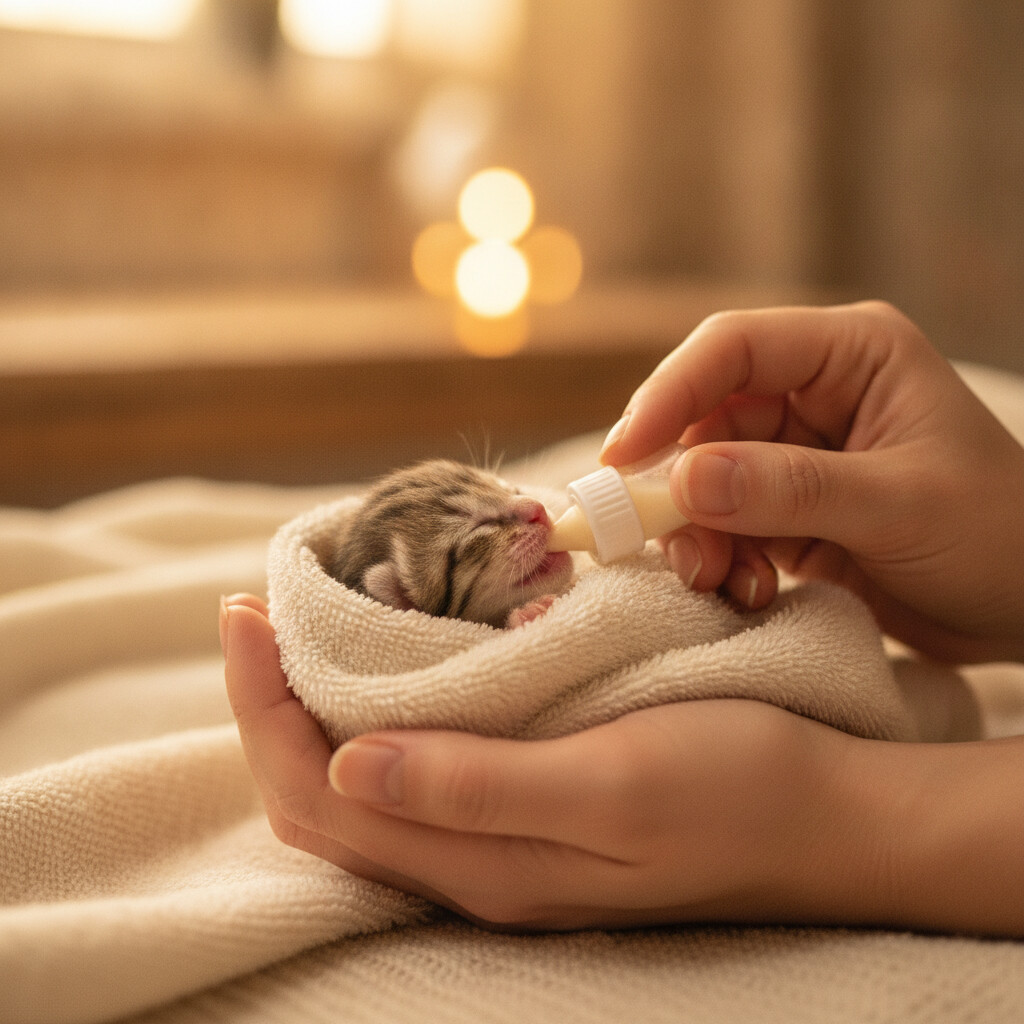
She weighed 62 grams. The vet tech who took her from me didn’t say anything encouraging — she just said “okay” in the flat, focused voice of someone doing math in her head. Four days old, eyes still sealed shut, found alone in a stack of firewood with no mother anywhere in earshot. The tech told me later, once it was clear the kitten would live, that she’d given her maybe one-in-five odds that first night. I didn’t know that at the time. I just knew I had a kitten in a shoebox and no idea what I was doing.
This is the story of how Wren made it — and everything I got wrong before I figured out what I was actually supposed to be doing.
The first 48 hours are the ones that matter most
Orphaned neonatal kittens die most often in the first two days, and almost always from one of two things: getting cold, or getting fed wrong. I made both mistakes within the first hour.
My first instinct was to warm her up fast — I wrapped her in a heating pad turned up high. A vet friend I called in a panic told me to knock it down immediately: neonatal kittens can’t move away from a heat source that’s too hot, and thermal burns on top of hypothermia is a genuinely common way bottle babies get hurt by well-meaning rescuers. The safer approach, she told me, is a heating pad on low, covered with a towel, warming only part of the enclosure so the kitten can crawl off it if she gets too warm.
The second mistake was worse. I tried to feed her before she was properly warmed. A cold kitten can’t digest food — her body redirects blood flow away from the gut to protect the core organs, and formula given too early can sit undigested or cause aspiration if she’s too weak to suckle properly. The rule I learned the hard way: get the kitten’s body temperature up first (check by feel — cold ears and pads are the tell), and only then attempt a feed.
What actually keeps a bottle baby alive
Once I’d stopped making rookie mistakes, the routine became almost meditative, if exhausting: kitten-specific formula (never cow’s milk, which most kittens can’t digest and which doesn’t come close to the fat and protein density they need) every two to three hours around the clock, including through the night, for the first two weeks.
A few things I wish someone had told me on day one:
- Never feed a kitten on her back the way you’d feed a human infant. Kittens nurse belly-down, and feeding them on their back dramatically raises the risk of formula going into the lungs instead of the stomach.
- Stimulation isn’t optional. Kittens under about three weeks can’t urinate or defecate on their own — a mother cat licks them to trigger it. A warm, damp cotton ball or cloth, gently rubbed on the genital area after every feed, does the same job. Skip it and a kitten can develop a dangerously distended bladder within a day.
- Weigh daily, same time, same scale. A kitten who isn’t gaining weight steadily — even a kitten who seems otherwise fine — is telling you something’s wrong before any other symptom shows up. Wren’s weight gain, tracked on a kitchen scale accurate to the gram, was the single most useful piece of data I had for two weeks straight.
By ten days her eyes had opened. By three weeks she was trying, badly, to walk. By five weeks she was doing the thing kittens do where they attack your ankles from underneath the couch, which felt like the single greatest achievement of my adult life.
The weeks I didn’t expect to be hard
What surprised me wasn’t the physical exhaustion of overnight feeds, which I’d braced for. It was how isolating it is. Bottle-raising a kitten alone means you can’t really leave the house for more than three hours at a stretch, for weeks. Friends who’d never done it didn’t really understand why I couldn’t just “get someone to check on her” — a two-week-old kitten’s care isn’t something you can hand off to someone without training and expect to go well.
If you’re in this situation, the thing that saved me was finding a local kitten-fostering network through a rescue group — experienced fosters who’d done this dozens of times and would answer a 3 a.m. text about whether a kitten’s stool color was normal. If you’re taking on a bottle baby without that kind of backup, building it before the crisis rather than during it makes an enormous difference. Fostering Cats: What It Involves and How to Make It Work covers what that support system actually looks like day to day.
What I’d tell someone finding an orphaned kitten today
First: confirm the mother is actually gone before intervening. Mother cats often leave kittens for hours while hunting, and a kitten who looks abandoned frequently isn’t — watching from a distance for a few hours before assuming the worst avoids unnecessarily separating a kitten who was fine where she was.
If the mother genuinely isn’t coming back, get the kitten warm before anything else, get her to a vet or experienced rescue for a health check within 24 hours if possible, and find kitten formula (from a pet store or vet, never a grocery-store substitute) before the next feeding is due. From there, Raising Kittens: A Week-by-Week Guide from Birth to 12 Weeks is worth reading in full — I wish I’d had it printed out and taped to my wall that first week instead of learning most of it from a string of late-night phone calls.
Wren is a year and a half old now. She’s enormous, unbothered by almost everything, and has no memory of any of this. I remember all of it.