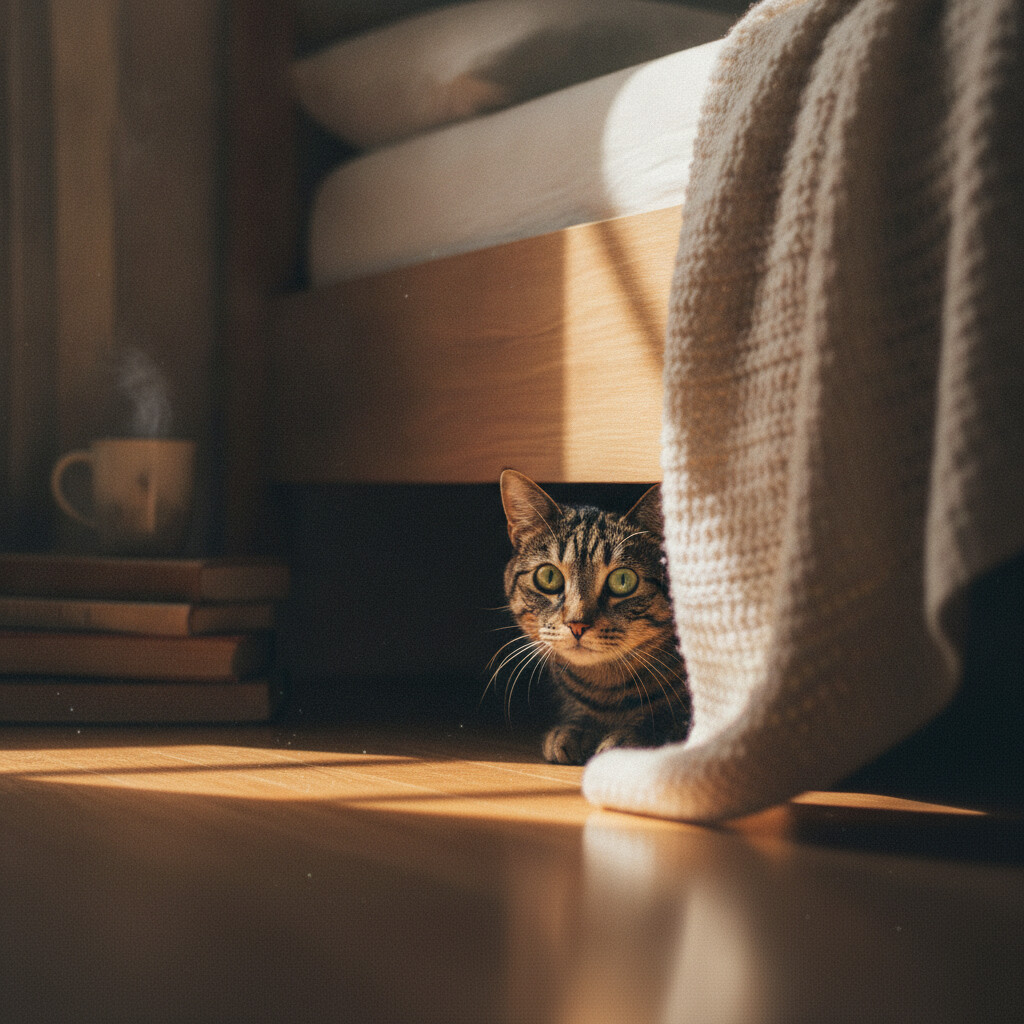
She lived under our bed for the first four months. Not hiding-when-scared under the bed — living there. Eating there, using a litter box we slid in and out on a cookie sheet, watching our ankles go by from the dark. We adopted Marmalade at eleven months old from a shelter that had pulled her from a hoarding situation, and for the first year of her life with us, she would not let a single person touch her.
This isn’t a rescue story with a fast redemption arc. It took a full year before she let me rest a hand on her back without bolting. Here’s what that year actually looked like, and what finally worked.
Why “just give her time” wasn’t enough on its own
Every rescue group we talked to said some version of “give her time,” and they weren’t wrong — but time alone wasn’t doing the work. Shelters and behaviorists often reference something like the “3-3-3 rule” (popularized by rescue organizations including the ASPCA): roughly three days to decompress, three weeks to start settling in, three months to feel truly at home. Marmalade blew through all three of those windows without much visible change, and it took me embarrassingly long to realize that “time” needed to be paired with a plan, not just patience.
What we were actually waiting on was her nervous system recalibrating. Cats coming out of chronic stress — overcrowding, unpredictable food access, constant noise — don’t reset on a fixed schedule. Research tracking stress hormones in newly adopted shelter cats has found that cortisol markers can stay elevated for weeks even in cats who look outwardly calm, which matched what we were seeing: a cat who wasn’t hissing or hiding-hiding anymore, but whose whole body stayed tense the second anyone got close.
What actually moved the needle
Three things changed the trajectory, and none of them were dramatic.
We stopped trying to pet her and started existing near her. Every well-meaning approach — slow blinks, offered hands, sitting quietly nearby hoping she’d come to us — she read as pressure. What worked was doing something else entirely: reading on the floor near her doorway, working on a laptop a few feet from the bed skirt, narrating nothing in particular in a low voice. No agenda. No hand extended. Just presence without expectation, repeated daily for months.
We moved to feeding by hand, but from a distance that grew by inches, not feet. This is a technique Fear Free-certified veterinary professionals (the organization co-founded by veterinarian Dr. Marty Becker) recommend for undersocialized or fearful cats: pairing your presence with something unambiguously good, at a distance the cat chooses, and letting the cat close that distance herself over time rather than you closing it for her. Some weeks the distance didn’t change at all. Around month seven, it started closing on its own.
We stopped taking setbacks personally. She’d have a good week — eating near us, tail up, walking through the room in daylight — and then a bad week where a dropped pan sent her back under the bed for three days. Fear Free guidance is explicit that regression after a stressor isn’t the cat “forgetting” progress; it’s a nervous system that’s still learning the house is safe, and setbacks don’t erase the learning underneath them, even when they feel like it undoes everything.
The first touch
It happened on an unremarkable Tuesday. She was sitting a foot away from me on the couch — which itself had taken months — and I rested two fingers on her shoulder without thinking about it, the way you’d touch a cat you’d had for years. She didn’t move. I didn’t either, for a long time.
I wish I could say it was all smooth after that. It wasn’t. But that touch was the marker that something had fundamentally shifted, and from there, the pace of change sped up in a way the previous year hadn’t.
What I’d tell someone starting this today
If you’re four, six, nine months into a rescue cat who still won’t let you close, the thing I needed to hear was this: the absence of progress on your timeline is not the absence of progress. A cat rebuilding trust after chronic stress isn’t behind schedule — there was never a schedule that applied to her specific history. What actually predicts a better outcome isn’t how fast things move, it’s whether the cat is given consistent, pressure-free access to a person who doesn’t ask for anything in return.
If you’re in month one or two of a similar situation, our guide to how long it actually takes a new cat to settle in covers the more typical range — and if Marmalade’s story sounds like your own rescue cat, our guide to helping a rescue cat decompress and settle in walks through the early groundwork we wish we’d been more deliberate about from day one.
If it’s been well over a year and there’s been genuinely zero movement — no closing distance, no curiosity, active fear rather than wariness — that’s worth a conversation with a certified feline behaviorist or your vet, since chronic, unrelenting fear can sometimes have a treatable medical component underneath it.
Marmalade sleeps on my chest most nights now. She still doesn’t love strangers, and she still disappears for a day if we host a party. But she chose the couch, then the lap, then the two fingers, then everything after — all in her own time, which turned out to be the only time that mattered.