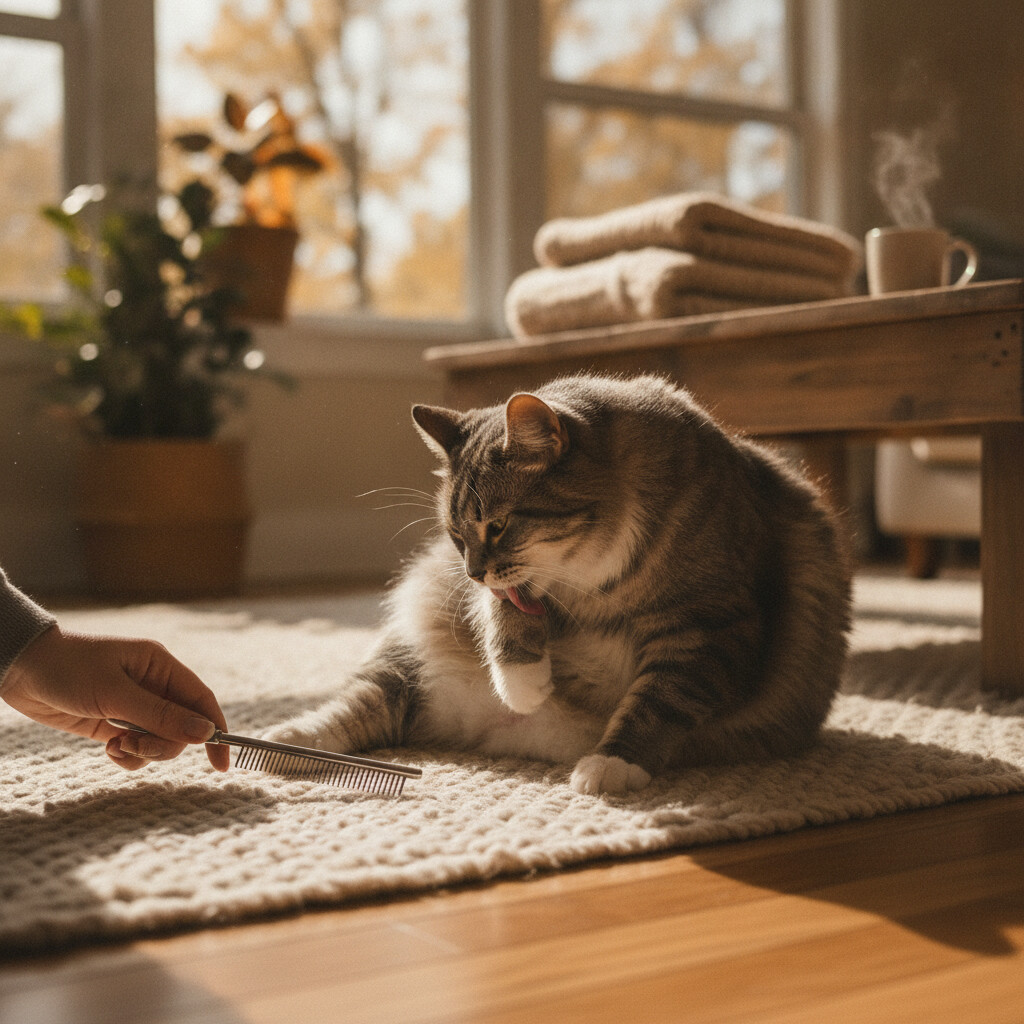
Our indoor cat Juniper licked her belly and inner thighs almost bald over one autumn, and we were sure it was stress. It wasn’t. It was flea allergy, in a cat who never went outside, and we never saw a single flea on her.
If your cat is pulling or licking out patches of fur, don’t assume it’s “just anxiety” until a vet has ruled out the medical causes first, starting with fleas. Here’s how we got it wrong, and what finally fixed it.
The bald patch we blamed on the move
Juniper was six, a fluffy grey tabby who had never been outdoors. We’d moved apartments in August, and by October her belly was pink and smooth, with a thin, stubbly strip running down the inside of each back leg.
It seemed to make sense. New home, new noises, cat licks herself raw. We’d read that cats can overgroom when they’re stressed, so we bought a pheromone diffuser, added another cat tree by the window and played with her more every evening. She loved the extra play. The licking didn’t change.
What we didn’t think hard enough about: the new building allowed dogs, and our own dog, Rufus, had started going to a busy dog park on weekends. His flea collar had run out over the summer and we hadn’t replaced it, because “he’s never had fleas.”
Why we never saw a single flea
At the vet, the first thing she did was run a fine-toothed flea comb through Juniper’s lower back and tip what came out onto a damp paper towel. A few black specks bled out into rusty-red smears. That was flea dirt: flea droppings, which are digested blood.
There were no live fleas to be seen, and the vet said that’s very common in cats. They’re such thorough groomers that they often remove and swallow the adult fleas before an owner ever spots one. A cat with flea allergy doesn’t need many fleas, either. The reaction is to proteins in flea saliva, so a handful of bites can keep an allergic cat itchy for days.
The Merck Veterinary Manual describes flea allergy dermatitis as one of the most common skin diseases in cats and dogs. It shows up in a few classic ways in cats:
- Overgrooming hair loss, often on the belly, inner thighs and flanks, where the cat can easily reach
- Miliary dermatitis, lots of tiny crusty bumps along the back and neck that you feel more easily than you see
- Scabs around the head and neck from scratching
Juniper had the first one, plus a few of those crusty bumps near the base of her tail that we’d never noticed under all the fluff.
“Indoor-only” doesn’t mean flea-free
This was the part that stung. We’d assumed an indoor cat couldn’t get fleas. But fleas hitch rides inside on dogs, on clothes and shoes, and even through shared hallways in apartment buildings.
Most of a flea infestation isn’t on the pet at all. The adults on the animal are only a small fraction. The eggs, larvae and pupae sit in carpets, couch cushions and pet bedding, and the pupae can wait there for weeks to months before hatching. Rufus had brought in a few fleas. They’d laid eggs in the rug. Juniper, the allergic one, was paying for it.
More hairballs, and a tapeworm surprise
The vet asked whether Juniper had been vomiting hairballs more. She had, which we’d put down to all the grooming. She also asked if we’d seen anything like grains of rice near her tail or in her bed.
We had, once, and thought it was litter. It was a tapeworm segment. The common flea tapeworm (Dipylidium caninum) spreads when a pet swallows an infected flea while grooming, so it often turns up alongside a flea problem. One dose of a dewormer dealt with that.
What the vet ruled out first
Our vet was clear that she wasn’t going to label it “stress” without checking the alternatives. Overgrooming in cats has a long list of possible causes: fleas and other parasites, food allergy, environmental allergies, ringworm, and pain. Pain in the bladder or belly, for example, can make a cat lick the skin over the sore spot.
She told us about a study published in the Journal of the American Veterinary Medical Association in 2006 (Waisglass and colleagues). It looked at 21 cats that had been referred with suspected “psychogenic” (stress-related) hair loss. After a full workup, 16 of them turned out to have an underlying medical cause, mostly allergies. Only two were purely behavioural. Stress can still play a role, but it’s what’s left once everything else is ruled out, not where you start.
She looked at a few of Juniper’s hairs under the microscope. The tips were broken off rather than tapered, which told her the hair was being licked off, not falling out on its own.
What actually fixed it
The plan was simple, but it had to be done properly:
- Every pet in the house got a vet-recommended flea treatment: a cat product for Juniper and a dog product for Rufus, both monthly. Our vet stressed that dog flea products must never go on a cat. Many contain permethrin, which is highly toxic to cats and can cause tremors and seizures.
- We kept treating for at least three months, because new fleas keep hatching from pupae in the environment and you have to keep killing them until that supply runs out.
- We washed all the pet bedding hot and vacuumed every day for the first few weeks, emptying the vacuum outside each time.
- Juniper had a short course of anti-itch medication to break the lick-itch cycle while the flea treatment did its job.
Within two weeks the licking had dropped noticeably. By about eight weeks there was soft new fuzz on her belly. By spring you’d never have known.
We now treat both animals year round, which is what the Companion Animal Parasite Council recommends for most pets in most of the US. Fleas survive perfectly well indoors through winter.
If you’re sorting out prevention for your own animals, our guide to flea, tick and worm prevention for cats compares the options. Our article on why cats lose hair covers the other causes of bald patches, and food allergies in cats is worth reading if fleas get ruled out.
When to see a vet
Book an appointment if your cat:
- has bald, thinning or stubbly patches, especially on the belly, inner thighs or flanks
- is licking, chewing or scratching more than usual
- has small crusty bumps along the back, neck or base of the tail
- has rice-like segments near the tail or in their bedding
- keeps overgrooming even after you’ve made changes to reduce stress
Go sooner, the same day if you can, if the skin is broken, oozing or smells bad, if your cat is licking one spot obsessively, or if the overgrooming comes with straining in the litter box, vomiting, a poor appetite or hiding. Licking over the lower belly can sometimes be a sign of bladder pain, and a cat straining to pee needs a vet urgently.
What we’d tell other owners
Don’t let “indoor cat” or “I’ve never seen a flea” rule fleas out. Comb, check for flea dirt, and let your vet do the detective work before you settle on stress. And if you have a dog, their flea prevention is your cat’s flea prevention too.
Juniper is fluffy again and back to grooming at a normal, slightly smug level.
Has your cat ever had a “stress” problem that turned out to be something else entirely?
A note on this story: it’s a composite, built from situations owners commonly describe and checked against published veterinary guidance. Names and personal details are illustrative. The medical information is not, so please talk to your vet about your own cat.