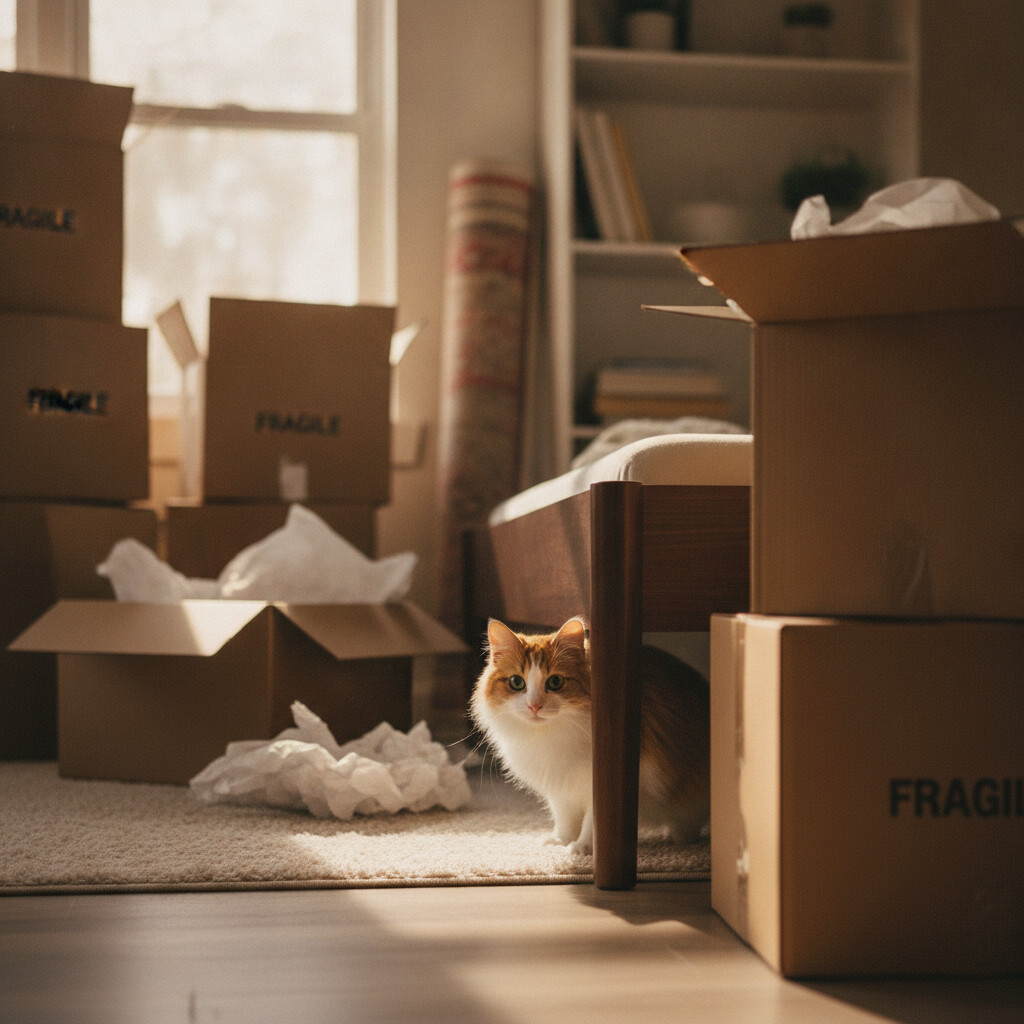
Our cat Mochi didn’t come out from under the guest bed for three weeks after we moved from Chicago to Denver. Not for food left six inches from her face. Not for the sound of the can opener, which had never once failed to summon her in nine years. We started to think we’d broken something in her that wasn’t coming back.
It did come back. But the three weeks taught us more about how cats actually process upheaval than anything we’d read beforehand — and looking back, we made almost every mistake there was to make.
Why moves hit cats so much harder than they hit us
Cats aren’t attached to places the way dogs are attached to people — they’re attached to scent. Every room in your old home was layered with months or years of your cat’s own pheromone markers: the facial rubbing on doorframes, the scratching near the couch, the sleeping spot that smelled unmistakably like them. A new home has none of that. It’s not that the new house is “wrong” — to a cat’s nose, it’s simply unclaimed territory, which registers as unsafe until proven otherwise.
Research on feline stress responses backs this up: a 2011 study in the Journal of Feline Medicine and Surgery found that environmental unpredictability — new spaces, new smells, disrupted routines — is one of the most reliable triggers of chronic stress behavior in cats, more so than most single stressful events. A move stacks several of these triggers at once: a new space, a new smell, a disrupted routine, and often a stressful car or crate ride to get there.
Hiding, in this context, isn’t dysfunction. It’s a completely rational strategy. A cat under a bed has one door to watch, walls on three sides, and nothing coming at them from above. We didn’t know that at the time, and it would have saved us a lot of worry.
What we got wrong the first week
We tried to coax her out. Constantly. We moved her food bowl closer to the bed, then closer to the door, thinking gradual exposure would help. We let houseguests come meet her “so she’d get used to people again.” We even tried carrying her out to the living room a few times, thinking she just needed a nudge.
Every one of these was, in hindsight, exactly backwards. Separation anxiety in cats and generalized situational stress share a lot of the same wiring — the nervous system needs to register safety before behavior can change, and you can’t force that registration by moving the goalposts closer. Forced exposure to a stressed cat reads as a threat, not comfort, and it resets the clock.
What actually worked, once we stopped trying to manage her and started managing the environment:
We shrank her world instead of trying to expand it. We picked one small room — the guest room she’d already claimed — and made that her entire territory for the first ten days. Litter box, food, water, and her bed, all within a few feet of her hiding spot. No visitors in that room. No coaxing.
We stopped moving the food bowl. Every time we moved it to “encourage” her forward, we were undoing whatever tiny bit of territory claim she’d started to build around it. We put it down once, in the small room, and left it alone.
We brought her old scratching post and unwashed cat bed over before we washed anything. This sounds almost too simple, but it mattered more than anything else we did. Familiar scent in an unfamiliar space is one of the few genuine shortcuts available — it tells a cat’s nose “you’ve been here before,” even when the eyes disagree.
We used a synthetic feline pheromone diffuser (Feliway) in that room. It’s not magic, and the evidence for it is more “modestly helpful” than “miracle cure,” but a few controlled studies — including one published in Applied Animal Behaviour Science — found reduced stress-marking and hiding behavior in cats exposed to synthetic facial pheromone analogs during relocation. Worth the eight dollars, in our experience.
The turning point
Mochi came out on her own on day nineteen, at around 2am, and we know this because we heard her knock a picture frame off a shelf in the hallway — the exact kind of chaos we’d been missing. By day 24 she was sleeping on the bed again. By six weeks, you’d never have known anything had happened, except that she now insists on inspecting every new box that comes into the house before anyone’s allowed to open it.
What we’d tell anyone about to move with a cat: the timeline is not linear, and it is not really predictable. Some cats adjust in three days. Some take longer to settle into any new environment regardless of how careful you are, and personality — not how “traumatic” the move was — seems to be the biggest factor in how long it takes.
When hiding becomes something else
Most post-move hiding is exactly what it looks like: a stressed but healthy cat waiting out an unfamiliar situation. But there’s a line where it stops being a normal adjustment and starts being a medical situation, and it’s worth knowing where that line is.
Call a vet if your cat:
- Hasn’t eaten or drunk anything in over 24 hours
- Isn’t urinating (this can indicate a urinary blockage, which is a genuine emergency in cats, especially males)
- Is hiding and showing signs of pain — hunched posture, reluctance to move, vocalizing when touched
- Shows no improvement at all after two to three weeks, or seems to be getting more withdrawn rather than less
A cat that’s simply cautious will usually show small, incremental signs of curiosity — an ear turning toward a sound, eyes tracking movement from under the bed, eating even if they won’t be watched doing it. A cat that’s shut down completely, with no appetite and no interest in anything, needs professional eyes on them sooner rather than later.
The practical takeaway
If you’re moving with a cat, plan for the cat’s timeline, not yours. Set up one small, quiet room before anything else gets unpacked. Bring their old scent with them — don’t wash it away. Let them choose when to expand their territory instead of trying to expand it for them. And keep a genuinely low bar for calling a vet if eating, drinking, or using the litter box stops rather than just slows down.
It’s disorienting to watch a cat who used to run the whole house reduce their world to the space under a bed. But that’s not your cat breaking. That’s your cat doing exactly what a cat is built to do when the map suddenly doesn’t match the territory — and given a little time and a lot less coaxing than you’d think, most of them redraw it just fine.