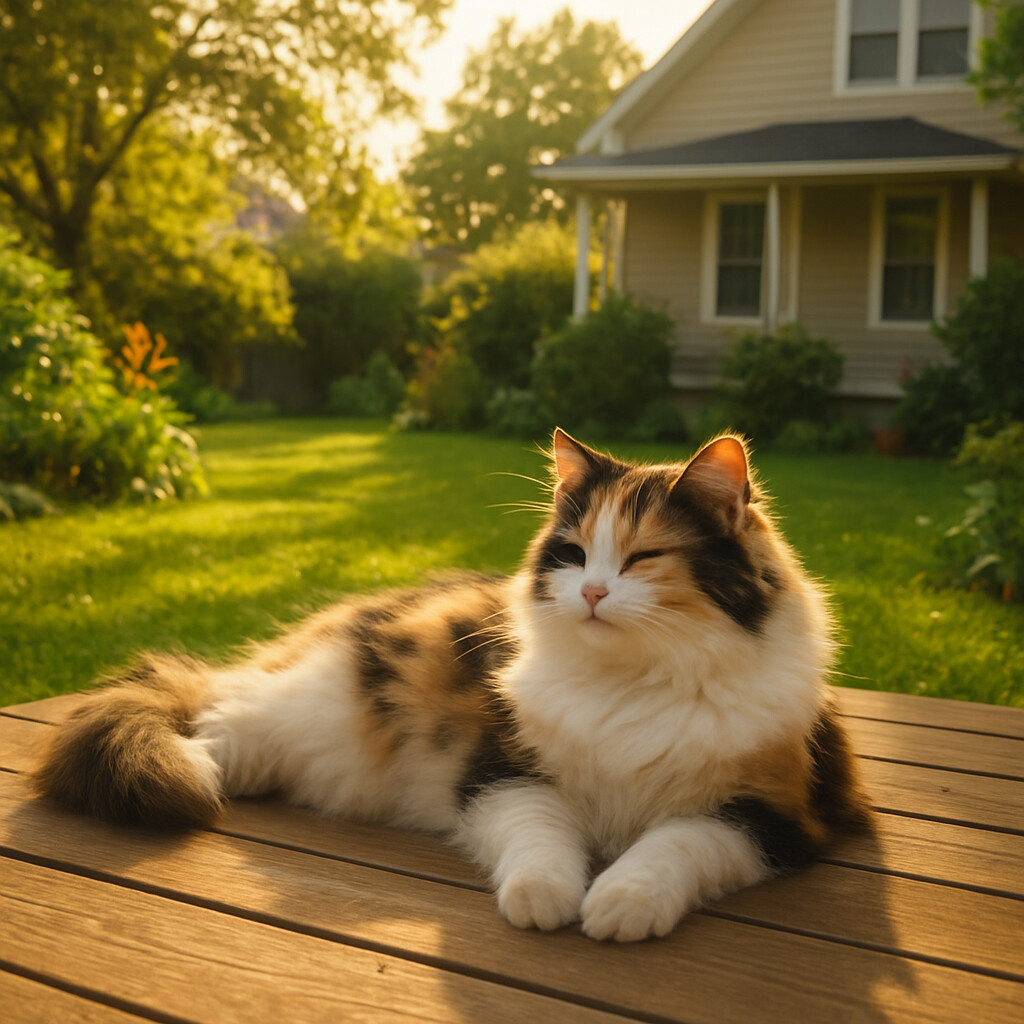
This is a story about a cat named Luna, a rental house in Portland, and what happens when you decide to stop feeling guilty about keeping a cat indoors.
The Cat We Didn’t Expect to Keep
Luna came to us the way a lot of cats do — with zero planning. My neighbor found her in a parking garage, half-starved, coat matted into little knots. She fostered her for a week before her landlord said no, and somehow the handoff ended at our door.
She was estimated to be around three years old. The vet said she’d clearly been outdoors at some point — she had old ear mite scarring and one of her back claws had a growth abnormality consistent with an old injury. She’d survived. That was her whole résumé.
We lived in a rented house with a medium-sized backyard in a quiet Portland suburb. The yard wasn’t fenced — standard for a lot of Pacific Northwest rentals — and the neighborhood had cars, raccoons, and at least one coyote that the neighbors had caught on a Ring camera the previous fall.
The instinct was to keep her inside. The guilt was immediate.
The Indoor Cat Compromise Nobody Talks About
Luna was not an easy indoor cat.
By month two, she was waking us up at 4 AM, methodically knocking things off every surface she could reach. By month four, she’d developed a strange bald patch on her belly — stress grooming, the vet confirmed. We tried every enrichment recommendation: puzzle feeders, window perches, wand toys, a $180 cat tree. It helped. It didn’t solve it.
What Luna wanted — and what I kept denying her — was outside. Not just a window to watch it through. The real thing: grass under her paws, birds at close range, the smell of rain on concrete.
I’d read enough to know the risks. The average outdoor cat’s lifespan is significantly shorter than an indoor cat’s. Cars, disease, predators, neighbor poison, other cats. I was not interested in meeting that statistic up close. But I also wasn’t interested in watching Luna systematically dismantle her own fur.
The Fence Problem
We started looking at options around month six. Catios were the obvious answer, but our backyard was about 40 feet wide and we rented. A full enclosure meant landlord approval and a project that wasn’t going to fit in our budget or our lease terms.
Someone in a local Facebook group for cat owners mentioned cat-proof fence rollers — the kind that spin so cats can’t get traction and fall back into the yard rather than escaping. I’d vaguely seen these mentioned somewhere before but assumed they were a niche product.
They weren’t. The technology actually made sense to me — cats climb by gripping and pushing off. A rotating surface gives them nothing to grip. No grip, no climb.
We had a conversation with our landlord. She was, against my expectations, completely fine with it — she’d had outdoor cats her whole life and understood the problem. The one condition: the fence couldn’t be permanently altered. Post brackets that attach without drilling were within what she’d allow.
The Setup
We fenced the backyard perimeter and spent a weekend installing brackets and rollers across the top of three sides. The back gate was the fiddliest part — the gaps required some extra attention. There was one corner where two fence lines met at a weird angle and we had to think through the geometry.
Was it completely DIY-ready? Mostly yes. The physical installation was manageable. The parts that required thinking: any gates, corners, or fence height variations. For anyone considering it, I’d say be honest about your fence situation before you order.
We did the full perimeter over one Saturday. Luna watched from the back window, deeply suspicious of the entire operation.
What Happened Next
We opened the back door for the first time on a Tuesday afternoon in October.
Luna walked to the doorway, stopped, and sat down. She sat there for maybe five minutes, just watching the yard. Then she stepped out onto the patio, sniffed the concrete extensively, and walked to the garden bed at the far end of the yard. She ate some grass, which is apparently universal cat behavior. She rolled in a patch of dirt near the fence line. She found the highest point of the fence — the back corner post — and sat up there, surveying her kingdom for about twenty minutes.
She did not attempt to leave.
I realize that sounds like a miracle, but it isn’t. The rollers work physically — she tried once or twice in those first few days, and each time the roller spun and she dropped back down. By the end of week two, she’d stopped trying. The yard was hers. It was enough.
What Changed
The 4 AM alarm clock behavior: stopped within two weeks. The bald belly patch: fully regrown by month three. The general ambient anxiety that had made her knock things over and pace the hallway: dramatically reduced.
She’s not a perfectly serene cat. She still has opinions. But she’s a cat who goes outside when she wants to, rolls in the same dirt patch approximately once a day, and comes in when she’s ready. Her life got bigger. Her coat got better.
We’re in a new house now — with an actual fence. Luna has more yard than she’ll ever patrol. But the experience in Portland changed how I think about the whole indoor/outdoor debate. The goal isn’t to pick a side. It’s to find a way to give them what they need without gambling with their safety.
For Luna, that meant a spinning roller and one conversation with a reasonable landlord.
— CatLady6