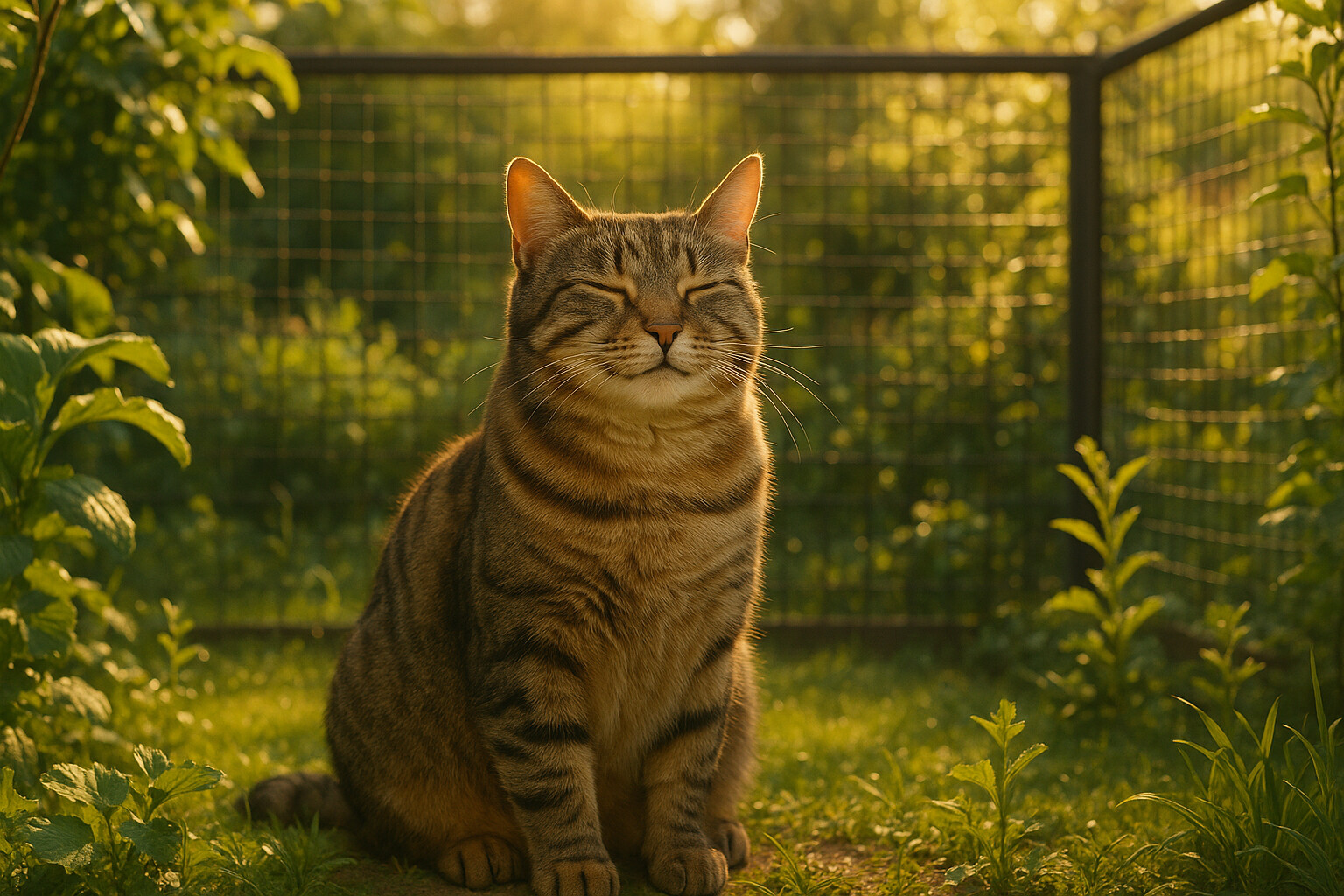
I’ll be honest: I used to think outdoor enclosures for cats were overkill. A bit over-the-top, actually. My cat Biscuit had always been a free-roaming outdoor cat, and he seemed perfectly happy that way. Then one April evening, he didn’t come home.
He turned up three days later, thin and limping, with a wound on his back leg that the vet suspected came from a coyote or a car. The bill came to just under $800. More than the money, though, it was the three days of not knowing that broke something in me. I lay awake running through every worst-case scenario, guilt spiraling at every one.
That was the turning point. I started researching outdoor enclosures seriously — and what I found completely changed how I think about letting cats outside.
Why I’d Always Dismissed the Idea
Like a lot of cat owners, I assumed enclosures meant a small wire cage in the corner of a yard — something cramped and sad that would frustrate an active cat more than it would satisfy him. The word “containment” didn’t exactly conjure warm feelings either.
I also genuinely believed that keeping a cat contained was somehow less caring than letting him roam freely. That felt counterintuitive to upend.
What Actually Changed My Mind
The research I did shifted my thinking pretty fast. According to the ASPCA and multiple veterinary organizations, outdoor cats face dramatically higher risks than indoor-only cats — traffic, predators, disease, and accidental poisoning being the big four. Studies estimate the average lifespan of a free-roaming outdoor cat is significantly shorter than that of an indoor or safely contained cat.
But the more compelling thing I found wasn’t the statistics. It was talking to cat owners who’d made the switch. One family in our neighborhood had installed a fence containment system a year earlier. Their two cats spent hours outside every day — chasing bugs, rolling in the grass, sitting in the sun — without ever leaving the yard. The cats weren’t miserable. They were thriving.
I also came across this piece on how to transition your indoor cat to outdoor life safely which walked through the process week by week. It made the whole thing feel a lot more achievable than I’d assumed.
Setting It Up
We went with a fence roller system that installs along the top of an existing fence. The rollers spin freely when a cat tries to grip them, so climbing over becomes physically impossible without requiring netting or anything that blocks the view. Our yard stayed open and attractive while Biscuit’s range was safely limited to it.
The setup took an afternoon. Biscuit spent the first week eyeing the fence line suspiciously, clearly running physics calculations. By week two, he’d apparently accepted the situation and redirected his energy toward hunting the squirrels he could now observe from much closer range, which he seemed to enjoy enormously.
What surprised me most was how much more outdoor time Biscuit got after we set this up. Before, I’d limited his outside time to daylight hours only, constantly anxious about where he was wandering. Now I let him out in the morning and he has the run of the yard all day. He’s outside more than he ever was as a free-roamer.
The Shift in How I Think About “Freedom”
The framing that finally clicked for me was this: a cat that can roam anywhere has freedom of geography but almost no safety. A cat in a well-designed contained space has access to fresh air, enrichment, sunshine, and natural stimulation — just without the Russian roulette of roads and predators.
For most cats, “outside” isn’t really about covering miles. It’s about the sensory richness of being outdoors — the smells, the breezes, the birds to observe, the grass to roll in. A well-set-up yard delivers all of that.
As the Spring Energy Burst guide from Oscillot puts it: enriched outdoor access doesn’t have to mean uncontrolled roaming. The goal is a stimulating environment, not unlimited range.
Two Years Later
Biscuit is now 11. He spends three or four hours outside most days, weather permitting. He has never had another injury requiring a vet visit that wasn’t routine. He’s heavier than he should be (that’s an unrelated ongoing battle), but healthy.
I still occasionally get the “don’t you feel bad keeping him confined?” question from people. My answer these days is pretty simple: I feel a lot better than I did during those three days I didn’t know if he was alive.
If you’re on the fence about outdoor enclosures — pun intended — I’d encourage you to look past the “cage” mental image. A proper setup doesn’t look like a cage. It looks like a yard. It just has better boundaries.
Biscuit approves. I’m relatively certain of it.