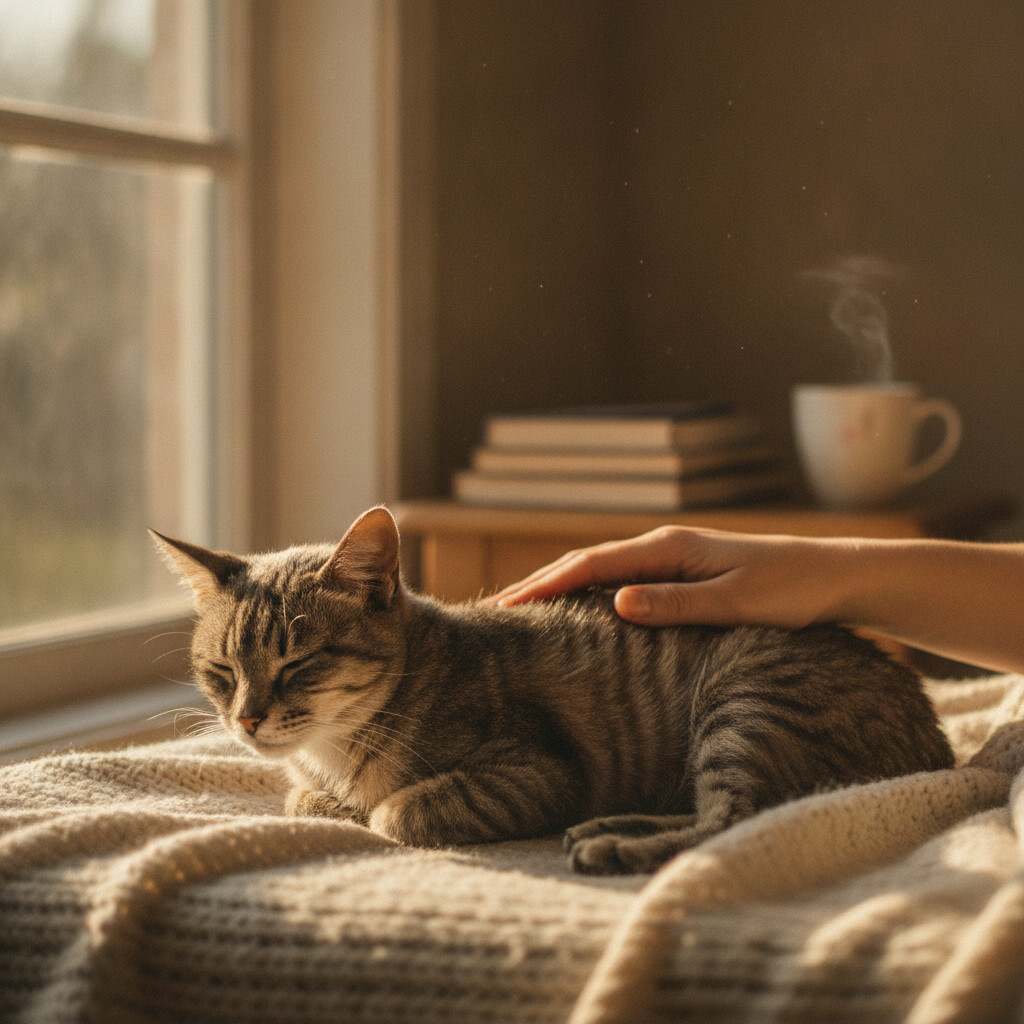
If your older cat feels bony along the spine and hips, even though the scale says their weight hasn’t changed much, you’re probably feeling muscle loss. It’s common in senior cats, it’s often the first visible sign of an underlying illness, and it’s worth a vet visit rather than just a bigger food bowl.
Here’s what’s going on, how to check your cat at home, and what actually helps.
The short answer: why older cats lose muscle
There are two overlapping processes, and vets treat them a little differently:
- Sarcopenia is age-related muscle loss that happens even in otherwise healthy older animals. Muscle fibres shrink and aren’t replaced as efficiently. It’s slow, and it tends to show up first over the back and hind legs.
- Cachexia is muscle loss driven by disease. Chronic kidney disease, hyperthyroidism, heart disease, cancer and chronic gut disease all push the body to break down muscle faster than it can rebuild it.
Lisa Freeman, a veterinary nutritionist at Tufts, described both syndromes in dogs and cats in the Journal of Veterinary Internal Medicine (2012), and made a point that matters for owners: a cat can lose a lot of muscle while staying at a “normal” weight, because fat can mask the change. That’s why the scale alone isn’t enough.
In practice, most senior cats with obvious muscle loss have a bit of both. Age makes the muscle harder to keep, and an illness speeds up the loss.
How to check your cat’s muscle at home
The World Small Animal Veterinary Association (WSAVA) publishes a Muscle Condition Score chart that vets use alongside body condition score. You can do a rough version of the same check on the sofa.
Run your hand gently along your cat and feel these four areas:
- The spine. In a well-muscled cat, you feel the bumps of the vertebrae under a smooth layer of muscle on either side. With muscle loss, the bones feel sharp and the dip beside them gets deeper.
- The shoulder blades. These should feel padded. Prominent, ridge-like shoulder blades suggest loss.
- The skull. The muscles on top of the head and at the temples thin out with muscle loss, so the bony ridge down the middle of the skull becomes easy to feel.
- The hips and back thighs. Hip bones that stick up, and thighs that feel thin compared with the belly, are a classic senior-cat pattern.
WSAVA grades the result as normal, mild, moderate or severe loss. You don’t need to grade it precisely. What you’re looking for is change: if your cat feels noticeably bonier than they did six months ago, that’s the useful information.
A habit worth building: do this check once a month, on the same day you weigh them, and jot down a line in your phone. Small trends are much easier to spot in writing than in memory.
What’s actually causing it?
Your vet will want to rule out the conditions that commonly drive muscle loss in older cats. The usual suspects:
- Chronic kidney disease (CKD). Very common in cats over 10, and often comes with drinking more, peeing more and a fussier appetite.
- Hyperthyroidism. An overactive thyroid speeds up metabolism, so cats can lose muscle and weight while eating more. Restlessness, vomiting and a scruffy coat are common companions. Our guide to hyperthyroidism in cats covers this in detail.
- Arthritis. Painful joints mean less movement, and less movement means less muscle. A 2010 review by Duncan Lascelles in Veterinary Surgery noted that degenerative joint disease is very common in older cats and is badly under-recognised, partly because cats hide it so well.
- Diabetes, heart disease, gut disease and cancer. All can cause cachexia, sometimes before any other obvious signs.
- Reduced digestion. Research summarised by Dottie Laflamme and Danièlle Gunn-Moore (Veterinary Clinics of North America, 2014) found that a significant share of cats over 12 digest fat less efficiently, and some digest protein less efficiently too. The cat eats a normal amount but absorbs less of it.
- Dental pain. A sore mouth quietly cuts how much a cat eats, especially of dry food.
This is why the bloodwork and urine test at a senior check-up matter so much. If you’ve had results back and aren’t sure what they mean, our explainer on senior cat blood work results walks through the main numbers.
Should a senior cat eat less protein?
Usually no, and this is one of the more persistent myths in cat care.
Older cats generally need as much or more high-quality protein than younger adults to hold onto muscle, according to the Laflamme and Gunn-Moore review. Cutting protein “because they’re old” can speed up muscle loss.
The exception is diagnosed kidney disease, where the protein question is more nuanced and depends on the stage. That’s a decision to make with your vet, based on your cat’s results, not something to change on your own. Our guide to the best diet for senior cats covers how to approach it.
Practical things that usually help, once your vet has ruled out (or started treating) any illness:
- Make every bite count. Ask your vet about a senior or recovery diet that’s energy-dense and highly digestible.
- Make food easier to eat. Wet food, warmed slightly to body temperature, is more appealing to many older cats and easier on sore teeth.
- Feed smaller meals more often. Three or four small meals can suit a cat with a reduced appetite better than two big ones.
- Raise the bowl. A slightly elevated bowl is more comfortable for a cat with stiff neck or front-leg joints.
Exercise: yes, even for an old cat
Muscle that isn’t used isn’t kept. That doesn’t mean making your 15-year-old sprint, but gentle, regular movement genuinely helps.
- Short play sessions. Two or three five-minute sessions with a wand toy dragged slowly along the floor are plenty. Our piece on how much play a senior cat still needs has ideas pitched at older joints.
- Food puzzles at ground level. These make a cat move a little to eat, without any jumping.
- Easy access everywhere. Ramps and steps keep a stiff cat using the sofa, the bed and the window instead of giving up on them. See ramps and steps for senior cats.
- Treat the pain. If arthritis is the reason your cat has stopped moving, pain control is often the single biggest lever for muscle. Several options exist, including a monthly injection (frunevetmab, sold as Solensia) that the FDA approved for feline osteoarthritis pain in 2022. Your vet will advise what suits your cat. Never give human painkillers, which can be fatal to cats.
When to see a vet
Book an appointment if:
- Your cat feels bonier than they did a few months ago, even if their weight looks stable
- They’re losing weight, or eating more but still getting thinner
- They’re drinking or peeing more than usual
- They’ve stopped jumping, are struggling with stairs, or their back legs look weak or wobbly (our guide to weak back legs in senior cats covers the causes)
- Their coat has gone scruffy, greasy or matted along the back
Contact a vet the same day if your cat hasn’t eaten for 24 hours or more, is vomiting repeatedly, is breathing fast or with effort, or suddenly can’t use their back legs. Cats that stop eating can develop liver problems quickly, and older cats have less reserve.
The 2021 AAHA/AAFP Feline Life Stage Guidelines recommend check-ups at least every six months for senior cats, with weight, body condition and muscle condition recorded at every visit. If your vet isn’t mentioning muscle score, it’s completely reasonable to ask.
The practical takeaway
Muscle loss in an older cat is a signal, not just a sign of age. Check your cat’s spine, shoulders, head and hips once a month, write down what you feel, and take any downward trend to your vet. Once the cause is known, the right food, pain control and a little daily movement can slow the loss, and in some cats rebuild some of what was lost.
Have you noticed your older cat feeling bonier lately, and did a vet visit turn up a cause?