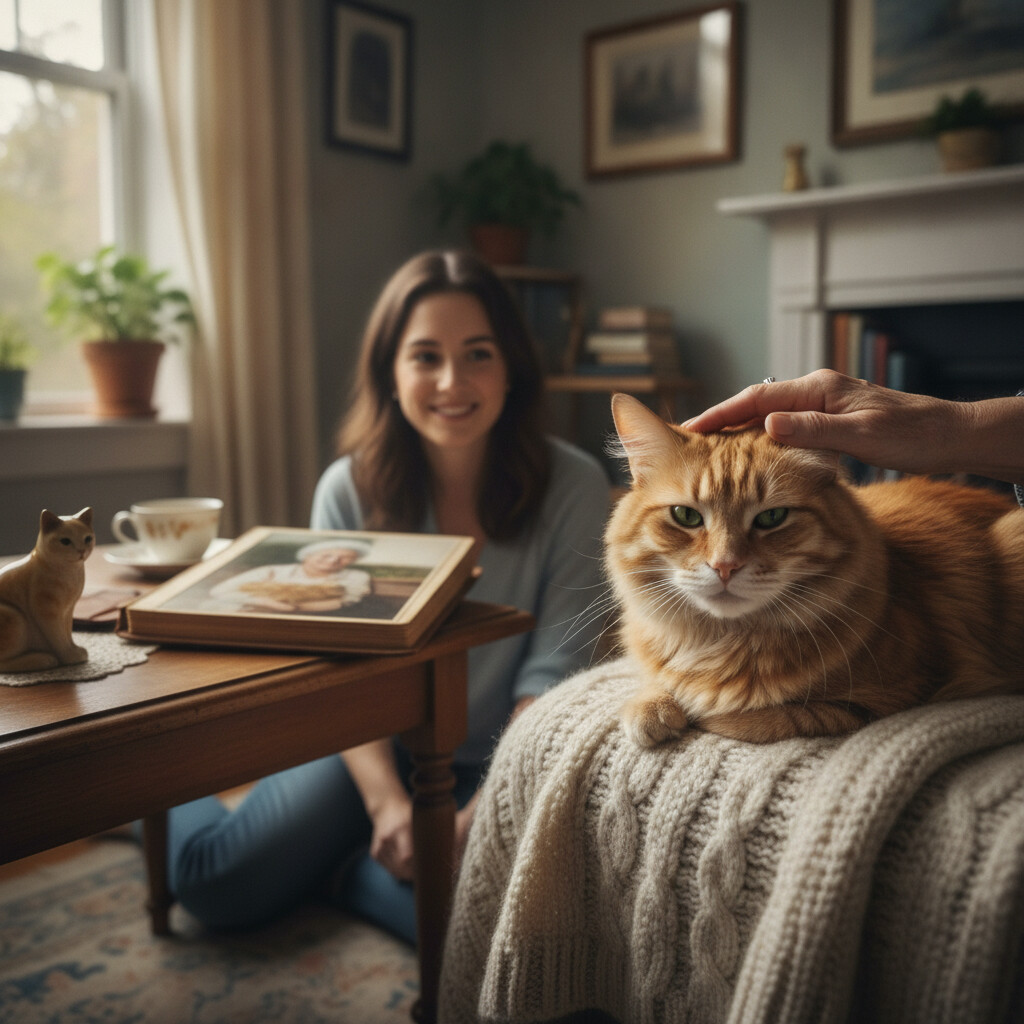
My grandmother’s cat, a fourteen-year-old orange tabby named Whiskey, spent his first three days with us hiding behind the water heater. He didn’t eat. He barely drank. When I reached back to check on him, he pressed himself flatter against the wall like he could disappear into it. I remember thinking: I don’t know how to fix this.
Whiskey had lived with my grandmother since he was a kitten. When she passed away in the spring, taking him in wasn’t really a decision — it was just what happened next. What I hadn’t planned for was how long it would take him to believe he was allowed to be okay again, or how much I’d learn about grief that doesn’t look like grief until you know what you’re looking at.
The First Few Days Looked Like Nothing Was Working
Whiskey wasn’t sick, according to the vet we saw within the first week — just stressed, and old enough that stress hits differently. Cats don’t process the loss of a person the way we do, but they absolutely register the loss of routine: the same voice, the same chair, the same hands, the same schedule, all gone at once, replaced by a different house that smelled wrong and moved wrong.
For the first few days he ate almost nothing. I left food near — not directly in front of — his hiding spot, because a cornered cat won’t eat where it feels watched. I didn’t try to pull him out or hold him. I just sat on the floor nearby sometimes, not looking at him directly, and let him get used to my presence being unremarkable.
By day four, he’d started eating at night, after the house went quiet. By day ten, he came out while I was in the room, as long as I didn’t move toward him. It was slow in a way that tested my patience daily, and I now understand that’s completely normal — most cats need real time to settle into a new home, and an older cat grieving a person he’d known his entire life needed more of it than most.
What Actually Helped
A few things made a real difference, in hindsight:
Keeping his stuff. I brought his bed, his scratching post, and — this mattered more than I expected — an unwashed blanket from my grandmother’s house. Familiar scent in an unfamiliar place seemed to do more for him than anything else I tried.
Not forcing affection. Whiskey had been a lap cat his whole life, and I wanted that back immediately, for both of us. But pushing for it early just sent him back under the water heater. Letting him choose when to approach — even when that took weeks — rebuilt trust faster than any amount of coaxing would have.
One consistent person. My husband, well-meaning, kept trying to win him over too, and for the first month that was one variable too many. We agreed I’d be his primary person until he was stable, and only then did we let him build a relationship with anyone else on his own timeline.
Keeping everything else the same. Same food, same litter, same feeding schedule as my grandmother had used, even the parts I would’ve changed eventually. This wasn’t the time to also introduce a new diet or a different litter box setup. One less unfamiliar thing to adjust to.
Is This Actually Grief?
I asked our vet directly whether what I was seeing counted as grief, or whether I was reading too much into it. Her answer was measured: cats don’t grieve the way humans narratively understand loss, but there’s real evidence they respond to the disappearance of a bonded companion — human or animal — with measurable stress behaviors: appetite changes, increased vocalization or its opposite, withdrawal, disrupted sleep. Whether you call that grief or just profound stress from a broken routine, the practical response is the same, and it lines up with what research on how cats process loss generally describes: give it time, keep things predictable, and don’t mistake quiet for “fine.”
Six Months Later
Whiskey sleeps on my husband’s feet now, which took nearly five months and which my husband will not stop mentioning. He still startles at sudden noise more than most cats I’ve known, and I don’t think that’s going away — he’s old, and the year rearranged everything he knew. But he comes when I shake the treat bag. He sits in the window in the afternoon, the same way, I’m told, he used to at my grandmother’s house.
I don’t know that I did anything remarkable. Mostly I waited, kept things boring and predictable, and didn’t take the hiding personally. If you’re bringing home an older cat after a loss — theirs or yours — that’s really the whole playbook: less change than feels natural, more patience than feels reasonable, and trust that “not ready yet” isn’t the same as “never.”