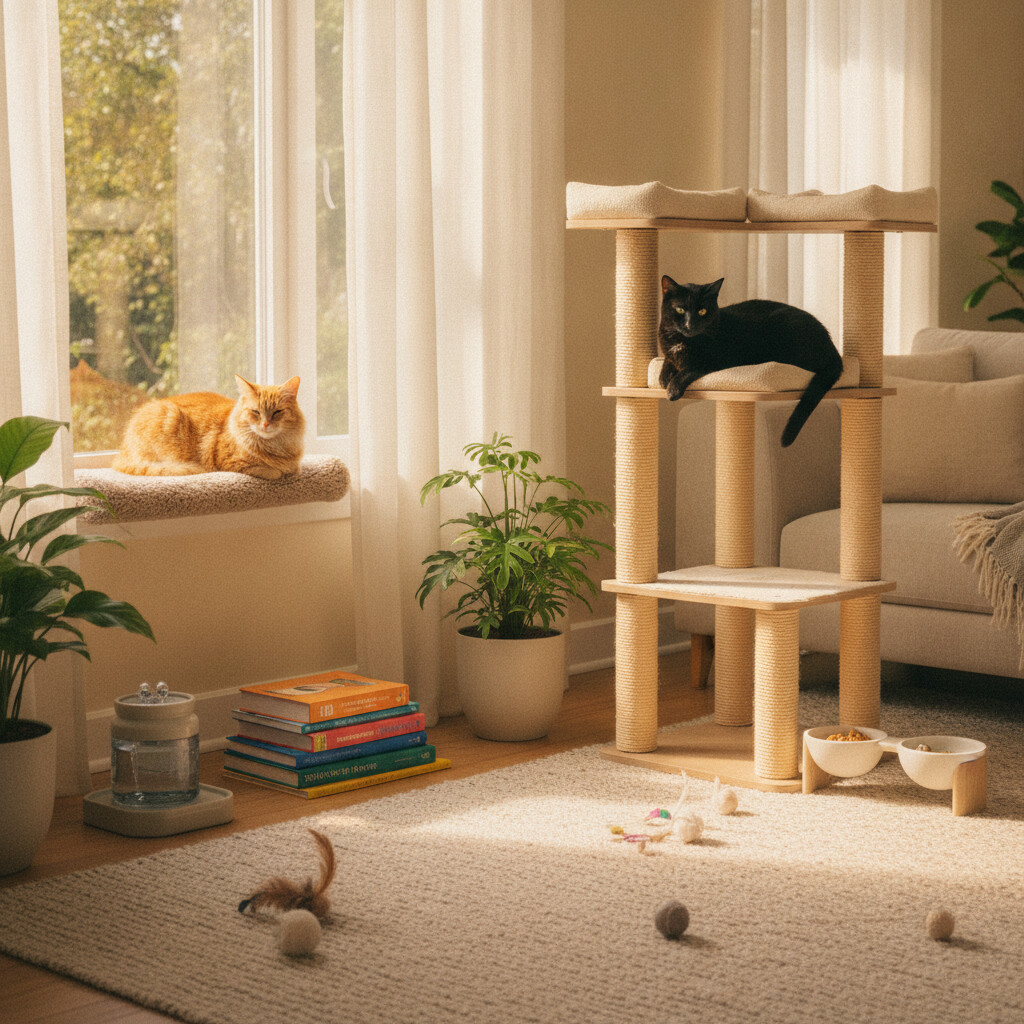
Multiple cats fighting over resources usually isn’t a personality clash — it’s a math problem. Most conflict in multi-cat homes traces back to too few resources spread across too little space, not cats who simply “don’t get along.” Fix the setup and a surprising number of behavior problems resolve on their own.
Here’s how to actually structure a home for more than one cat, based on feline environmental needs research rather than guesswork.
Why Setup Matters More Than Personality
Cats are not naturally social in the way dogs are. They evolved as solitary hunters, and even cats who like each other still default to avoiding direct competition when they can. The Feline Environmental Needs Guidelines, published jointly by the American Association of Feline Practitioners (AAFP) and the International Society of Feline Medicine (ISFM) in the Journal of Feline Medicine and Surgery, identify resource distribution as one of the five pillars of a healthy feline environment — alongside safe spaces, opportunities for play, and predictable, non-threatening human interaction.
The core idea: cats don’t need to be forced to share. They need enough of everything that sharing is never required. When two cats appear to be fighting over territory, they’re often really negotiating access to a single food bowl, litter box, or sunny window ledge that both want at the same time.
The Resource Math: How Much Is Actually Enough
The most-cited rule of thumb from feline behaviorists is one resource per cat, plus one extra — for litter boxes, feeding stations, water bowls, resting spots, and scratching posts alike. For two cats, that means three litter boxes, not two. For three cats, four feeding stations, not three.
This isn’t arbitrary. It removes the bottleneck moment — the split second where one cat has to decide whether to wait, retreat, or challenge another cat for access. Multiply that moment across a food bowl, a litter box, and a favorite window three times a day, and you get chronic low-grade stress that shows up as spraying, overgrooming, or sudden “fights” that seem to come from nowhere.
Placement matters as much as quantity:
- Spread resources across different rooms, not lined up in a row. A “litter box row” in one hallway still creates a single access point a confident cat can guard.
- Separate food and water from litter boxes entirely. Cats are hardwired to avoid eating near where they eliminate.
- Give each cat a route to leave a resource without passing another cat. Dead-end feeding nooks force confrontation; a bowl with two exits doesn’t.
Vertical Space Is Resource Space, Too
Floor space is only part of the picture. Cats use height to manage social distance the way we might use separate rooms — a cat on a shelf and a cat on the floor are, functionally, not in the same space, even in a small apartment. If you haven’t already, our guide on why cats need vertical space and how to provide it covers the specifics of shelving, cat trees, and window perches.
In multi-cat homes specifically, vertical space does double duty: it multiplies the number of “territories” available in the same square footage, and it lets a lower-confidence cat opt out of a tense floor-level interaction without leaving the room entirely. Aim for at least two elevated resting spots per cat, at different heights, so cats aren’t forced to negotiate the same perch.
Reading the Difference Between Setup Problems and Real Incompatibility
Not every multi-cat conflict is a resource issue. Some cats genuinely dislike each other, usually because of a poor introduction, a medical issue changing one cat’s scent or behavior, or a personality mismatch that no amount of extra litter boxes will fix. If you’re in the thick of active fighting rather than tension over access, our guide to how to stop cats from fighting in multi-cat households walks through de-escalation and reintroduction.
The practical way to tell the difference: fix the resource math first. Add the extra litter box, split the feeding stations, add vertical space. If the tension eases within a couple of weeks, it was a setup problem. If it doesn’t, you’re likely dealing with a genuine relationship issue that needs a slower, more deliberate reintroduction process — the kind covered in our piece on introducing two cats for the first time, which applies just as well to cats who need a reset.
A Note on Litter Boxes Specifically
Litter boxes deserve their own callout because they’re the single most common flashpoint in multi-cat homes. Beyond the one-per-cat-plus-one rule, box location matters: cats want an escape route, not a corner they can be cornered in, and they want distance between boxes — not three boxes touching in the same closet, which functions as one resource with extra scooping. If you’re still working out the right count and placement for your home, how many litter boxes you actually need goes deeper on the specifics.
The Practical Takeaway
Before assuming two cats “just don’t get along,” audit the setup: count the litter boxes, feeding stations, and resting spots against the one-per-cat-plus-one benchmark, and check whether any of them are bottlenecked into a single access point. Most multi-cat tension is a spatial problem with a spatial fix — more of everything, spread further apart, with genuine vertical territory added in. It’s less glamorous than a training plan, but it’s usually the thing that actually works.