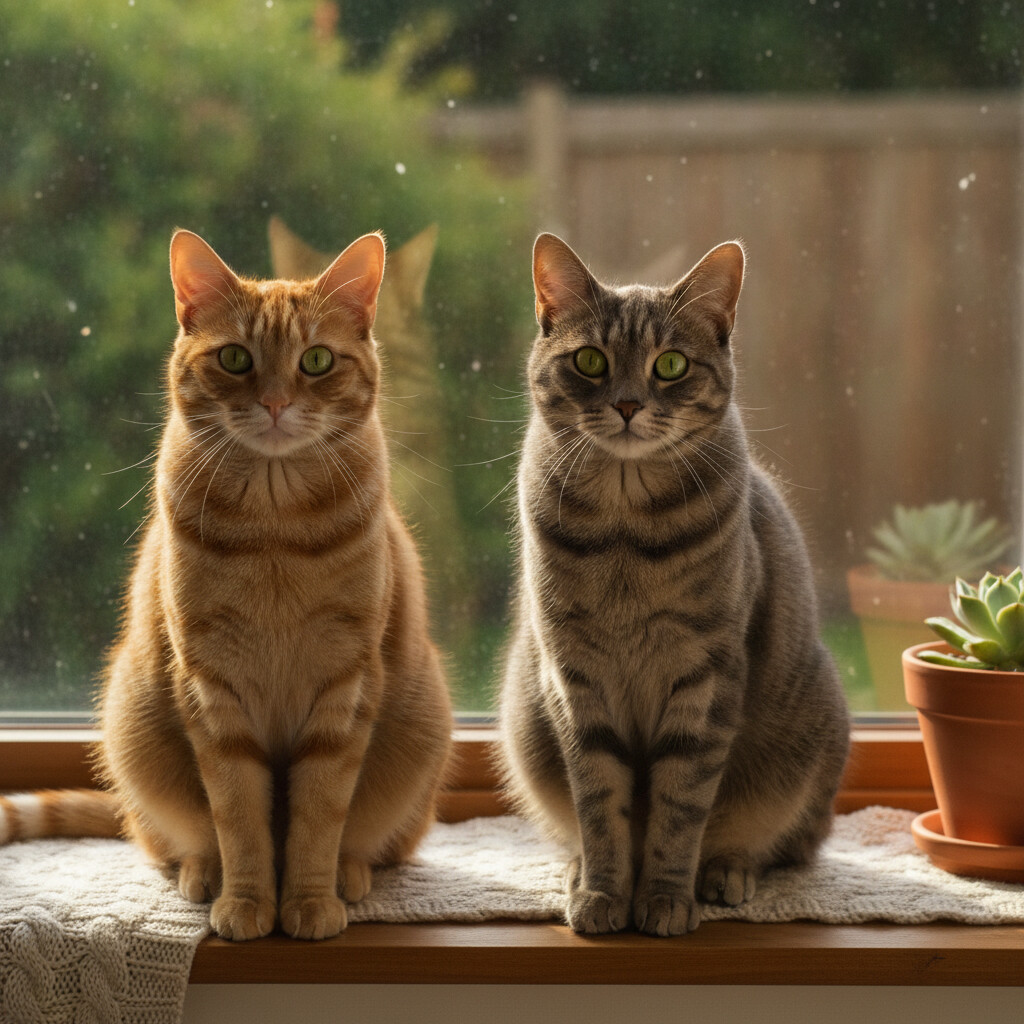
Short answer: no, not in any way that should drive your decision. The research on sex-based personality differences in cats is thin and inconsistent, and the differences people swear by — “males are more affectionate,” “females are more independent” — are far better explained by individual temperament, early socialization, and whether a cat is spayed or neutered than by sex itself.
If you’re choosing between a male and female cat, here’s what actually has evidence behind it, and what’s mostly folklore.
Where the “Personality Difference” Idea Comes From
A lot of the male/female cat stereotypes trace back to intact (unneutered) cat behavior, not sex itself. Intact male cats spray to mark territory, roam farther, and can be more aggressive toward other males, driven by testosterone. Intact female cats go into heat cycles that bring their own set of behaviors — yowling, restlessness, and a strong drive to escape and find a mate. Neither of these behavior sets has much to do with personality; they’re hormone-driven reproductive behaviors.
Once a cat is spayed or neutered, most of this hormonal behavior disappears within weeks to a few months. Our guide on whether to spay or neuter your cat covers the timeline and what changes physically and behaviorally. The practical upshot: the “male cats are like this, female cats are like that” comparisons mostly describe intact-versus-fixed differences, not male-versus-female ones.
What the Research Actually Shows
Feline behavior researchers have looked for consistent sex-based personality traits and generally come up short. A widely cited feline temperament study framework (the “Feline Five” personality model, developed by researchers at the University of South Australia and University of Sydney) assesses cats across five traits — skittishness, outgoingness, dominance, spontaneity, and friendliness — and found that individual variation within each sex dwarfs any average difference between males and females.
Where studies do find small statistical differences, they tend to be modest and inconsistent across populations: some studies find slightly higher rates of inter-cat aggression in intact males, others find no significant sex effect once neuter status is controlled for. No study has found a reliable, replicable “females are more independent” or “males are more affectionate” effect. If a friend tells you their three male cats have all been lap cats, that’s a sample size of three, not a pattern.
What Actually Predicts a Cat’s Personality
If sex isn’t the reliable predictor, what is? Based on what feline behaviorists do agree on:
- Early socialization (2–7 weeks old) is the single biggest factor. Kittens handled gently and exposed to varied, low-stress experiences during this window tend to grow into more confident, people-friendly adults, regardless of sex.
- Individual genetics and breed tendencies matter more than sex — a Siamese and a British Shorthair will differ more from each other than a male and female of the same breed typically will.
- Age at acquisition plays a role too — our piece on choosing between a kitten and an adult cat goes into how a cat’s established temperament (visible once they’re past kittenhood) can actually make adult adoption more predictable than getting a kitten of either sex.
- Home environment and consistency — a calm, predictable household tends to produce a calmer cat than a chaotic one, independent of the cat’s sex.
Should Sex Factor Into Your Decision At All?
There are a small number of legitimate, practical reasons sex might matter, and they’re mostly about household logistics rather than personality:
- Multi-cat households: if you already have an intact cat of one sex, an opposite-sex intact cat obviously creates a breeding risk — but this is solved by spaying/neutering both, not by picking a same-sex pairing.
- Spraying risk: unneutered males are statistically more likely to spray than unneutered females, but neutering largely closes this gap. If a shelter cat is already fixed (most are), this isn’t a meaningful factor.
- Litter size planning: some multi-cat households find odd numbers or specific sex ratios reduce resource-guarding conflicts, but this is about group dynamics and resource availability (litter boxes, feeding stations, vertical space), not an individual cat’s disposition.
What About Common Claims Like “Male Cats Are Cuddlier”?
This is the single most repeated claim in male-vs-female cat comparisons, and it’s worth addressing directly because it’s almost entirely anecdotal. Some owners do report that their male cats seek out laps and physical contact more than their female cats did — but when you look at large-scale surveys rather than individual households, the effect either disappears or flips depending on the population studied. Breed also confounds this heavily: breeds marketed and bred for sociability (Ragdolls, Maine Coons, Siamese) skew the perception, and within any given household, whichever cat arrived first or was held more as a kitten often becomes the “cuddlier” one regardless of sex.
The honest answer is that if you meet ten unrelated adult male cats and ten unrelated adult female cats, you will find huge variation in affection levels within each group — probably more variation within each sex than between the two averages. That’s the opposite of what a meaningful personality difference would look like.
The Practical Takeaway
Pick a cat based on the individual cat in front of you — how they act around you at the shelter or foster home, their energy level, whether they seek you out or hang back — not their sex. If you’re set on getting your cat spayed or neutered (recommended by veterinary consensus bodies including the AVMA for population and health reasons), most of the behavioral differences people attribute to “boy cats vs. girl cats” will fade regardless of which one you choose. The kitten who headbutts your hand and purrs the second you sit down is telling you more about their future personality than their chromosomes ever will.