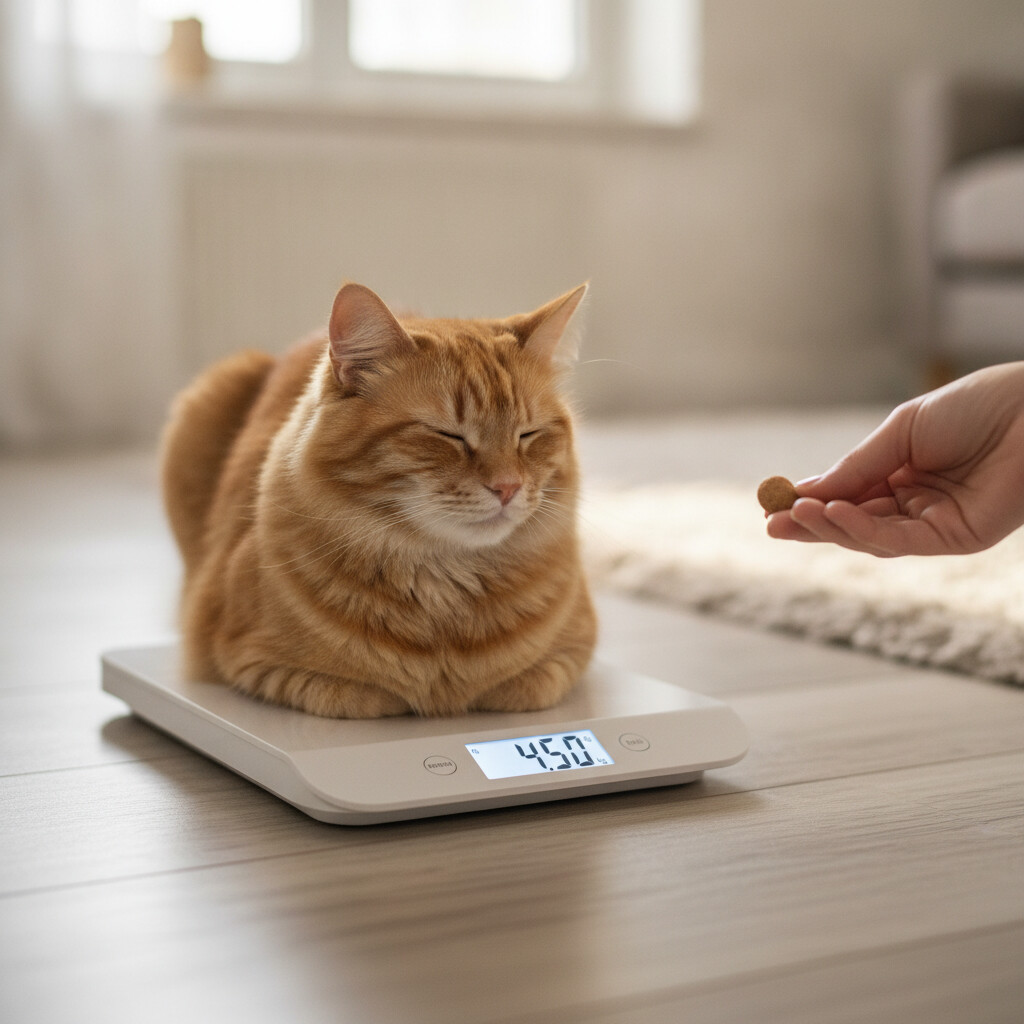
The best way to weigh a cat at home is on a digital pet or baby scale that reads in small increments (0.01 lb or 5 g), not the “weigh yourself, then weigh yourself holding the cat” method on a bathroom scale. That trick is fine for a rough number, but it usually can’t detect the small changes that actually matter. Here’s why home weighing is worth doing, which scales work, and how to get a reading you can trust.
Why weigh your cat at home at all?
Weight change is one of the earliest signs that something is going on with a cat’s health, and cats are very good at hiding illness. The AAHA/AAFP Feline Life Stage Guidelines recommend recording body weight and body condition at every vet visit for exactly that reason. The WSAVA Global Nutrition Guidelines make the same point: weight, body condition and muscle condition are part of a basic nutritional assessment for every pet.
The catch is that a once-a-year vet visit only gives you one data point a year. Home weighing fills in the gaps.
The numbers involved are small. A 10 lb cat that loses half a pound has lost 5% of their body weight, which is the equivalent of a 160 lb person losing 8 lb without trying. Many vets treat unexplained weight loss of that size as worth investigating. Research from Purina’s pet care centre (Pérez-Camargo, 2004) also found that cats with age-related illness often began losing weight long before other signs appeared, sometimes years earlier.
Home weighing is especially useful for:
- Senior cats (around 11 and up), where gradual weight loss and muscle loss can creep in unnoticed
- Cats on a weight-loss diet, where the target is slow, steady loss
- Cats with a diagnosed condition such as kidney disease, hyperthyroidism or diabetes, if your vet wants you tracking it
- Kittens, especially young or bottle-fed ones, where daily gains tell you feeding is on track
The bathroom scale method: why it falls short
Most people start here: stand on the scale, note your weight, pick up the cat, weigh again, subtract.
It works for a ballpark number. The problem is precision. Many bathroom scales display in 0.2 lb or 0.5 lb steps, and their readings can drift by a similar amount from one weigh to the next, depending on where you stand and how the cat wriggles. When the change you’re watching for is 0.3 to 0.5 lb, the scale’s own error can swamp it.
If a bathroom scale is all you have, you’ll get better results if you:
- use the same scale, on the same hard floor, every time
- weigh yourself and then yourself-plus-cat back to back, within a minute
- take two or three readings and use the average
Which scale actually works?
Digital pet or baby scale (best option)
These have a flat or curved tray, usually read in 0.01 lb or 5 g increments, and hold up to about 40 to 60 lb, so they cover any cat. Prices typically sit somewhere around $25 to $60. Look for:
- A tare (zero) button, so you can zero out a towel, basket or box
- A “hold” or “lock” function, which captures a stable reading even if the cat shifts
- Readings in both lb/oz and kg/g, since vets often record in kg
- A tray big enough for your cat to sit or stand on, with a lip or curved edge so they feel secure
Baby scales and pet scales are mostly the same hardware. Buy whichever has the features above at the better price.
Kitchen scale (kittens and small cats)
A digital kitchen scale is excellent for kittens: it reads to the gram, which is what you need when a young kitten may only gain around 10 to 15 g a day. The limit is capacity. Many kitchen scales max out at around 5 kg (11 lb), and an adult cat won’t sit on a small platform anyway. Put a shallow box or bowl on the scale, tare it, then pop the kitten in.
Carrier on a scale
If your cat won’t sit on an open tray, weigh the carrier on its own, tare it out, then weigh with the cat inside. This works on a pet scale or a sturdy bathroom scale. It’s usually the least stressful option for nervous cats, and many cats will walk into a carrier on their own if it’s left out with a treat inside.
Smart scales and litter-box scales
Some smart litter boxes and feeder mats weigh the cat automatically every visit and chart the trend in an app. That can be genuinely useful for tracking, but readings can vary between visits, and in multi-cat homes the box may mix up who’s who. Treat the trend as useful and any single reading with caution. We looked at the wider pros and cons in our piece on smart litter boxes with health monitoring.
How to get an accurate reading
The scale is half of it. Consistency is the other half.
- Same time of day. First thing in the morning, before breakfast, gives the most consistent result.
- Same scale, same surface. A hard, level floor, not carpet.
- Tare everything. Zero out the towel, box or carrier before the cat goes on.
- Make it worth their while. A treat on the tray or a familiar towel helps. Don’t hold them down; a calm two-second reading beats a wrestled one.
- Write it down. Date and weight in a note on your phone or a sheet on the fridge. A trend over months is far more useful than any single number.
How often? For a healthy adult cat, once a month is plenty. Your vet may ask for weekly weigh-ins for a cat on a diet plan or with a medical condition, and daily for young kittens.
Making sense of the numbers
To work out a percentage change: (old weight minus new weight) ÷ old weight × 100. A cat going from 10.0 lb to 9.4 lb has lost 6%.
A scale tells you weight, not whether that weight is right for your cat. Pair it with a hands-on body condition check: you should be able to feel the ribs under a light layer of fat, and see a waist from above. If your cat needs to lose weight, our calorie guide covers how much to feed.
When to see a vet
Book a vet visit if your home weigh-ins show:
- unexplained weight loss of around 5% or more, especially if it’s steady over a few weeks or months
- any weight loss alongside other changes, such as increased thirst, eating more or less than usual, vomiting, diarrhoea or hiding
- rapid weight gain, or a swollen-looking belly, without a change in diet
- a kitten that stops gaining or loses weight, which needs a call to the vet the same day
Bring your weight log. Being able to show your vet a dated trend is far more useful than “I think she feels lighter.”
The bottom line
A $30 digital pet or baby scale, used at the same time once a month, gives you one of the simplest early-warning tools in cat care. The bathroom scale trick is fine for a rough number, but if you’re watching a senior cat or a cat on a diet, real precision is worth the small cost.
Have you ever tried weighing your cat at home, and how did they take it?