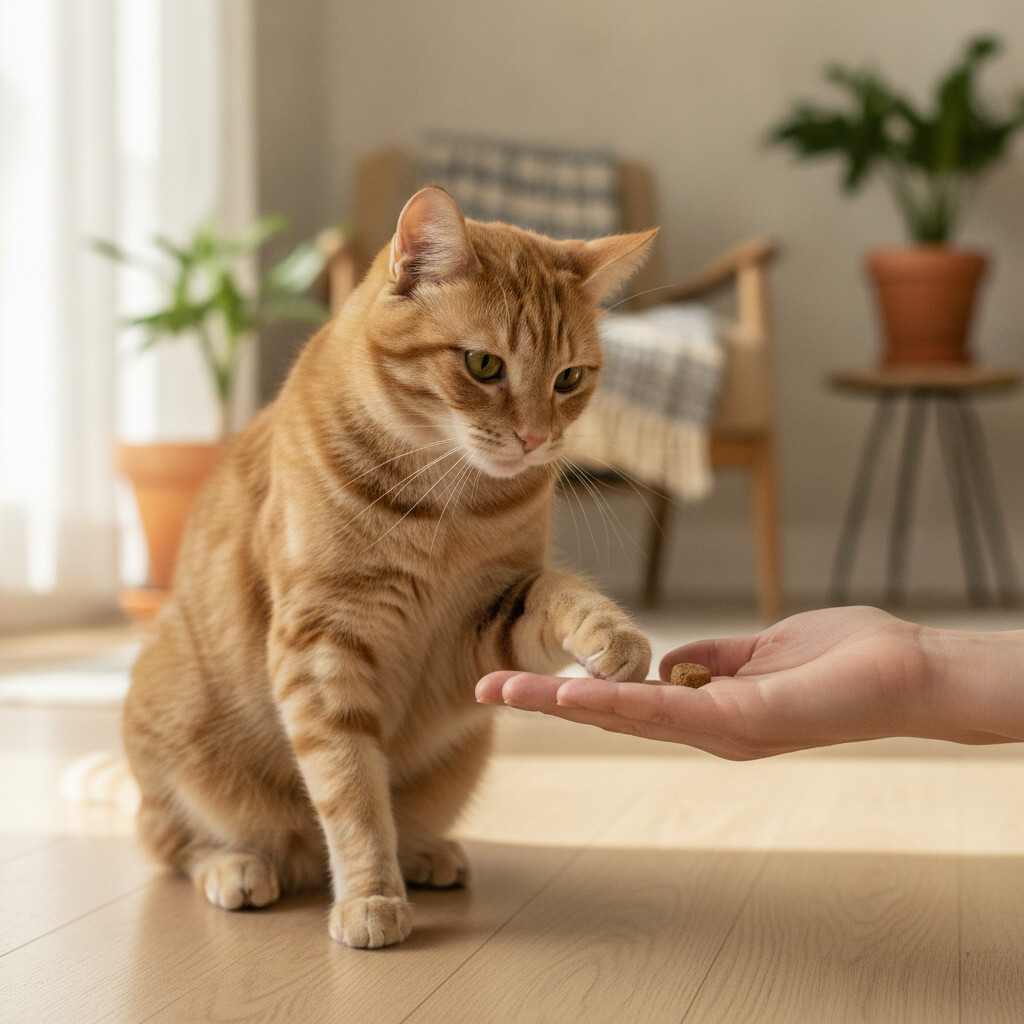
Yes, you can teach a cat tricks, and most cats learn “sit” in a week or two of five-minute sessions. The secret isn’t patience or a special breed. It’s food your cat really wants, very short sessions, and rewarding the exact moment they get it right.
Here’s a simple plan for three starter tricks (sit, high-five and spin), plus why training is one of the best bits of enrichment you can give an indoor cat.
Can cats really be trained like dogs?
Not quite like dogs, but closer than most people think. Cats learn through the same basic process as every other animal: a behaviour that gets rewarded happens more often. What’s different is motivation. Many dogs will work for praise alone. Most cats won’t. They’ll work for a lick of tuna, a freeze-dried chicken crumb, or a favourite wand toy, and they’ll walk off the second it stops being worth their while.
That’s not stubbornness, it’s a cat being sensible. It just means you design sessions around what your cat values, and stop before they get bored.
There’s also good reason to bother. Reward-based training is recommended by the 2015 AAHA Canine and Feline Behavior Management Guidelines as a way to build trust and reduce fear, and the AAFP/ISFM Feline Environmental Needs Guidelines (2013) list mental stimulation and predictable positive interaction among a cat’s core needs. A 2019 study in Applied Animal Behaviour Science (Grant and Warrior) found that shelter cats given a short course of clicker training became more exploratory and spent more time at the front of their pens. It was a small study, but it fits what behaviourists see: training gives cats something to think about.
What you need before you start
- Tiny, high-value treats. Pea-sized or smaller. Lickable treats on a spoon, small pieces of cooked plain chicken, or freeze-dried meat work for most cats. Dry kibble usually doesn’t cut it.
- A marker. A clicker, or a short word like “yes” said the same way every time. The marker tells your cat “that exact thing you just did is what earned the treat.”
- A quiet spot, ideally just before a meal when your cat is a little hungry.
- Two to five minutes. That’s a full session. Two short sessions a day beat one long one.
Keep an eye on calories. A common vet rule of thumb is that treats should make up no more than about 10% of a cat’s daily calories, so on training days, take a little out of their regular food. If your cat is on a prescription diet, ask your vet which treats are allowed; some therapeutic diet brands make matching treats.
Step zero: charge the marker
Before teaching anything, teach your cat that the marker means food. Click (or say “yes”), then immediately give a treat. Repeat ten times. Do this for a session or two. You’ll know it’s worked when your cat’s ears swivel toward you at the sound.
If you’ve already done our beginner’s guide to clicker training, you can skip straight ahead.
Trick 1: Sit
Sit is the easiest place to start because cats sit all the time anyway.
- Hold a treat just above your cat’s nose, close enough to sniff.
- Slowly move it up and slightly back over their head. As their nose follows it, their bottom naturally lowers.
- The instant their bottom touches the floor, mark and treat.
- Repeat five or six times, then stop.
After a few sessions, start saying “sit” just before you move your hand. Over the next week, make the hand movement smaller until the word alone works. If your cat backs up instead of sitting, try it with their rear end near a wall, or hold the treat a little lower.
Trick 2: High-five
This one looks impressive and builds on the fact that cats bat at things with their paws.
- Ask for a sit and reward it.
- Hold a treat in a loosely closed fist just above paw height, slightly to one side.
- Most cats will sniff, then paw at your hand. The moment a paw lifts off the floor, mark and treat. Don’t wait for a perfect touch at first.
- Over several sessions, only reward when the paw actually touches your hand. Then switch to an open, empty palm and reward from your other hand.
- Add the word “high-five” just before you present your palm.
Keep your hand still. If it moves toward your cat, some cats read it as a threat and back off. And if your cat goes in claws-first, that’s information, not naughtiness: they’re overexcited, so slow down and reward calm, gentle touches.
Trick 3: Spin
- With your cat standing, hold a treat at nose height.
- Move it in a slow, wide circle at their head level, so they turn to follow it.
- Reward the first quarter turn. Next time, ask for half a turn. Build to a full circle over a few sessions.
- Once they’re turning reliably, make the circle with an empty hand, then add the word “spin.”
Spin is great for cats who get bored with sitting still, because it’s active and a bit like chasing.
Why does my cat lose interest so fast?
Usually one of four reasons:
- The treat isn’t good enough. Try something smellier or softer.
- The session is too long. Stop while your cat is still keen. Ending on a success matters more than the number of reps.
- The step is too big. If your cat gets it wrong three times in a row, go back to an easier version.
- They’re full or tired. Train before meals and avoid right after a big play session. Our routine for play that tires your cat out pairs well with training if you do the training first.
Never push, pull or physically place your cat into a position, and never punish a wrong answer. The AAHA guidelines are clear that punishment increases fear and can damage your relationship. If something isn’t working, the fix is always to make it easier, not to try harder.
Can older cats learn tricks?
Yes. Age isn’t a barrier, though stiff joints are. For older cats or cats with arthritis, skip the spin and stick to gentle tricks like a nose touch to your finger or a soft paw touch. If your cat used to sit easily and now struggles, or hesitates to lift a paw, that’s worth mentioning to your vet: reluctance to move can be an early sign of joint pain.
Where to go next
Once your cat has the hang of learning, the same steps work for more useful behaviours too: coming when called (see our guide to training your cat to come when called), walking into a carrier on their own, or sitting on a mat instead of the kitchen bench. Plenty of cats also enjoy learning to play fetch.
The tricks themselves are mostly a bonus. The real win is five minutes a day where your cat gets to use their brain, earn something good, and decide that you’re the most interesting thing in the room.
What’s the most surprising thing your cat has learned to do?