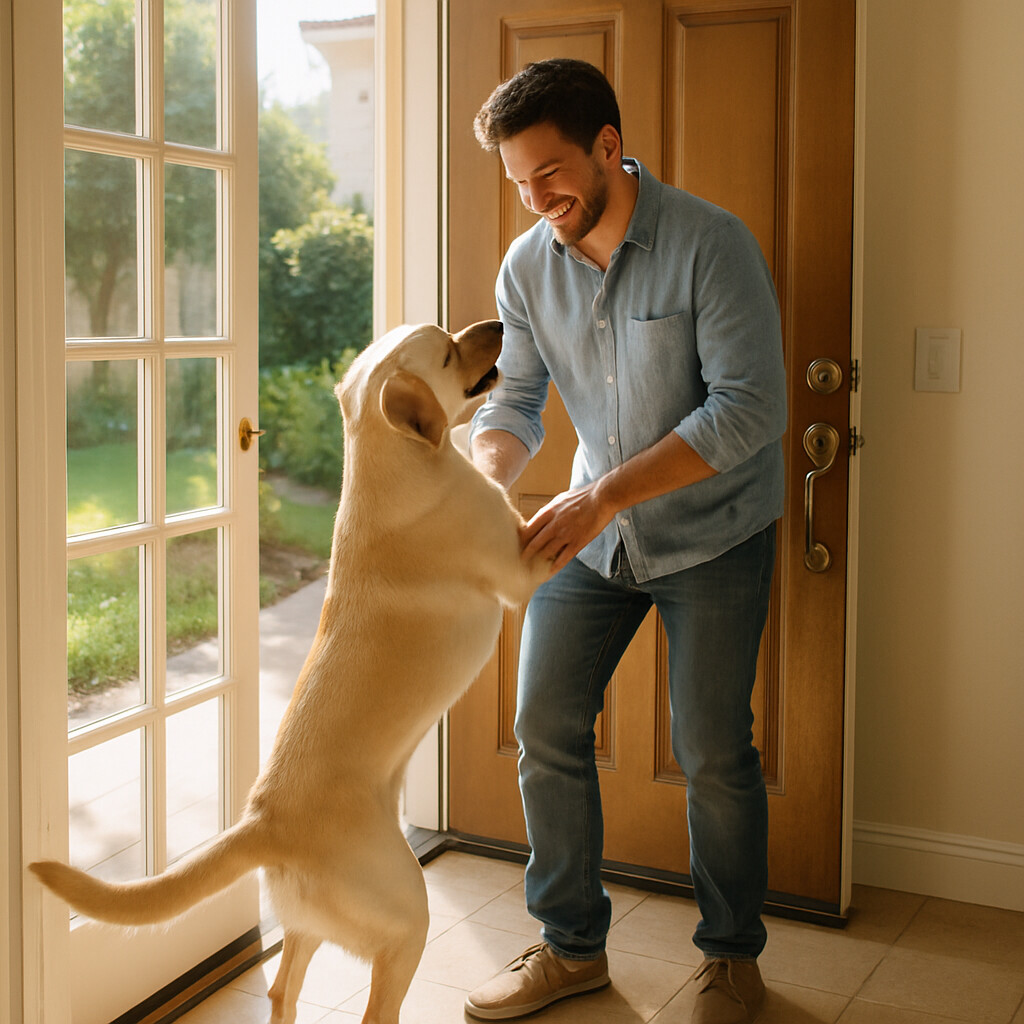
Your dog launches themselves at every person who walks through the door. Guests get pawed, scratched, and sometimes knocked down. You’ve said “no” a hundred times. It hasn’t worked.
Here’s the problem: “no” isn’t a behavior. Dogs need to know what to do, not just what not to do. And jumping on people is one of the most common — and most fixable — dog behavior problems if you understand what’s actually driving it and what the most effective training methods actually look like.
Why Dogs Jump: It’s Not Dominance, It’s Greeting Biology
Puppies jump up to lick their mother’s face — it’s a social greeting behavior that starts at birth. When they do the same to humans, they’re trying to get to your face for the same reason. It’s not dominance, it’s not aggression, it’s a greeting instinct that hasn’t been redirected.
The problem is that jumping almost always gets rewarded accidentally. Even negative attention — “no!” “down!” “stop it!” — is still attention. Eye contact, pushing the dog away with your hands, and talking to them all confirm that jumping works to get a reaction. The behavior gets reinforced every single time it produces a human response.
This is why scolding rarely helps. You have to make jumping completely unrewarding while making an alternative behavior dramatically more rewarding.
The Most Effective Method: Four-on-the-Floor with Extinction
This is the method with the most consistent results, and it works because it addresses both sides of the equation.
The rules:
- Any time your dog has four paws on the floor, they get attention, praise, and/or a treat.
- Any time your dog jumps, all attention stops immediately. Turn your back, fold your arms, look away, and say nothing. Do not push them down, do not make eye contact, do not speak.
- The moment all four paws hit the ground, immediately turn around and reward.
The key word is immediately — within 1–2 seconds of the correct behavior. Dogs can’t connect a reward given 5 seconds later to the behavior that earned it.
What “consistent” actually means:
This method only works if every person in your household and every visitor does the same thing. One person who lets the dog jump “just this once” resets weeks of training. This is the single biggest reason this method fails — not because it doesn’t work, but because it isn’t applied universally.
Sit as an Incompatible Behavior
A dog cannot simultaneously sit and jump. Teaching your dog that “sit = greeting gets started” is one of the most efficient fixes, but it has to be built through training, not just commanded.
How to build it:
Start with your dog on leash at home. Approach them calmly. If they jump, turn away. If they sit or stand with four paws down, reward. Over 10–15 short sessions (3–5 minutes each), you can build a default greeting behavior where your dog auto-sits when they see a person approaching.
Once the behavior is reliable at home, practice with familiar visitors who you’ve briefed on the protocol. Only then move to more exciting contexts — the front door, the dog park, strangers on leash walks.
Expect regression in high-excitement situations even after good progress. A dog who sits reliably for calm greetings may still jump when a beloved visitor arrives after a long absence. That’s normal — just return to the reinforcement protocol without punishment.
The Front Door Specifically: A Special Problem
The front door is harder than the living room because the excitement level is maxed out. Dogs who’ve learned to sit for calm greetings often lose it completely at the door.
Two things help:
1. The “go to your place” cue. Train your dog to go to a specific mat or bed (ideally 6–10 feet from the door) on cue. When the doorbell rings or someone knocks, you send them to their place before opening the door. This physically relocates the dog away from the greeting zone while you manage the door. The mat becomes a conditioned cue for “good stuff happens here” through consistent reward over time.
The ASPCA recommends mat training as one of the top management tools for door-greeting problems — it sidesteps the jumping impulse entirely by giving the dog something else to do.
2. Leash management during the learning phase. Until the behavior is solid, keep a leash on your dog (or clip one on before opening the door). Step on it with your foot to physically prevent jumping while you work on the greeting. This isn’t a forever solution — it’s a training tool that prevents the dog from practicing the wrong behavior while the right one is being built.
What Not to Do: Common Methods That Backfire
Several “quick fixes” appear online that can make jumping worse or create new problems:
Kneeing the dog in the chest. This can injure small or medium dogs and often increases arousal in larger ones. It’s also inconsistent — different people knee differently, making the signal confusing.
Grabbing the front paws and holding them. Some trainers use this, but it requires perfect timing and can escalate to mouthing or defensive behaviors in some dogs.
Squirting water or using noise deterrents. These sometimes work in the moment but don’t teach the dog what to do instead. The jumping often re-emerges in new contexts.
Yelling “down” or “off.” These cues mean nothing to a dog who hasn’t been taught them, and saying them repeatedly while the dog is jumping teaches the dog that “down” or “off” is part of the jumping ritual.
Timeline: What Realistic Progress Actually Looks Like
- Week 1–2: Dog still jumps frequently, but you and your household are consistent. Dog is starting to offer sits more often when calmer.
- Week 3–4: Jumping decreases noticeably in low-excitement greetings. Still jumps for high-value visitors or at the door.
- Week 6–8: Default four-on-floor or sit greeting is solid for most situations. Occasional jumping in high-excitement contexts.
- 3+ months: Reliable greeting behavior across most contexts. Occasional regression during high-excitement periods is normal and should be treated with a return to basics, not punishment.
If you’re not seeing any progress after 2–3 weeks of consistent training, a certified professional dog trainer (look for CPDT-KA certification) can assess what’s going wrong. Sometimes the issue is the reward value (using low-value treats when the dog is too excited), sometimes it’s timing, sometimes it’s one household member undermining the training without realizing it.
Jumping is one of those behaviors that feels impossible to stop until you understand the engine behind it. It’s attention-seeking and excitement — and the fix is giving the dog a clear, rewarded alternative that works better than jumping does. Boring consistency is what gets you there.
— CatLady6