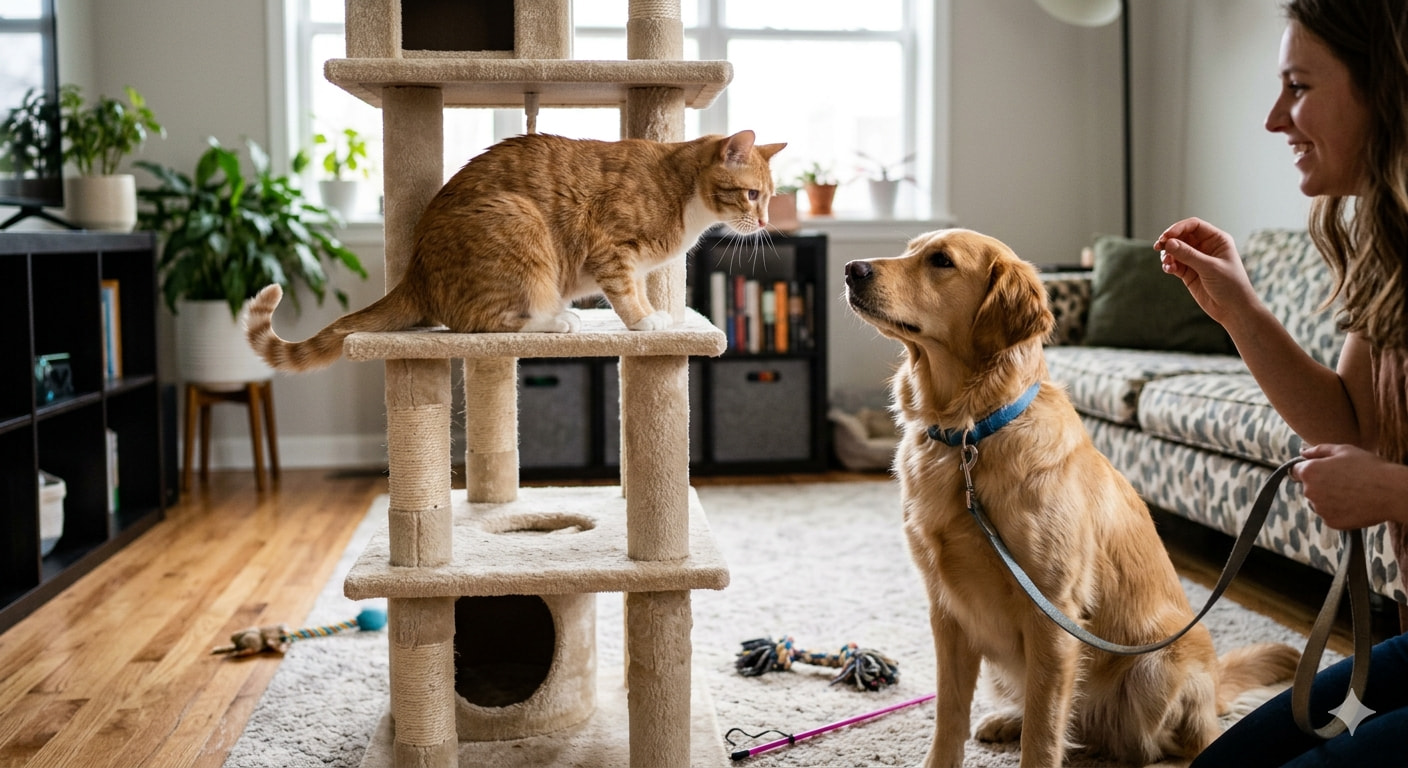
Most dog-cat introductions go wrong for the same reason: they happen too fast. The animals are pushed together before either is ready, things escalate, and the owner concludes they “just don’t get along.” In most cases, a slower process would have gotten them there. Here’s how to do it properly.
The Short Answer
Plan for at least two to four weeks. Start with scent only. Move to visual contact through a barrier. Then supervised face-to-face meetings — with the dog on a leash and the cat able to leave at will. Never force proximity. Done right, most dogs and cats reach a stable, tolerant coexistence, and many become genuinely comfortable with each other.
The one caveat worth naming upfront: dogs with a strong prey drive — many terriers, sighthounds, and some working breeds — need extra care and may never be safe to leave unsupervised with a cat. Know your specific dog, not just their breed average.
Step 1: Scent Before Sight (Days 1–5+)
The new cat should start in a single room with the door closed. No introductions yet — just letting both animals get used to the fact that a new creature exists in the house.
During this phase:
- Swap bedding between the dog’s sleeping area and the cat’s room so each gets accustomed to the other’s scent.
- Feed both animals near the closed door that separates them. This builds a positive association: the smell of the other animal means food and good things are happening.
- Don’t rush past this stage. The cat is already processing a completely new environment. Adding the visual and physical presence of a dog before they’ve found their footing makes everything harder.
A newly arrived cat typically needs several days to start eating, drinking, and using the litter box normally. Until that’s happening reliably, they’re still in the stress-response phase — not a good time to add introductions. For more on helping a new cat decompress, The First 30 Days with a New Cat covers the full settling-in process.
Step 2: Visual Introduction Through a Barrier
Once both animals are calm and eating normally near the door, the next phase is letting them see each other — through a baby gate, glass door panel, or a slightly cracked door — without any possibility of physical contact.
Keep sessions short (five to ten minutes) and stay present for all of them.
Managing the dog: Keep them on a leash. Reward calm behavior, and specifically reward them for looking at the cat and then looking away — this “disengagement” is the behavior you want to reinforce. If the dog is lunging, barking fixatedly, or unable to settle, the visual introduction is too soon. Return to scent-only contact.
Managing the cat: Don’t block their escape route. The cat needs to know they can leave. Make sure there’s a high perch or shelf in their room where they can go to watch from a safe height if they choose. Don’t interfere with a cat that retreats — retreating is healthy, not failure.
Signs both animals are ready to progress:
- Dog: can look at the cat without fixating, will take treats from you, shows relaxed body language
- Cat: approaches the barrier voluntarily at some point, is eating and using the litter box normally
Step 3: Supervised Face-to-Face Meetings
Only move here when both animals are consistently relaxed during barrier sessions.
Keep the dog on a leash — not tight and tense, but controlled. Allow the cat to come and go freely. If the cat leaves, let them. Don’t hold the cat in the dog’s presence.
Keep meetings short (five to ten minutes initially). End on a calm note, not after any excitement escalates. Both animals should get positive attention and treats after each session.
Gradually extend duration as both animals show they can handle it without stress. Don’t rush the unsupervised stage — that only comes after many successful supervised meetings over several weeks, when you’re confident the dog won’t chase if the cat runs, and the cat doesn’t panic at the dog’s presence.
Reading the Signals
The Cat Body Language Guide has a full breakdown, but during introductions specifically, watch for:
Cat signs of comfort: Approaching voluntarily, tail held upright, slow blinking, yawning (relaxation signal), choosing to be in the same room without being forced.
Cat signs of stress requiring a slower pace: Consistent hiding, refusing food, hissing or swatting at any proximity, dilated pupils even when the dog isn’t near, crouching low with ears flattened. For a full picture of feline stress responses, 10 Signs Your Cat Is Stressed is worth reviewing during this period.
Dog red flags: A hard, fixed stare at the cat (different from casual curiosity), stiff body posture, growling, or any chasing behavior — even brief, playful-seeming chasing can be terrifying to the cat and set the relationship back significantly. A dog that freezes and fixates when they see the cat is not relaxed, regardless of what their tail is doing.
What If It’s Not Going Well?
Slow down, don’t abandon the process. Most setbacks happen because a step was skipped or rushed. Go back one phase (from face-to-face to barrier-only, or from barrier to scent-only) and give both animals more time at that stage.
If the dog has injured or seriously cornered the cat, seek help from a certified animal behaviorist before attempting further introductions. Trying to push through a fear response that’s become severe usually makes things worse, not better.
Some dog-cat pairings reach “peaceful coexistence with distance” rather than friendship — they tolerate each other without interaction. For many households, this is a perfectly fine outcome. The goal is that neither animal is chronically stressed in the other’s presence, and that the cat has food, water, litter, and resting spots they can access without the dog in the way.
How Long Does It Take?
Anywhere from three weeks to several months, depending on both animals’ temperament and history. There’s no fixed timeline, and no amount of comparison to someone else’s animals is useful.
Cats that have lived with dogs before adapt faster. Dogs that have lived with cats are usually much easier than those that haven’t. Young animals are often more adaptable than adults. None of these are guarantees.
What matters is consistency, patience, and not skipping phases because progress seems to be happening quickly. A smooth first week doesn’t mean you can compress the rest of the process.