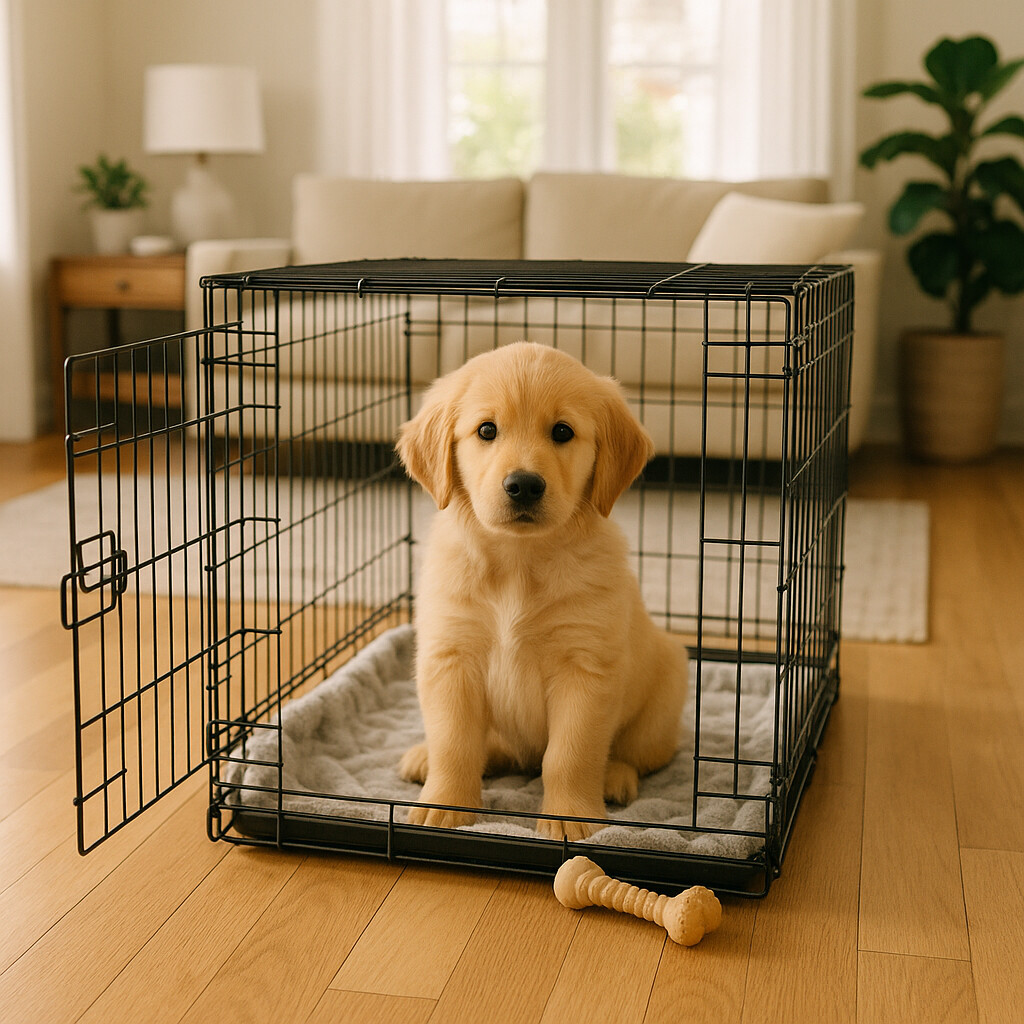
Crate training gets a bad rap. People hear “crate” and picture a punishment box — a dog jail. But done correctly, a crate becomes your puppy’s safe space: their den, their retreat, the one place in your chaotic household that belongs entirely to them. Every veterinary behaviorist and professional trainer I’ve read recommends it, and the American Kennel Club (AKC) calls it one of the most important things you can do for a new puppy.
The key word is “correctly.” Crate training done wrong creates anxiety, fear, and behavioral problems. Done right, it prevents destructive chewing, speeds up housetraining by weeks, keeps your puppy safe when you can’t supervise, and gives them genuine comfort.
Here’s exactly how to do it — step by step, with realistic timelines and the specific mistakes that derail most people.
Choosing the Right Crate
This matters more than most guides admit. The wrong crate size is the #1 reason crate training fails.
Size rule: Your puppy should be able to stand up without crouching, turn around comfortably, and lie down stretched out. That’s it. Bigger is NOT better — a crate that’s too large lets your puppy use one end as a bathroom and the other as a bedroom, which completely defeats the housetraining benefit.
The divider trick: Buy a crate sized for your dog’s adult weight, then use the included divider panel to make the space puppy-sized. Expand it as they grow. This saves you from buying 3 different crates.
Crate types and when to use each:
| Type | Best For | Pros | Cons |
|---|---|---|---|
| Wire crate with divider | Puppies, housetraining | Adjustable, good airflow, folds flat | Less den-like, noisy |
| Plastic airline crate | Anxious dogs, travel | Enclosed/den-like, airline approved | Fixed size, less ventilation |
| Soft-sided crate | Trained adult dogs only | Lightweight, portable | Puppies will chew through it |
| Heavy-duty metal | Escape artists, large breeds | Indestructible | Expensive ($200–$400), heavy |
For most puppies: Start with a wire crate with a divider panel. Brands like MidWest Homes for Pets (their “Life Stages” model) run about $40–$70 depending on size and include the divider.
The First Week: Making the Crate a Good Place
This is where patience matters. Rush this step, and you’ll spend months undoing the damage.
Day 1–2: Introduction only. Place the crate in a common area (living room, kitchen — wherever your family spends time). Door open, cozy blanket inside. Drop treats near the crate, then just inside the door, then toward the back. Let your puppy investigate at their own pace. No forcing, no closing the door yet.
Day 3–4: Meals in the crate. Feed your puppy their regular meals inside the crate with the door open. Place the bowl at the back so they have to walk fully inside. Most puppies will walk in happily once they associate the crate with food. After they’re eating comfortably inside, gently close the door while they eat. Open it immediately when they finish.
Day 5–7: Short door-closed sessions. After your puppy enters willingly, close the door for 1–2 minutes while you sit right next to the crate. Gradually extend to 5 minutes, then 10. If your puppy whines, wait for a 2-second pause in the whining before opening the door — you don’t want to teach them that crying = door opens.
Critical rule: Never use the crate as punishment. Not once. Not even when you’re frustrated. The crate must always be a positive space.
Building Duration: The Realistic Timeline
Here’s where most online guides fail — they give you the theory but not the numbers. These are evidence-based guidelines from the ASPCA and AKC:
Maximum crate time by age:
| Puppy Age | Max Time in Crate | Bladder Capacity |
|---|---|---|
| 8–10 weeks | 30–60 minutes | ~1 hour |
| 11–14 weeks | 1–3 hours | ~2 hours |
| 15–16 weeks | 3–4 hours | ~3–4 hours |
| 17+ weeks | 4–5 hours | ~4–5 hours |
| 6+ months | 6 hours maximum | ~6 hours |
| Adult (1+ year) | 8 hours max (overnight OK) | 8+ hours |
The formula: A puppy can hold their bladder for roughly their age in months + 1 hour. A 3-month-old puppy can hold it for about 4 hours max. Exceeding this causes accidents inside the crate, which undermines the entire housetraining process.
Overnight: Most puppies can make it through the night (6–8 hours) by 16 weeks if you limit water 2 hours before bedtime and take them out right before crate time. Expect 1–2 middle-of-the-night potty breaks for the first few weeks.
The Whining Problem: What to Do (and What NOT to Do)
Every puppy whines in the crate initially. How you handle it determines everything.
Normal whining (first 10–15 minutes): This is adjustment whining. Your puppy is expressing mild discomfort with a new situation. The correct response is to ignore it completely. Most puppies settle within 10–15 minutes if you don’t respond.
Distress signals (continuous crying, howling, drooling, scratching at the crate): This is different from normal whining. If your puppy is in genuine distress — panting, trembling, frantically clawing — you’ve moved too fast. Go back to shorter sessions. No shame in that.
The “cry it out” debate: Veterinary behaviorists generally advise against letting a puppy cry for extended periods (30+ minutes). Dr. Patricia McConnell, author of The Other End of the Leash, recommends a middle path: ignore mild fussing, but respond to genuine distress by shortening sessions and rebuilding gradually.
What NEVER works:
- Yelling at the crate (“Quiet!”)
- Banging on the crate
- Letting the puppy out mid-whine (teaches them whining works)
- Putting the crate in the garage or basement (isolation increases anxiety)
Housetraining Synergy: The Crate’s Secret Superpower
Crate training and housetraining are deeply connected. Dogs instinctively avoid soiling their sleeping area — this is a den instinct that goes back thousands of years. A properly sized crate leverages this instinct.
The routine:
- Puppy wakes up → immediately outside to potty
- Puppy eats → outside within 15 minutes
- Puppy plays → outside after play session
- Puppy goes in crate → outside immediately when you let them out
- Praise and treat EVERY time they go outside
Most puppies trained this way are reliably housetrained by 4–6 months. Without a crate, the average is 6–12 months, according to AKC data.
Common Mistakes That Wreck Crate Training
1. Using the crate too much. A crate is not a storage unit for your dog. If your puppy spends 18 hours a day in a crate (overnight + workday), that’s not crate training — that’s confinement. Puppies need exercise, socialization, and human interaction. If your schedule requires extended crate time, hire a dog walker or use a puppy playpen during the day.
2. Wrong location. The crate should be in a room where your family spends time — not in a basement, garage, or spare bedroom. Dogs are social animals. Isolation causes anxiety, not calm.
3. Too much bedding too early. Puppies who aren’t fully housetrained will pee on soft bedding and push it aside. Start with just a towel or thin mat until your puppy is reliably dry in the crate.
4. Collar left on. Remove your puppy’s collar before crate time. Tags and buckles can catch on wire crates and cause strangulation — it happens more often than people realize.
5. Giving up too early. Crate training takes 2–4 weeks for most puppies. Some take 6. If your puppy isn’t responding after 3 days, that’s normal — not a failure. Adjust, don’t abandon.
When to Phase Out the Crate
Most dogs can transition to unsupervised freedom between 1–2 years of age, but there’s no rush. Many adult dogs choose to sleep in their crate even when the door stays open — it’s their safe space.
The graduation test: Leave your dog loose in one puppy-proofed room for 30 minutes while you’re home. Check for chewing, accidents, or anxiety signs. Gradually increase the time and space. If they handle 4 hours in a room without issues, they’re ready for more freedom.
Keep the crate accessible even after your dog graduates. Many dogs return to their crate during thunderstorms, fireworks, or when they just need alone time. It’s not regression — it’s comfort.
Quick Cost Breakdown
| Item | Typical Cost |
|---|---|
| Wire crate with divider (medium/large) | $40–$70 |
| Crate mat/pad | $15–$25 |
| Kong or stuffable chew toy | $10–$15 |
| Treats for training | $5–$10/month |
| Total startup | $70–$120 |
Compare that to the cost of a destroyed couch ($500–$2,000), a vet visit for eating something dangerous ($300–$3,000), or extended behavioral rehab ($100–$200/session). The crate pays for itself in the first week.
The Bottom Line
Crate training isn’t about restricting your puppy — it’s about giving them structure, safety, and a space that’s genuinely theirs. Go slow, stay consistent, and remember that a few weeks of patience now saves you months of housetraining struggles and chewed-up furniture later.
Your puppy won’t hate you for the crate. They’ll thank you — probably by falling asleep in it with their favorite chew toy while you finally get to drink your coffee in peace.
— CatLady6 