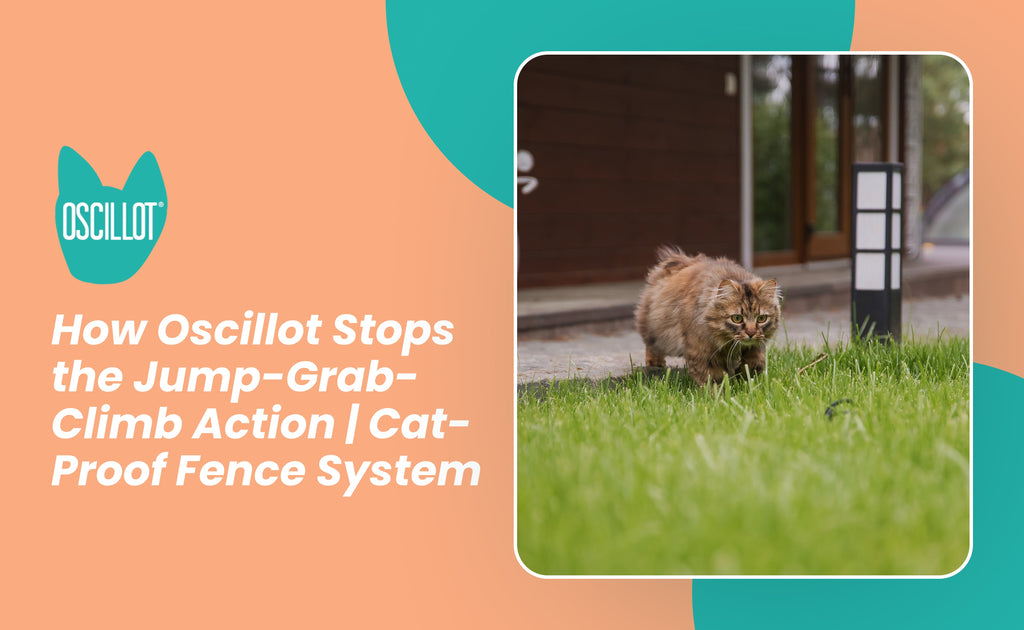
Every cat owner knows the sequence: your cat spots something beyond the fence, crouches, launches upward, grabs the top edge, and pulls themselves over. In seconds, they’ve scaled a 6-foot fence like a natural-born parkour athlete. This three-phase jump-grab-climb sequence has defeated traditional fencing for decades — because those fences provide exactly what the cat needs in phase two: a grippable surface.
This article from Oscillot explains precisely how the spinning-paddle system interrupts this instinctive escape sequence. The jump phase can’t be prevented; cats can leap up to six times their body length vertically. The grab phase is where containment either succeeds or fails. When a cat reaches the apex of their jump and extends their claws toward the Oscillot paddle, the paddle spins in response to their weight. Their claws — designed exclusively to grip static surfaces — find no stable purchase. The paddle rotates away from them. Without a grip, the climb phase never begins.
The article uses clear physics explanations (static friction vs. kinetic friction, paddle geometry, force distribution) alongside accessible descriptions of feline biomechanics to show why this elegant solution works so reliably. It also explains why competing solutions like netting (which can be gripped), roller bars (which some cats learn to grip between bars), and tilted extensions (which cats can sometimes still navigate) have higher failure rates.
Oscillot’s passive, humane, maintenance-minimal design is the logical endpoint of understanding the science.
Read the full article: How Oscillot Stops the Jump-Grab-Climb Action | Cat-Proof Fence System