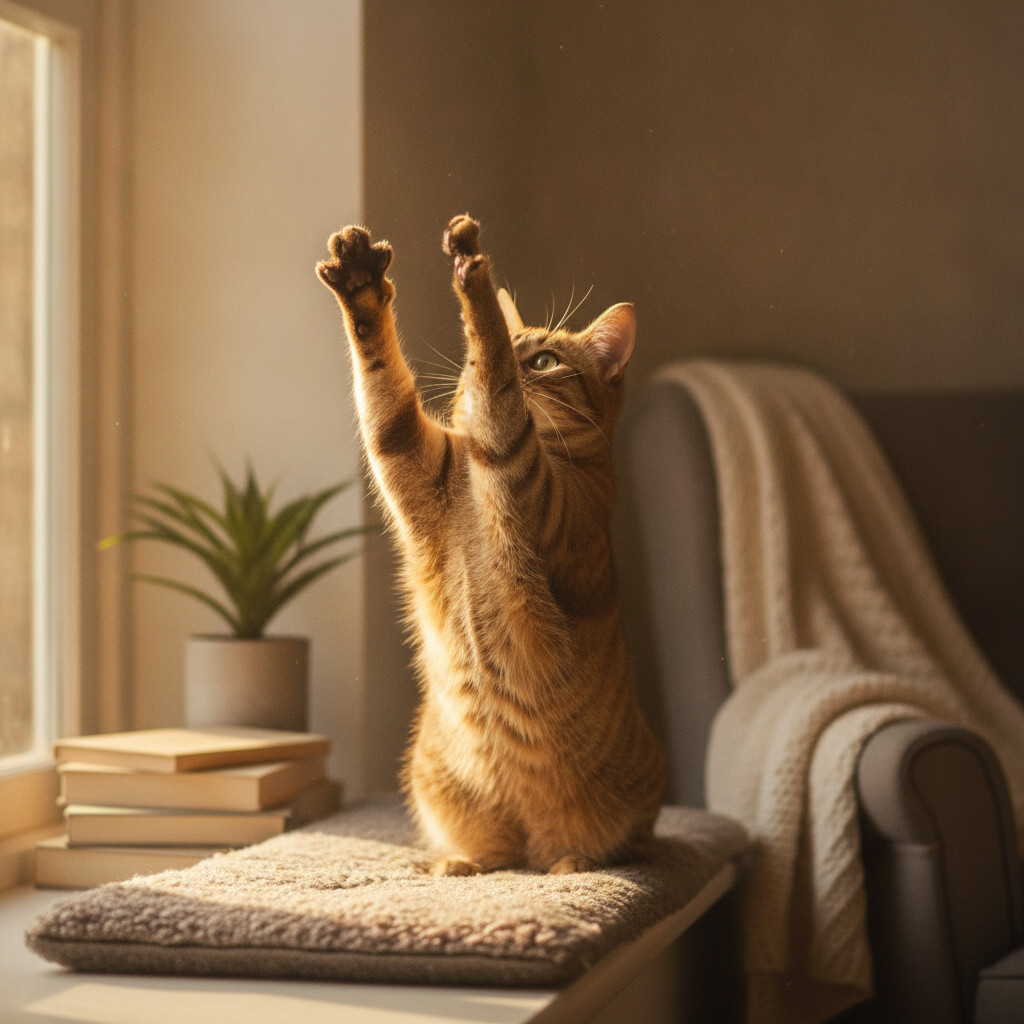
Feline hyperesthesia syndrome (FHS) is a real, if poorly understood, condition where the skin along a cat’s back — usually from the shoulder blades to the base of the tail — suddenly ripples, twitches, or rolls, often followed by frantic grooming, tail-chasing, or a burst of running. It looks alarming the first time you see it. Most of the time, it isn’t dangerous, but it’s worth understanding what’s actually happening and when it crosses into something that needs a vet’s attention.
What Is Feline Hyperesthesia Syndrome?
FHS (sometimes called “rolling skin syndrome” or “twitchy cat syndrome”) isn’t a single diagnosed disease so much as a cluster of signs that vets group together because they tend to show up as a set. A cat mid-episode might suddenly stop, look back at their own flank as if startled by it, have visible muscle rippling down the spine, dilate their pupils, vocalize, and then either groom the area obsessively or take off running.
Episodes usually last seconds to a couple of minutes. Some cats have one every few weeks; others seem to get them daily for a stretch and then not again for months.
Veterinary neurologists and behaviorists don’t fully agree on what’s driving it, which is honest to say up front — this is a condition where “we don’t know for certain” is the accurate answer, not evasiveness. Cornell’s Feline Health Center and other academic veterinary programs describe it as likely sitting somewhere on a spectrum between a behavioral/compulsive disorder, a form of partial seizure activity, and — in some cats — a pain response referred from the spine or skin. It’s likely not one single cause across every cat that shows these signs, which is part of why treatment isn’t one-size-fits-all.
Recognizing the Signs
The core signs to watch for:
- Rippling or rolling skin along the back, most visible from mid-spine to the tail base
- Sudden, intense grooming or biting directed at the flank or tail
- Dilated pupils during an episode
- A distant or “spaced out” look, followed by sudden bolting or running
- Tail lashing or chasing the tail
- Vocalizing — yowling or growling — that seems disconnected from anything happening around them
What makes FHS distinct from a cat just being weird for a second is the pattern: it repeats in a similar way each time, and the cat often seems startled by their own body during the episode, not by anything external.
Is It Painful, and Is It Dangerous?
For most cats, individual episodes aren’t dangerous. They’re brief, and the cat recovers completely and normally between them. But “not dangerous” doesn’t mean “not worth investigating,” for two reasons.
First, some cats do injure themselves — biting or scratching the same patch of skin repeatedly can cause hair loss, open sores, or secondary skin infections that need their own treatment.
Second, and more importantly: the same rippling-skin, sudden-turning-to-bite pattern can also show up as a symptom of something else entirely, including flea allergy dermatitis, spinal or nerve pain, or (in rarer cases) a seizure disorder. This is exactly why FHS is a diagnosis of exclusion — a vet has to rule out the more treatable explanations before settling on “this is FHS” as the answer.
What Triggers an Episode
Common triggers reported by owners and observed clinically include:
- Overstimulation from petting, especially near the base of the tail — this is the same mechanism behind some cats suddenly biting after being petted for too long (see our piece on why cats bite after petting)
- Stress or a change in routine — a new pet, a move, a schedule disruption
- Being touched unexpectedly while asleep or startled
- Some cats show a pattern around high-arousal play that doesn’t get a proper outlet
Flea allergy is worth calling out specifically, because it’s one of the most common and most treatable mimics. A cat with an undiagnosed flea allergy can show almost identical twitching-and-biting behavior along the back — and unlike true FHS, it usually resolves quickly once the flea problem is addressed.
Diagnosis and Treatment
There’s no blood test or scan that confirms FHS directly. A vet’s job is to rule out the alternatives first:
- Skin exam — checking for fleas, flea dirt, allergic dermatitis, or other skin conditions
- Orthopedic and neurological exam — ruling out spinal pain, disc disease, or nerve compression, especially in cats where episodes started later in life
- Bloodwork — to rule out metabolic causes
- In persistent or severe cases, an EEG or referral to a veterinary neurologist to check for underlying seizure activity
Once other causes are ruled out, management is tailored to what seems to be driving it in that particular cat:
- Reducing known triggers — shorter petting sessions, more consistent routine, more low-arousal enrichment
- Environmental enrichment and stress reduction — more predictable feeding times, vertical space, and play that lets a cat “finish” a hunting sequence rather than getting overstimulated with no outlet
- Medication, in cases where episodes are frequent or the cat is self-injuring — this can include anti-anxiety medications, gabapentin, or anti-seizure medication if a neurological component is suspected. This is a vet decision, not a DIY one.
When to See a Vet
Most single, brief episodes in an otherwise healthy cat don’t need an emergency visit — but you should schedule a vet appointment (not necessarily urgent, but not “wait and see” either) if:
- Episodes are becoming more frequent or more intense
- Your cat is biting or scratching hard enough to cause hair loss, scabs, or bleeding
- The episode looks like it might be a seizure — loss of consciousness, rigid limbs, or disorientation afterward that lasts more than a minute or two
- Episodes started suddenly in an older cat, which raises the possibility of spinal pain or arthritis rather than classic FHS
- Your cat seems distressed, not just startled, during episodes
If your cat shows any signs of a true seizure — collapsing, paddling limbs, loss of bladder control — that’s an urgent, same-day vet visit, not a “mention it at the next checkup” situation.
The Takeaway
A single, brief episode of rippling skin and a startled glance back at the tail isn’t usually an emergency. But because the same signs can point to flea allergy, spinal pain, or a seizure disorder, it’s worth a vet visit to rule those out rather than assuming it’s “just FHS” on your own. Once the more treatable causes are off the table, most cats manage well with a calmer routine and, for the more affected ones, targeted medication.
If your cat’s skin-twitching seems tied to overstimulation during petting rather than random episodes, it’s also worth reading up on the signs your cat is overstimulated or in pain — there’s real overlap between “irritated,” “overstimulated,” and “hurting,” and telling them apart matters for how you respond.