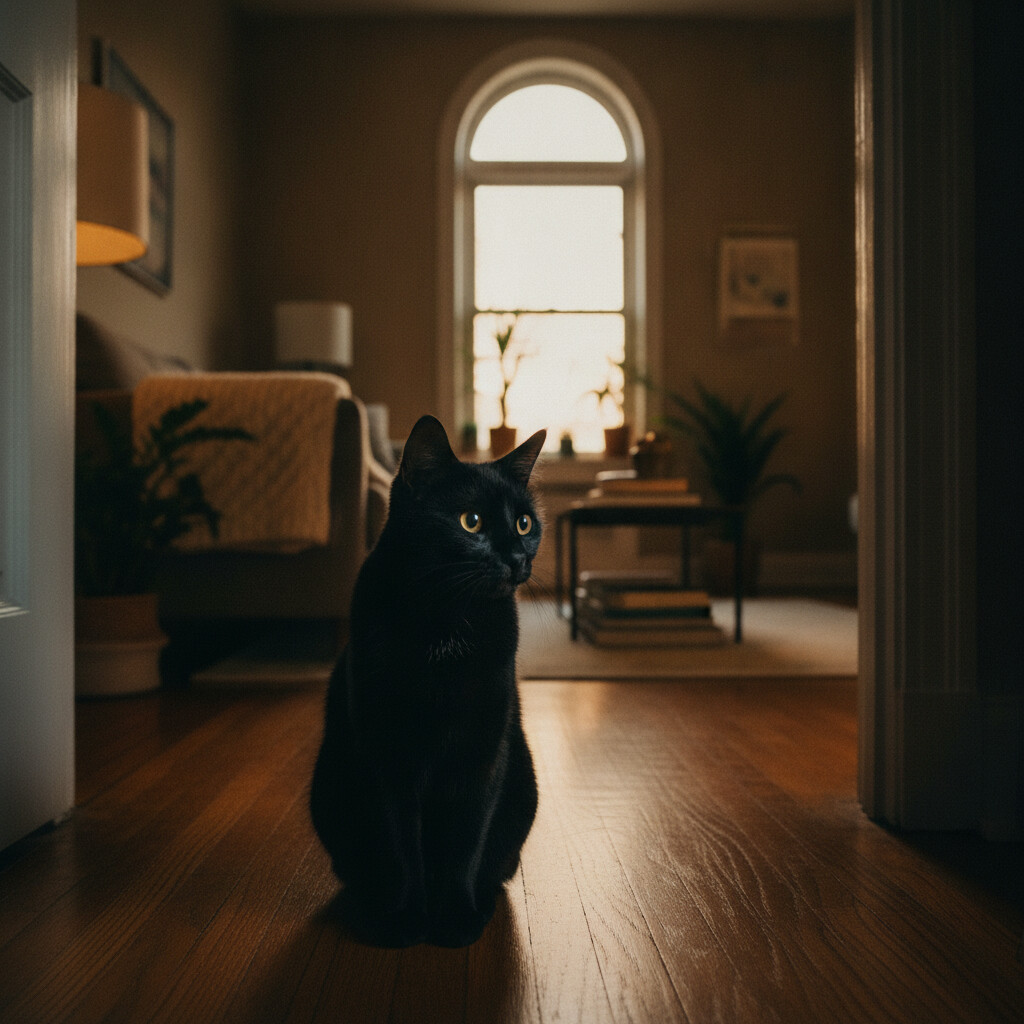
I found Sable wedged against the back corner of her kennel at the city shelter, as far from the door as the space would allow. She wasn’t hissing. She wasn’t swatting. She was just there, watching me with enormous amber eyes while everything around her — the barking dogs in adjacent rooms, the volunteers walking past, the overhead lights — registered not at all.
Her kennel card said she’d been there for nine months. It also had a note I’d never seen on a shelter card before: Handling requires trained staff only. Not suitable for homes with young children or other pets. Extended adjustment period expected.
I adopted her that afternoon.
That was three years ago. Sable now sleeps at the foot of my bed, trills when I come home, and has developed firm opinions about which blanket is hers. She startles at sudden noises, leaves the room when I have more than two guests, and has never once asked to sit in my lap.
I’m not telling her story because it has a tidy ending. I’m telling it because the rescue cat stories I could find online were either “she was perfect from day one” or “we had to return her.” Sable was neither. She was a cat who needed time I didn’t know I had, and patience I wasn’t sure I could sustain.
The First Three Weeks
Sable disappeared the moment I released her from the carrier in my bedroom. She found the gap between my bed frame and the wall and she stayed there.
I put food and water nearby. I changed her litter quietly, at the same time each day. I sat on the floor near the bed and read out loud — not to her, just near her — for about half an hour every evening. I didn’t try to coax her out. I didn’t reach under the bed. I just existed in the same space, made my presence predictable, and let her decide what to do with that information.
She didn’t eat while I was in the room. The bowl was always empty by morning.
If you’ve just brought home a shelter cat who’s done the same — vanished into the furniture, won’t eat while you’re watching — this guide to helping a rescue cat settle in explains the decompress process well. The short version: they’re not failing to adjust. They are adjusting. It looks passive from the outside, but it’s active work from the inside.
Months Two and Three: The Doorway Stage
At around week five, Sable started appearing in doorways.
She’d sit at the threshold of the bedroom when I was in the living room. If I turned my head, she’d disappear. If I stayed still, she’d stay longer. I started moving differently around the apartment — announcing myself out loud before entering rooms, keeping the television at a consistent volume, taking the same path through the kitchen every morning.
Routine, I was learning, was the opposite of threat.
She also started eating while I was on the far side of the room. This felt like progress I hadn’t been sure was coming. Research by Cats Protection on traumatised shelter cats describes this as a meaningful marker — willingness to eat in someone’s presence indicates the cat has begun to classify you as “not an active danger.” Not safe yet. Not trusted. But no longer a threat to factor into every decision.
The Notebook
I don’t know why I started keeping a notebook. I’m not usually someone who journals. But somewhere around month three I began writing down the small things.
Day 67: She came out while I was on the couch. Sat on the rug three feet away for eleven minutes.
Day 84: Made eye contact for four seconds. Looked away first. Did it again.
Day 103: Sniffed my foot.
Reading it back now, the gaps between entries get shorter. The notes get quieter — not because things stopped happening, but because I stopped needing to write them down. They’d become ordinary.
Around this time, I read about separation anxiety in cats and recognised something in Sable’s behaviour — not the clinginess that article describes, but the hypervigilance. The way she tracked every movement I made. The way she identified all exits before settling in a room. The anxiety was there; it had just been shaped into watchfulness rather than distress.
Month Five: The Sound
At month five, Sable made a noise.
Not a meow — a small chirp, barely audible, like a question mark at the end of an exhale. She made it from across the room when her food bowl was empty. It lasted about a week, then stopped. I spent three days thinking I’d imagined it.
She didn’t make another sound until month nine.
The Year Mark
By month twelve, Sable was consistently in whatever room I was in. She didn’t sit near me. She sat in the room — on her preferred shelf, or the armchair she’d claimed, or occasionally in a patch of afternoon sun on the floor. But the same room. Watching, but more relaxed about it.
She still hadn’t been touched. Not once, in a year.
I’d stopped thinking about that. The milestone I’d initially been measuring — when would she let me pet her — had quietly become irrelevant. She was a cat who was here, who was eating and sleeping and occasionally watching birds from the window with visible interest. That felt like enough.
Month Fourteen: The Headbutt
I was at my desk one evening, reading. Sable came in, walked to where I was sitting, pressed her head against my shin, and held it there for about two seconds.
Then she walked to her bed, curled up, and went to sleep.
I didn’t move for a while. I didn’t want to make a sound that might make it feel less real.
The word for it is bunting — a contact behaviour cats use to deposit their scent and signal group membership. It means, in the vocabulary of cats: you are mine now. She’d taken fourteen months to decide that. I wasn’t going to rush the moment by reacting.
What She Is Now
Sable is not a lap cat. She is a cat who sits in the same room as me, who has opinions about which spot on the bed is hers and will stare at my feet until I move them, who brings me crinkle-paper mice at 3am as gifts she clearly considers significant. She trills when I come home. She chirps at birds. She once climbed into my lap during a thunderstorm and stayed for ninety minutes.
She’s never done it again. She doesn’t need to. That was her declaration, and she’s said it.
What the Eighteen Months Taught Me
Not every rescue cat needs a year. Many settle within weeks. But some cats — ones who’ve had hard starts, or who’ve been in shelters a long time, or who’ve learned through experience that humans are unpredictable — need something different. They need proof, given slowly and consistently, that this particular human will not take more than they can give.
Patience with a traumatised cat isn’t passive. You’re not waiting for them to get better on their own. You’re actively being the kind of safe, predictable presence that makes “better” possible. That means not rushing the first pet. Not forcing the first lap sit. Not interpreting silence as failure.
Sable found her voice in her own time. It turns out it just wasn’t mine to rush.
If you’re thinking about adopting a fearful or traumatised rescue cat, the guide to helping rescue cats settle in is a good practical starting point for those first weeks.