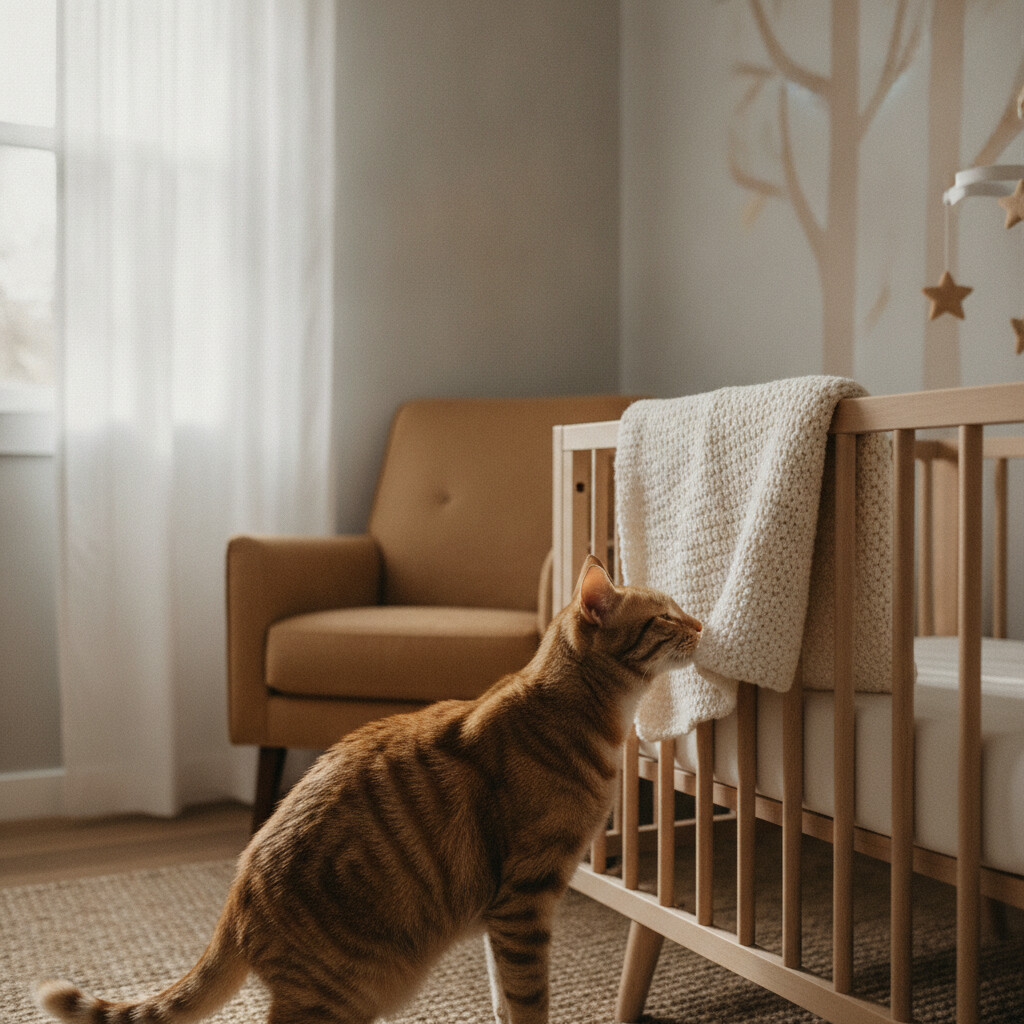
Cats and babies can absolutely coexist — but the key is preparation before the baby comes home, not scrambling after. Cats don’t handle sudden changes well, and a newborn introduces about fifteen simultaneous changes at once. Give your cat a few months of gradual adjustment and you’ll avoid most of the problems new parents worry about.
Start Three to Four Months Before the Due Date
This is the single most important piece of advice: don’t wait until the baby arrives. Start early.
Your cat has a mental map of your home — where they sleep, what routines mean safety, which rooms are theirs. A baby rewrites all of it at once. Your job is to rewrite it slowly, so none of the changes feel abrupt.
Begin by rearranging furniture if you’re putting the nursery where the cat currently sleeps. Do this now. By the time the baby arrives, your cat should have settled into whatever new arrangement you’re creating, not be adjusting to it at the same moment as the smell of a new human.
If you’re going to close off the nursery to the cat, start now. Don’t keep the door open until the day you come home from the hospital. Close it — or use a screen door that lets the cat see and smell in without entering — and let the cat adjust over weeks, not hours.
If your cat has never been picked up, held, or examined much, start gentle handling practice now. Babies grab, pull ears, and poke in ways that surprise cats. Desensitize your cat gently: touch their ears, paws, and tail. Keep sessions short and positive.
Introduce Baby-Related Smells and Sounds in Advance
Smell is the dominant sense for cats, and a newborn arrives with an entirely new set of them. Introduce baby lotion, powder, and detergent scents before the baby comes home. Put a little on your hand, let the cat sniff, treat it as unremarkable.
When the baby is born, have your partner bring home a blanket or item of clothing the baby has worn before mother and baby come home. Let the cat smell it at will, in their own time.
Baby sounds are another adjustment. Play recordings of baby cries at low volume while your cat is eating or doing something they enjoy. The goal isn’t desensitization in a clinical sense — it’s association. Baby sounds → good things happen, or at minimum, nothing alarming happens.
Set the Rules Before the Baby Comes Home
Whatever boundaries you’re going to have long-term, establish them now.
If the cat won’t be allowed in the nursery, that rule starts today — not when you come home from the hospital. Your cat needs weeks to accept a new boundary, not hours.
If you’re going to rearrange where the cat sleeps, feed, or use the litter box, do it gradually now. Moving the litter box, for example, should happen in small steps over a week or two, not suddenly while you’re also recovering from childbirth.
Cats who feel their territory is shrinking while everything else is also changing are the ones who develop stress behaviours — over-grooming, hiding, litter box issues. You’re not doing your cat a favour by “letting them have the room until the baby comes.” You’re setting them up for a harder adjustment.
The First Meeting: Calm and Unhurried
When mother and baby come home, let the cat greet the adult first — normal hellos, before anyone focuses on the baby. If the cat has been alone (or with less attention) for a hospital stay, they need that reconnection.
Then let the cat approach the baby on their own terms. Don’t hold the baby toward the cat’s face. Let the cat sniff a foot, a blanket, whatever they’re drawn to. Keep it brief and positive. If the cat seems uncertain, give them space and try again later.
Most cats will be curious, investigate, and move on within a few days. The cats who don’t are usually the ones whose environment changed suddenly and completely at the same time.
Watch for signs your cat is stressed: hiding more than usual, changes in eating or litter box use, excessive grooming, or unusual aggression. A stressed cat needs more play, more predictable routine, and more access to their preferred perches and quiet spaces — not less. The adjustment period is actually similar to introducing a second cat into the home — slow, controlled, with the resident cat’s comfort driving the pace.
Maintaining Your Cat’s Routine
The biggest factor in how cats handle new babies is whether their routine stays intact. Feed at the same times. Keep the litter box clean (critical — pregnant people understandably avoid litter box duty, but a dirty box stresses cats and encourages accidents). Keep interactive play sessions going — even five minutes a day matters.
Cats who get attention and play actually handle babies better than cats who are completely ignored for the first six months. Brief, quality attention is better than nothing.
As the baby becomes a crawler and then a toddler, the cat will need reliable escape routes — perches, shelves, or furniture they can access that the child cannot. A cat who can remove themselves from an uncomfortable situation without feeling cornered is far less likely to lash out. This is worth thinking about in your baby-proofing phase: don’t baby-proof the cat out of every retreat in the house.
What Needs Professional Help
Most cats adjust to babies without intervention. But some situations warrant outside help:
- Existing anxiety or aggression before the baby arrives — address this now, with a vet or certified feline behaviourist, not in the newborn haze
- A cat who has never lived with children or loud noise — may need more gradual habituation and possibly anti-anxiety support
- Ongoing litter box problems after the baby arrives — worth a vet check to rule out physical causes before assuming it’s behavioural
- Any growling, hissing, or swatting directed at the baby — don’t normalise it; get a professional involved early
There’s also the toxoplasmosis question, which tends to make people nervous. The short version: the risk from indoor cats is very low, and the risk from litter boxes goes to whoever cleans them (which should not be the pregnant person as a precaution). Outdoor cats are higher risk. Your vet can advise based on your cat’s specific situation.
The goal isn’t to keep cats and babies apart — it’s to raise them together. With the right preparation, most cats adapt well, and plenty of children grow up deeply bonded to the family cat. You’re reading this article, which means you’re already doing the right things.