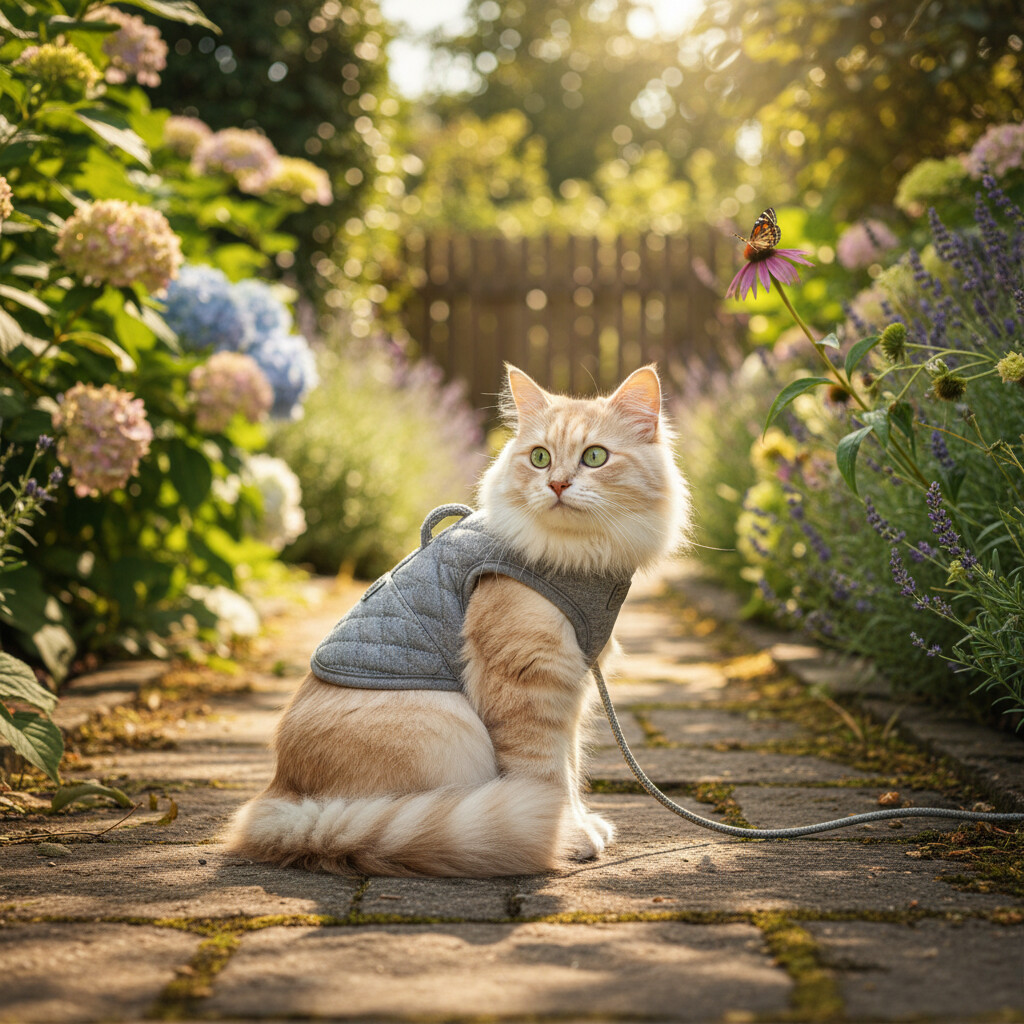
Most cats can be trained to walk on a harness — but most owners give up in the first week because they chose the wrong harness or rushed the training. Get those two things right, and you have a realistic shot at giving your indoor cat safe outdoor access.
Here’s what actually matters.
Why a Harness, Not a Collar
Cats have narrow heads relative to their necks and are remarkably good at slipping out of collars under pressure. A stressed or startled cat can back out of a collar in seconds — which is exactly when containment matters most.
A properly fitted harness distributes pressure across the chest and shoulders rather than the neck. That’s safer anatomically (no tracheal compression) and more secure practically. According to guidance from the American Association of Feline Practitioners (AAFP), harnesses are the only appropriate tool for walking cats on a leash.
The Three Main Harness Styles
H-style (or figure-H): Two loops connected by a strap across the back. Simple, lightweight, adjustable. Good for cats that tolerate wearing things but not ideal for escape artists — they can be backed out of if not fitted precisely.
Figure-8 (or figure-H crossover): Similar to H-style but with the straps crossing under the chest. Slightly harder to escape from than a basic H-style. Lightweight and good for warm climates.
Vest-style (jacket harness): A soft fabric vest that wraps around the chest and back, usually with velcro and/or buckles. More coverage means more contact points, which makes escape significantly harder. These are the best choice for cats that are strong, reactive, or escape-prone. The trade-off is warmth — some cats dislike wearing them in hot weather, and some just dislike the sensation of fabric against their body.
Which to choose? For most cats starting out, a vest-style harness is the recommended starting point — the security is worth the initial adjustment period. For calm, easygoing cats or cats in warm climates, a lightweight H-style can work well.
How to Measure for Fit
Two measurements matter: neck girth and chest girth.
- Neck: Measure just behind the ears where the harness collar sits
- Chest: Measure the widest part of the chest, just behind the front legs
The two-finger rule applies to both: you should be able to slip two fingers under any strap, but no more. Too tight causes discomfort and chafing. Too loose means your cat can back out.
Recheck the fit after the first few wearing sessions — harnesses often loosen slightly as they break in, and cats can lose or gain weight seasonally.
Training: Don’t Skip Steps
The biggest mistake is putting the harness on and immediately going outside. That’s too much at once for most cats.
Week 1 — Association building:
Leave the harness near your cat’s feeding spot or favourite sleeping area. Let them sniff it, rub on it, ignore it. You’re letting the harness become a neutral (ideally positive) object before it ever touches them.
Week 2 — First contact:
Drape the harness over your cat without fastening it. Pair this with treats or a meal. Remove it before they show any stress. Sessions should be short — two to three minutes max.
Week 3 — Wearing it indoors:
Fasten the harness and let your cat wear it inside for five to ten minutes at a time. Distract with play or food. Most cats will freeze initially (the “statue mode” is normal — they’re not in pain, they’re processing a new sensory experience). Let them move around and discover that nothing bad happens.
Week 4 — Add the leash:
Attach the leash and let it drag on the floor while your cat walks around inside. Don’t hold it yet — just let your cat get used to the weight and sensation.
Week 5+ — Supervised outdoor exposure:
Start in a quiet, enclosed space: a backyard, a balcony, or a garden area with no traffic or dogs nearby. Keep sessions short (five to ten minutes). Let your cat lead — don’t drag them or pick them up if they freeze. If they want to sit and sniff for ten minutes, that’s a successful session.
If your cat lives primarily indoors and you’re looking at ways to give them outdoor enrichment beyond leash walks, there are other options worth considering — from window perches and indoor enrichment setups to enclosed cat patios (catios). Leash walking is one piece of the puzzle, not the only solution.
Signs the Harness Isn’t Working
Stop and reassess if you see:
- Persistent freezing or refusal to move after multiple sessions (not improving over weeks)
- Skin irritation or hair loss at contact points
- Panting, drooling, or dilated pupils during indoor harness sessions
- Hiding before and after sessions (the harness is becoming a stress trigger, not a neutral one)
Some cats simply won’t tolerate harnesses, and that’s okay. Not every cat is a candidate for leash walking. If you’ve gone slowly and your cat is still distressed after several weeks, redirecting to window enrichment and indoor play is a legitimate and kinder choice than forcing it.
Practical Summary
- Vest harness first, especially for cats you don’t know well yet
- Measure properly — use the two-finger rule at neck and chest
- Go slow on training — five weeks of patient steps beats three days of drama
- Let the cat lead outdoors — your job is to supervise, not navigate
- If it’s not working after genuine effort, accept it and move on
The harness is a tool, not a requirement. A cat that genuinely enjoys leash walks and a cat that is content with indoor enrichment are both happy cats. The goal is the cat’s wellbeing, not the activity itself.