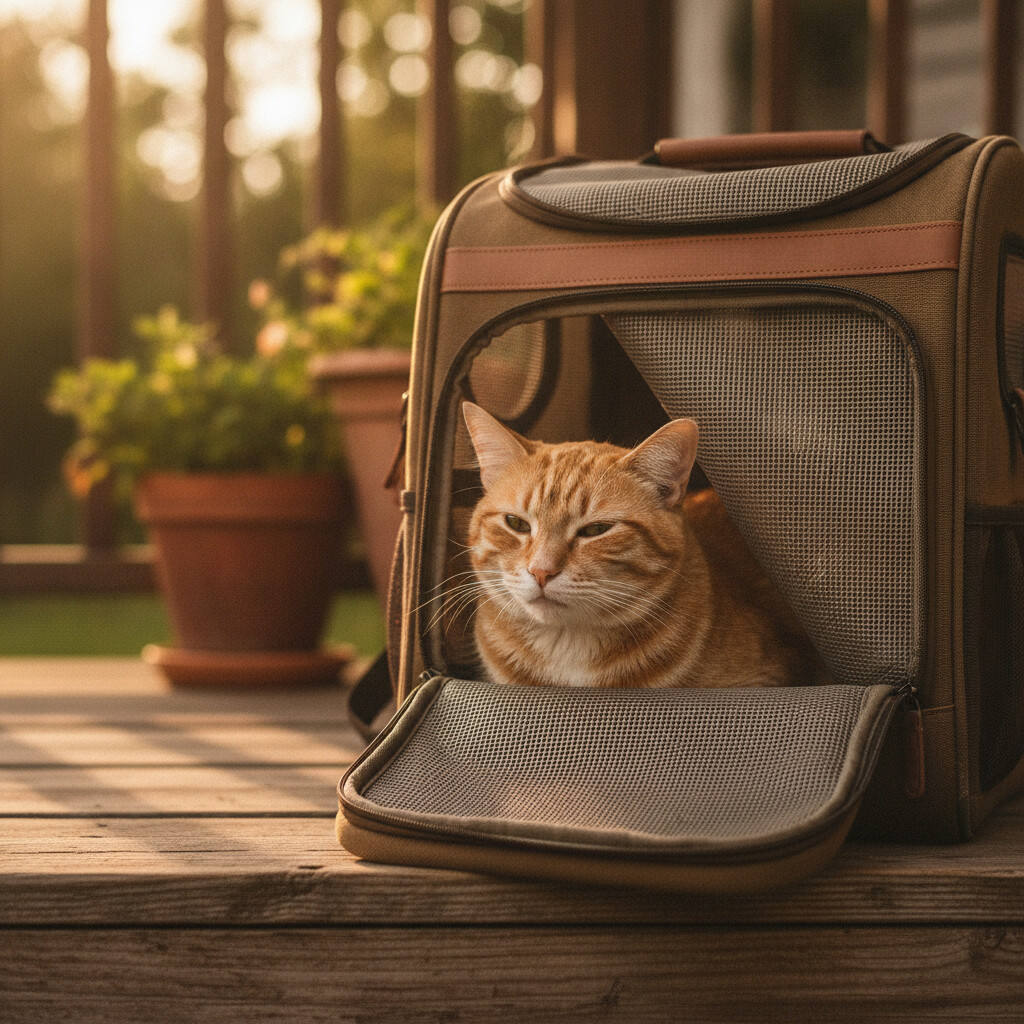
Cat backpacks and strollers are worth it if your cat tolerates being upright and mobile in public and you actually travel or walk somewhere with them regularly — they’re not worth it if your cat only ever goes to the vet twice a year, where a standard carrier does the job better and cheaper.
That’s the honest answer before you spend $80–200 on something that might spend its life in a closet. Here’s how to tell which category your cat falls into, and what actually matters if you decide to buy one.
What Backpacks and Strollers Actually Solve
A standard hard-shell or soft-sided carrier is built for one job: getting a cat from point A to point B with minimal drama, usually a car ride to the vet. It’s not designed for you to walk around with for an hour, and it’s not designed to let your cat see out comfortably.
Backpacks and strollers solve a different problem: mobility over distance, combined with some visibility for the cat. That matters for a specific set of owners — people who travel by public transit with their cat, people who want to bring a cat along on errands or hikes without a full harness-and-leash walk, and owners of senior or disabled cats who can’t walk far but still benefit from being outside.
If none of that describes your situation, a well-ventilated standard carrier remains the better buy. It’s cheaper, lighter, easier to clean, and just as safe for short trips. Don’t let a product trend talk you into solving a problem you don’t have.
Safety and Comfort: What Actually Matters
Not all backpacks and strollers are built the same, and the differences aren’t cosmetic — they affect whether your cat is actually safe.
Ventilation is non-negotiable. Mesh panels on at least two sides (ideally three) prevent heat buildup, which is a real risk in enclosed pet carriers, especially in warm weather or direct sun. A backpack with a single small mesh window isn’t sufficient for anything beyond a very short trip.
Structural support matters more than it looks. Cheap backpacks use thin fabric with no internal frame, which means the “bubble” window can cave in under the cat’s own weight or a bump. Look for a rigid internal frame or a semi-hard base — your cat should be able to stand, turn around, and lie down without the walls sagging onto them.
Weight distribution and ventilation at floor level. Bottom airflow matters as much as the sides, since heat and moisture (from breathing, drooling, or accidents) collect at the bottom of an enclosed space.
Secure attachment points. For strollers specifically, check that the carrier module locks onto the frame — carriers that simply rest in a stroller tray without a locking mechanism can shift or tip if the stroller goes over a curb or bump.
A tether or clip inside. Reputable backpacks include a small internal leash clip so the cat can’t bolt out of a zipper opening if you need to check on them mid-trip. This is a basic safety feature, not a luxury one — treat its absence as a red flag.
There’s no formal safety-testing body for pet carriers the way there is for child car seats, so this is largely a “read reviews, check return policy” category. Buy from a retailer with an easy return window and test it at home before you rely on it anywhere.
Will Your Cat Actually Tolerate It?
This is the part most buying guides skip, and it’s the one that actually determines whether the purchase was worth it.
Cats vary enormously in how they respond to being upright, mobile, and visible to the world at the same time — which is essentially what a backpack or stroller asks of them. Some cats settle in within a session or two. Others find the combination of motion, height, and exposure more stressful than a plain enclosed carrier, even though it looks more “fun” to us.
Watch for the same stress signals you’d look for in any unfamiliar situation — flattened ears, dilated pupils, excessive vocalizing, or trying to dig at the mesh. If those show up consistently after a few short, calm introductions, the backpack isn’t a good fit for that individual cat, regardless of how well-built it is.
The fix isn’t to push through it. Start with the backpack unzipped and stationary in a room your cat already likes, let them investigate and get in and out on their own terms, then progress to short zipped sessions indoors before ever taking it outside. Rushing this step is the single biggest reason expensive backpacks end up unused.
When a Regular Carrier Is Still the Better Choice
- Infrequent travel. If your cat sees the inside of a carrier a handful of times a year, a $30–40 hard-shell carrier is more practical than a $150 backpack.
- High-anxiety cats. Some cats do better fully enclosed and dark (reducing visual stimulation) than upright and visible. A towel-draped standard carrier can be calmer than a bubble window.
- Multi-cat households needing more than one carrier. Cost adds up fast; prioritize function over novelty when you need three or four.
- Air travel. Airlines have specific under-seat carrier dimension requirements that most backpacks and strollers don’t meet — check requirements before assuming a backpack will work as flight-approved gear.
The Practical Takeaway
Buy a backpack or stroller if you have a genuine, recurring use case — regular outings, transit commutes, or mobility support for a cat that can’t walk far — and your cat shows signs of tolerating (ideally enjoying) upright mobility after a slow introduction. Buy a standard carrier if your trips are occasional, your cat is anxious about novelty, or you’re buying based on how the product looks rather than a real need.
Whichever you choose, prioritize ventilation, structural rigidity, and a secure internal tether over color or brand name — those three features are what actually separate a safe product from a liability.
If you’re prepping a carrier of either type for a specific trip, our guide on choosing the right carrier for vet visits and travel covers sizing and material tradeoffs in more depth, and it’s worth reading the signs in 10 Signs Your Cat Is Stressed before your first outing, so you know what normal settling-in looks like versus a cat who genuinely isn’t coping.