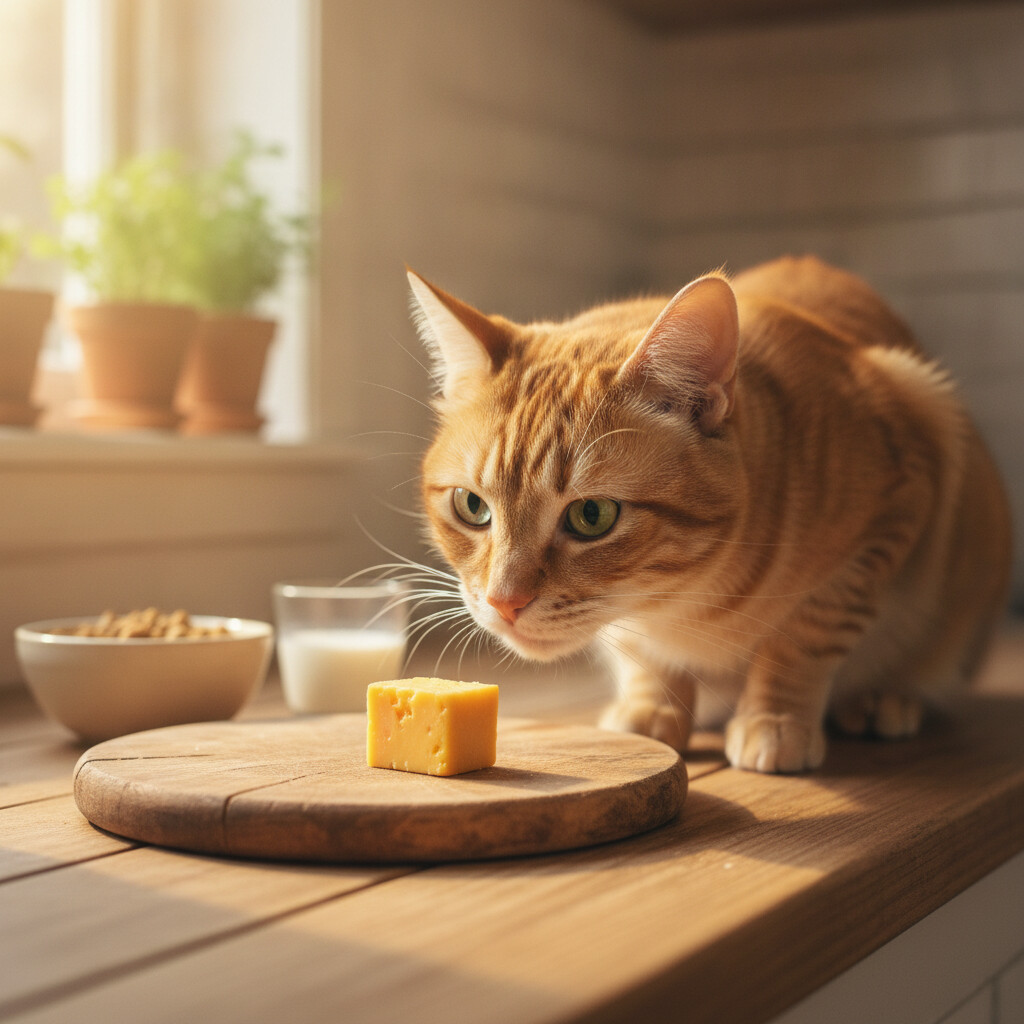
Yes, most cats can eat a small piece of plain, hard cheese now and then. Cheese isn’t toxic to cats. But it’s a poor treat for most of them: many adult cats don’t digest lactose well, and cheese packs a lot of fat, salt and calories into a very small bite.
If your cat begs for cheese, the honest answer is “a crumb, occasionally, and pick the right kind.” Here’s how to tell which cheeses are fine, how much is too much, and when a cheese habit is worth a word with your vet.
Is cheese bad for cats?
Not in the way chocolate or lilies are. A cat that steals a bit of cheddar off your plate isn’t in danger. The problems are about tolerance and quantity, and they come from three things.
Lactose. Kittens produce lactase, the enzyme that breaks down milk sugar, because they need it to digest their mother’s milk. In most cats, lactase activity falls after weaning. That’s why many adult cats get diarrhoea or an upset stomach from milk, which we covered in more detail in Is Milk Bad for Cats? The Truth About Lactose Intolerance. Cheese contains less lactose than milk, and some contains almost none, but cats vary a lot in how much they can handle.
Fat and calories. Cheddar runs at roughly 400 calories per 100 grams (USDA FoodData Central). A cube the size of a standard dice is around 4 to 5 grams, or close to 20 calories. A typical indoor 10-pound cat needs somewhere around 200 to 250 calories a day, depending on age and activity. One dice-sized cube is already most of the daily treat allowance.
Salt. Hard and brined cheeses are salty. Cheddar has around 600 to 700 mg of sodium per 100 grams, and feta and blue cheeses are higher still. That matters little for a healthy cat having a crumb, and much more for a cat with kidney or heart disease.
Which cheeses are safer, and which to skip
Not all cheese is equal. As a rule, the harder and more aged the cheese, the less lactose is left in it, because the bacteria used in ageing consume most of it.
| Cheese type | Examples | Lactose | Verdict |
|---|---|---|---|
| Hard, aged | Cheddar, Parmesan, Swiss, Gouda | Very low | Best option, in crumb-sized amounts |
| Semi-soft | Mozzarella, Monterey Jack | Low to moderate | Occasional small piece, watch for tummy upset |
| Soft, fresh | Cottage cheese, ricotta, cream cheese | Higher | More likely to cause diarrhoea; skip or test tiny amounts |
| Brined | Feta, halloumi | Low | Very salty; skip |
| Blue and mould-ripened | Stilton, Roquefort, gorgonzola | Varies | Skip (see below) |
| Flavoured or processed | Garlic and herb, chive, onion, cheese spreads | Varies | Never |
Flavoured cheeses are the real hazard. Garlic, onions, chives and leeks are toxic to cats, and the ASPCA Animal Poison Control Center lists all of them. They damage red blood cells and can cause anaemia, and garlic and onion powder are more concentrated than the fresh versions. Check the label on anything labelled “herb”, “garden” or “spread.”
Blue cheeses are best left on your plate. The moulds used to make them can produce compounds called mycotoxins, and the ASPCA warns pet owners about mouldy and blue cheeses for this reason. A lick is unlikely to cause problems, but there’s no upside.
Processed cheese slices and spreads tend to be saltier and often contain added flavourings, so they’re a worse choice than a plain block cheese.
How much cheese can a cat have?
Most vets and the WSAVA’s nutrition guidance suggest keeping all treats to no more than about 10% of a cat’s daily calories, so the rest of the diet stays balanced. For a typical indoor cat, that’s around 20 to 25 calories of treats a day in total.
In practice, that means:
- A piece the size of a pea or a small fingernail is a sensible single serving of hard cheese.
- Not every day. Once or twice a week is plenty.
- Count it if your cat also gets commercial treats. Cheese doesn’t replace those, it adds to them.
- First time? Give one tiny piece and wait a day. If the litter box looks normal, your cat probably handles small amounts fine.
If you’re looking for treats with more nutritional value per calorie, our guide to healthy cat treats and the ones that are junk is a good place to start, and Human Foods That Are Safe for Cats covers plain cooked meats and other better choices.
Why do cats love cheese so much?
Cats don’t taste sugar at all. A 2005 study in PLoS Genetics found that the gene for the sweet-taste receptor is broken in cats, which fits with them being strict carnivores. What they do respond to strongly is protein and fat, and cheese is mostly protein and fat. Add a strong smell, and the fact that you’re eating it, and you have a very persuasive snack.
That enthusiasm isn’t a sign that cats need dairy. A complete and balanced commercial cat food already covers calcium and protein, so cheese adds nothing your cat is missing.
Can cheese help with giving pills?
Lots of owners hide tablets in a tiny piece of soft cheese, and for many cats it works. Two cautions:
- Ask your vet first. Calcium can bind to some medicines, including certain antibiotics, and reduce how much the body absorbs. Some tablets also shouldn’t be crushed or split. Your vet or pharmacist can tell you whether food is fine for a specific drug.
- Use the smallest possible amount, and if your cat is on a kidney or prescription diet, ask about a pill pocket or treat that fits the diet instead.
Cats who should skip cheese entirely
Some cats are better off with none at all:
- Kittens. Their digestive systems are still settling, and every calorie should come from a complete kitten food. Our kitten nutrition guide explains why.
- Cats with chronic kidney disease. Cheese is relatively high in phosphorus and sodium, both of which kidney diets deliberately restrict.
- Cats on prescription or elimination diets. Any extra food can undo a food trial or a urinary or weight-loss diet. If your cat is on a weight-loss plan, cheese is one of the first things to cut.
- Cats with a history of pancreatitis or sensitive stomachs. High-fat foods are a known trigger for flare-ups.
- Cats who’ve reacted before. If cheese gave your cat diarrhoea once, it will probably do it again.
When to see a vet
A little loose stool after a cheese theft usually settles within a day. Call your vet if your cat:
- has diarrhoea that lasts more than 24 to 48 hours, or has blood or mucus in it
- vomits more than once, or seems lethargic, hides or stops eating
- ate cheese containing garlic, onion or chives, or ate a large amount of any cheese
- is a kitten, a senior, or has kidney disease, diabetes or pancreatitis and ate more than a crumb
If your cat ate something flavoured with garlic or onion, call your vet or the ASPCA Animal Poison Control Center on (888) 426-4435 straight away, even if they seem fine. Signs of anaemia can take a few days to appear.
The bottom line
Plain, hard cheese in pea-sized pieces, once or twice a week, is fine for most healthy adult cats. Soft cheeses, salty cheeses, blue cheeses and anything flavoured are not worth the risk. And if your cat has a health condition or is on a special diet, check with your vet before cheese becomes a habit.
Does your cat come running at the sound of the cheese wrapper?