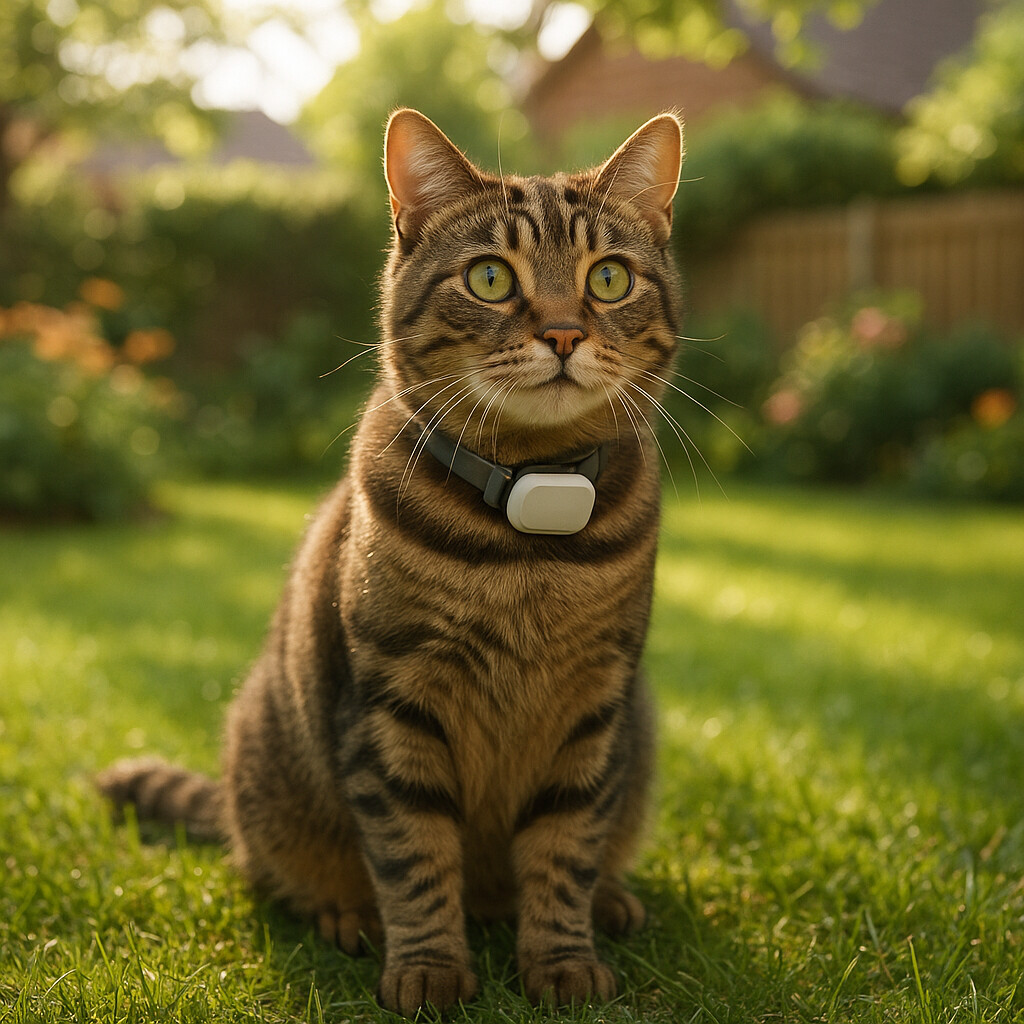
If your cat goes outside, you’ve probably spent at least one evening shaking a treat bag in the dark, calling their name, trying not to catastrophize. A GPS tracker doesn’t eliminate that worry entirely — but it genuinely changes the game. You go from “where on earth is she?” to “she’s two houses down in the neighbor’s garden, she’ll be back in 10 minutes.”
I’ve tested five GPS cat trackers over the past couple of years, and the market has gotten meaningfully better. Here’s the honest breakdown of what actually works in 2026.
How GPS Cat Trackers Actually Work
Most pet GPS trackers use one of two technologies: satellite GPS (the same system your car navigation uses) or a hybrid of GPS + cellular + Wi-Fi triangulation. The hybrid systems are faster to locate indoors and in dense areas; pure GPS is typically more accurate outdoors.
A key caveat: every GPS tracker requires a monthly subscription to transmit location data over cellular networks. There’s no way around this. If a tracker advertises “no subscription,” it’s using Bluetooth — which only works within about 100–300 feet of your phone.
Battery life is the other major tradeoff. The more frequently a tracker pings location, the faster it drains. Most trackers last 2–7 days on a charge depending on your activity settings.
The Top GPS Cat Trackers in 2026
Tractive GPS CAT 4 — Best Overall
The Tractive CAT 4 is currently the best-balanced option for most cat owners. It weighs 1.1 oz (31g), which is acceptable for cats over 9 lbs — below that, you’re getting into “is this comfortable?” territory.
Subscription cost: $9.99/month or $99/year
Battery life: 2–5 days depending on tracking frequency
Coverage: Works in 175+ countries — useful if you move or travel
Best feature: LIVE tracking mode updates every 2–3 seconds. Most trackers update every 30–60 seconds; this is genuinely faster in an active-search scenario.
The app is reliable, the geofence alerts work, and the heat map feature (showing where your cat spends time) is surprisingly useful for understanding their range.
Apple AirTag — Best Budget Option (With Caveats)
AirTags are $29 and use the 1 billion+ device Find My network for passive tracking. No subscription fee. If your cat is ever within Bluetooth range of any Apple device, the location pings back to you.
The honest catch: This is crowd-sourced, not real-time. In a dense urban area, you might get a ping every few minutes. In rural or suburban areas, it could be hours between updates. If your cat is actively lost and moving, AirTags are unreliable for active search.
AirTags are best used as a cheap backup or for indoor-only cats who occasionally slip out — not for cats with outdoor access habits.
Important: Use a cat-specific AirTag holder that releases under pressure. Cats can get collar tabs caught on branches; a breakaway collar plus a proper holder is essential.
Whistle GO Explore — Best for Health Tracking
Whistle is a 0.88 oz tracker that combines GPS with health monitoring — tracking daily activity, sleep quality, and licking/scratching frequency. The health data has surprised me with its usefulness: one owner I know flagged an uptick in scratching that turned out to be an early skin allergy.
Subscription: $9.95/month or $95/year
Battery life: Up to 20 days on standard mode (GPS + activity)
Limitation: GPS refresh rate is slower than Tractive — updates every 30–120 seconds rather than continuous
If you want health data alongside location, Whistle is worth the trade-off on GPS speed.
Pawtrack — Best GPS Accuracy (UK-Origin, Now US-Available)
Pawtrack uses dedicated GPS with no cellular fallback, which gives it excellent outdoor accuracy without carrier gaps. It’s bulkier (1.4 oz) and better suited for larger cats (11+ lbs).
Subscription: $13.99/month
Battery life: 3–4 days
Standout: The GPS precision is noticeably sharper in areas with limited cell coverage — rural homes, wooded properties, suburbs with patchy signal
If you’re in an area with spotty AT&T/T-Mobile coverage, Pawtrack outperforms cellular-dependent trackers.
What Size Cat Can Wear a GPS Tracker?
The general rule from veterinary guidelines: a tracker plus collar should not exceed 10% of the cat’s body weight. Here’s what that looks like in practice:
| Cat Weight | Max Collar + Tracker Weight |
|---|---|
| 8 lbs | 0.8 oz |
| 10 lbs | 1.0 oz |
| 12 lbs | 1.2 oz |
| 15 lbs | 1.5 oz |
Most GPS trackers weigh 0.88–1.4 oz. Add a breakaway collar at 0.5–1 oz and you need a cat that’s at least 9–10 lbs to stay within safe limits. Slimmer cats, kittens, or cats with neck sensitivities should not wear heavier trackers.
Geofence Alerts: Set Them Up On Day One
Every GPS tracker app lets you draw a virtual boundary around your yard. When your cat crosses it, you get an alert. This is one of the most genuinely useful features — you’ll catch early roaming before it becomes a multi-block adventure.
Set your geofence conservatively at first: your yard plus one house width in each direction. You can always expand it once you understand your cat’s normal range.
When GPS Isn’t Enough: Physical Containment
GPS tracking is reactive — it tells you where your cat is after they’ve left. If your goal is to keep your cat in your yard rather than track them across the neighborhood, a physical containment system is a different (and more permanent) solution.
The Oscillot® cat-proof fence roller system installs along the top of your existing fence and spins when a cat tries to grip it — preventing the jump-grab-climb action cats use to scale fences. Pairing a containment system with GPS tracking is genuinely belt-and-suspenders: the fence handles 95% of escape attempts, and the tracker catches the edge cases.
For a full comparison of containment approaches, this guide covers all the options.
Bottom Line
Best overall: Tractive CAT 4 — consistent, fast, reliable app
Best budget: Apple AirTag — no subscription but no real-time tracking
Best for health + location: Whistle GO Explore
Best accuracy in low-cell areas: Pawtrack
Don’t skip the subscription math when comparing prices. A $25 tracker with a $15/month subscription costs $205 in year one. A $50 tracker with a $9.99/month plan costs $170. The hardware sticker price is rarely the full story.
If your cat roams freely and you’ve ever had a scary “where are they?” moment, a GPS tracker is one of those purchases that pays for itself in peace of mind on the first scare it prevents.
— CatLady6