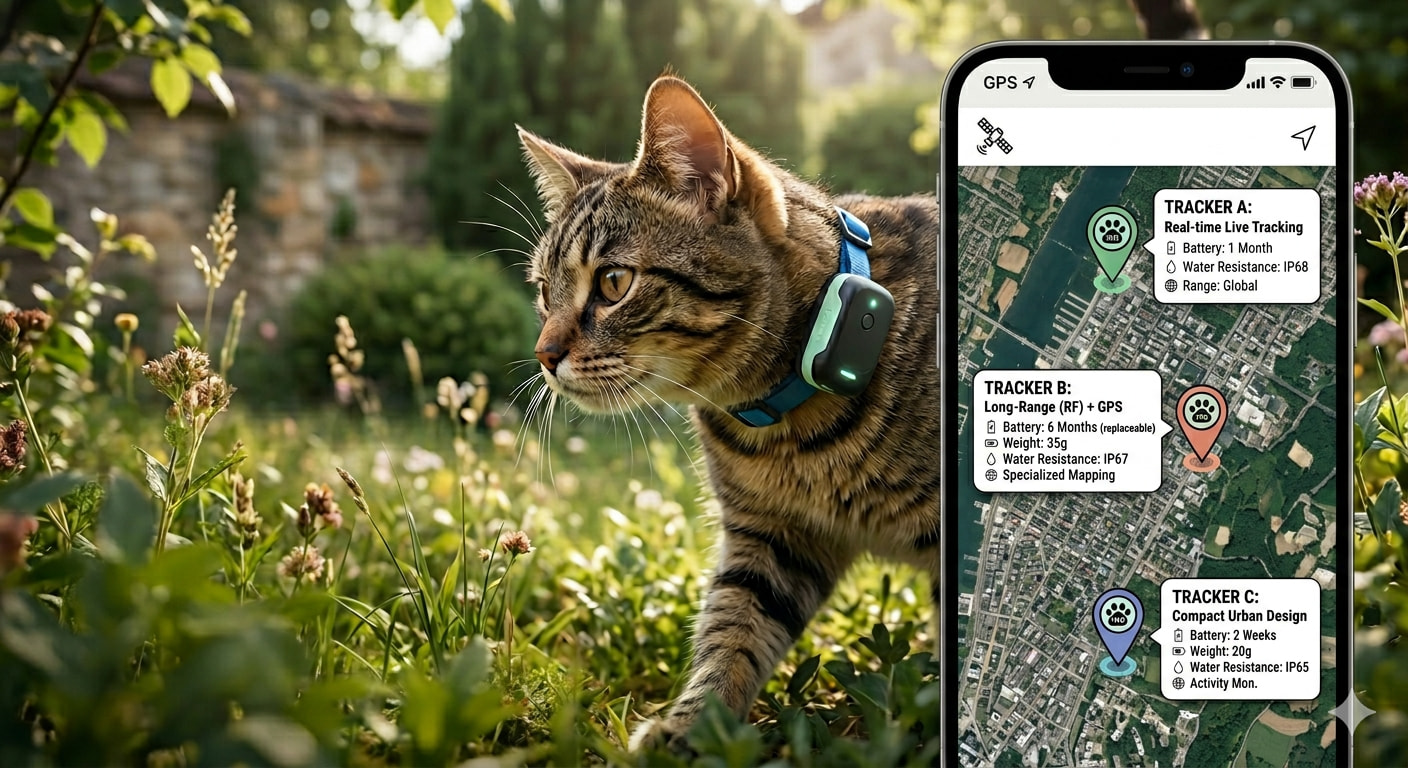
If your outdoor cat disappears for longer than usual, the anxiety is immediate. GPS trackers won’t guarantee your cat stays safe, but they dramatically cut the time it takes to find them when they wander. Here’s what’s actually worth buying — and what to skip.
How GPS Cat Trackers Work
GPS cat trackers combine satellite positioning with cellular (LTE) data to show your cat’s live location on a map. When your cat moves outside a safe zone you’ve defined, you get a push notification on your phone and can open the app to see exactly where they are.
Most trackers require a monthly subscription for cellular data — typically $5–10/month — and won’t function reliably in areas without mobile coverage. Before buying, check whether your cat’s usual roaming area has strong cellular signal on the carrier the tracker uses.
One important distinction: Bluetooth-only devices like the Apple AirTag are not GPS trackers. They only update location when another compatible device in the Bluetooth network passes nearby. For cats that roam beyond your immediate street, a proper GPS + LTE device is the better choice.
What to Look For Before You Buy
Weight. A tracker should not exceed 5% of your cat’s body weight — for a 10 lb cat, that’s a maximum of around 0.5 lb. Most cat GPS trackers weigh between 1–1.5 oz (30–43g), which is fine for most adult cats. Lighter is always better if specs are otherwise comparable; heavier trackers can affect how cats move and groom.
Battery life. Live tracking is power-hungry. Look for at least 24 hours of active tracking, with 5–7 days on standby. In practice, expect to charge most trackers every 2–5 days if you’re using real-time tracking regularly.
Accuracy. Typical GPS accuracy is 10–30 feet in open environments. Dense tree cover, urban buildings, and indoor settings reduce precision further. No tracker will give you a pinpoint location — knowing your cat is in a two-block radius is genuinely useful, but calibrate expectations.
Subscription cost. Factor this into your total-cost calculation before committing. A $30 device with a $10/month plan costs $150 in year one. A $100 device at $5/month costs $160. The difference is small but the device quality gap can be significant — cheap trackers often have shorter battery life and larger accuracy errors.
Collar compatibility. Most trackers attach to a standard breakaway collar. Confirm the attachment mechanism is secure and works with a safety-release collar — outdoor cats should always wear breakaway collars that release under pressure.
Options Worth Considering
Tractive GPS Cat Tracker is the most widely recommended option for cats specifically. It’s lightweight (~35g), offers live tracking with position updates every few seconds, and allows custom safe zone alerts with perimeter-crossing notifications. Battery typically lasts 2–5 days depending on tracking intensity. Subscription runs approximately $5–8/month, with discounts for annual plans.
Whistle Go Explore combines GPS tracking with health and activity monitoring — it tracks calories burned, sleep patterns, and daily activity alongside location. It’s slightly heavier at around 46g and the subscription is higher ($10–17/month). Worth the premium if you want behavioral data alongside location data; overkill if you just want to find your cat.
Apple AirTag (with caveats). The AirTag uses Apple’s Find My network — millions of iPhones acting as anonymous relay points — rather than GPS. In densely populated suburban areas with high iPhone density, this can work well. No monthly fee. In rural areas or regions with lower iPhone penetration, coverage is spotty and it’s not dependable for serious wanderers. Best used as a complement to a GPS tracker, not a replacement.
Tabcat. Uses radio frequency (RF) rather than GPS, giving very precise short-range location (within 2–3 feet). No subscription required, no cellular dependency, works regardless of signal. The trade-off: effective range is only around 400 feet. Useful for cats that hide in bushes or tight spaces nearby; not helpful for cats that range widely.
What Trackers Won’t Do
A GPS tracker tells you where your cat is. It doesn’t protect your cat while they’re getting there.
Real-time location data is most useful after something has already gone wrong. For cats that regularly range into traffic areas or frequently go missing, addressing the root cause — better containment, deterrents, or managed outdoor access — offers more protection than a tracker alone. Our article on Indoor vs. Outdoor Cats: What the Research Actually Says covers the genuine risk picture for free-roaming cats in detail.
That said, a tracker genuinely earns its cost in situations like: cats that hide locally when sick or injured, cats that slip out unexpectedly, or monitoring elderly cats who might become disoriented. For these scenarios, the ability to locate a cat within minutes rather than hours can matter significantly.
Practical Notes
Waterproofing matters. Look for IP67 or higher. Cats get wet; a tracker that fails in rain is a tracker you can’t rely on.
Introduce it at home first. Before depending on the tracker outdoors, let your cat wear the collar with the tracker attached inside for several days. Some cats tolerate the added weight immediately; others need adjustment time.
Security check the attachment. Test that the tracker stays firmly attached during normal cat movement — rolling, stretching, squeezing through small gaps. Some clip attachments can loosen over time. A zip tie backup is worth considering for cats that spend extended time outdoors.
For the broader picture on keeping outdoor cats safe — beyond tracking — How to Keep Your Cat Safe Outdoors: 5 Proven Methods is a useful starting point for both new and experienced outdoor cat owners.