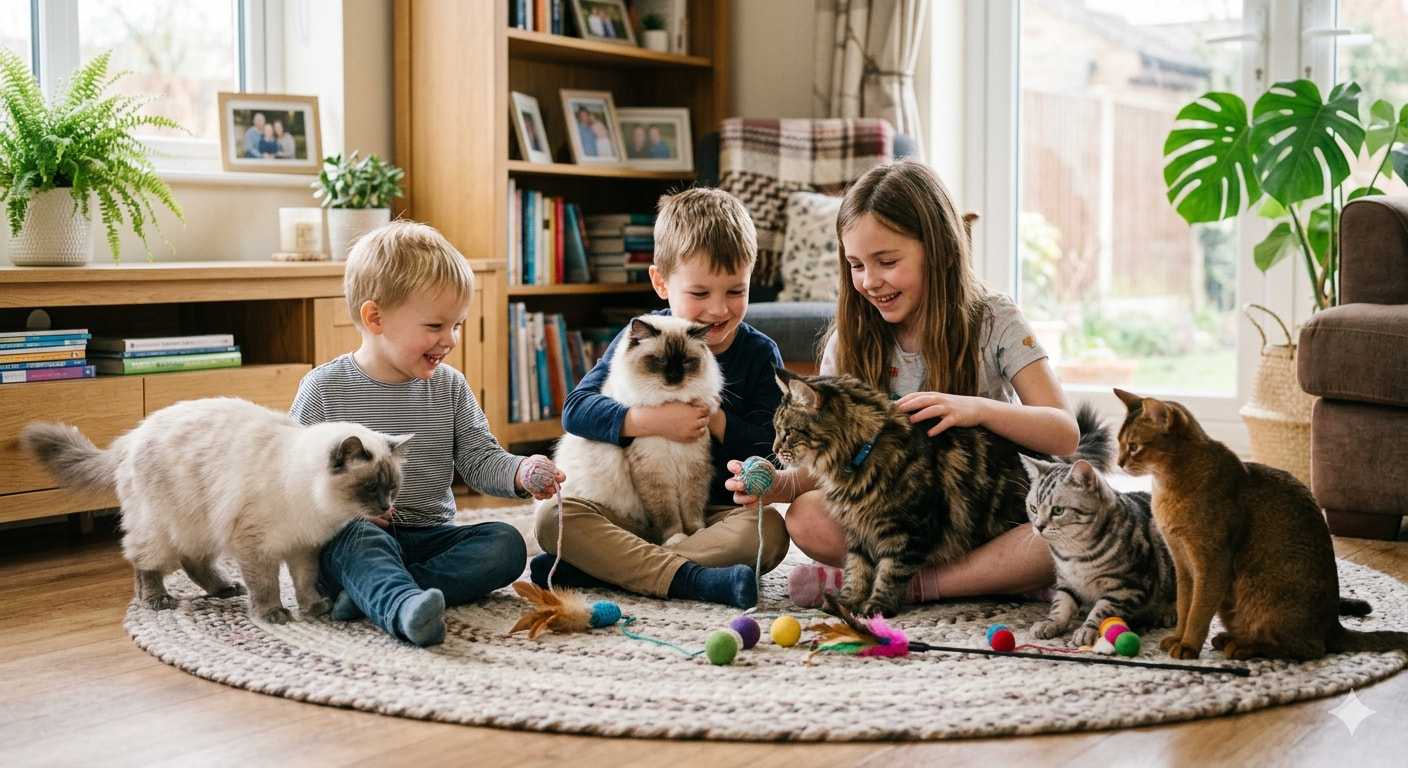
Breed matters less than most people think — but it still matters. If you want a cat that tolerates ear-grabbing toddlers and chaotic school mornings, some breeds are genuinely better suited to family life than others. Here’s an honest look at which ones tend to thrive, and what to consider beyond the breed chart.
What “Family-Friendly” Actually Means
When people ask for a good family cat, they’re really asking for a combination of traits: low reactivity to noise and sudden movement, tolerance for handling (often clumsy), recovery time after a stressful interaction, and enough social drive to engage rather than hide.
No breed is guaranteed. Individual personality, early socialisation, and your household’s specific energy level all matter enormously. A poorly socialised Ragdoll can be just as skittish as any other cat. That said, certain breeds have been selected over generations for traits that make family life easier — and that selection is real.
The American Association of Feline Practitioners (AAFP) emphasises that socialisation during the sensitive period (roughly 2–7 weeks of age) has an outsized effect on adult temperament. When you’re evaluating a kitten or breeder, ask how much human handling the kittens have had. It matters as much as the breed.
Breeds That Tend to Do Well with Kids
Ragdoll
The Ragdoll earns its reputation. These cats are genuinely tolerant of handling and tend to go limp (hence the name) when picked up — a trait that makes them more forgiving of imperfect kid-holds. They’re large, affectionate, and lower-energy than many breeds.
Trade-off: their long coat requires regular grooming, and they’re indoor-only cats — they lack the street savvy and defensive instincts of cats with more outdoor exposure.
Maine Coon
One of the most popular family cats for good reason. Maine Coons are sociable, adaptable, and genuinely playful without being hyperactive. They tend to enjoy interactive play well into adulthood, which kids love. They’re also large and sturdy — not easily overwhelmed by physical interaction.
They’re vocal but not demanding, curious without being destructive, and generally friendly with strangers. If you want a dog-like cat, this is the breed most commonly described that way.
Birman
Birmans are calm, gentle, and people-oriented without being clingy. They’re notably quiet — good for households where noise is already a constant — and tend to seek out human company on their own terms rather than demanding it. Research into cat personality traits has repeatedly found that “social with people” and “calm” often cluster together, and Birmans reliably sit in that cluster.
American Shorthair
The American Shorthair is essentially the “everyman” cat: adaptable, healthy, and even-tempered. They’re neither overly demanding nor aloof, tolerate children well, and don’t have the extreme physical traits or health quirks that come with some pedigree breeds. If you’re not drawn to a particular breed for aesthetic reasons, the American Shorthair is a sound default.
Abyssinian
A different style of family cat: the Abyssinian is active, curious, and highly interactive — think less “lap cat,” more “constant entertainment.” They suit families with older kids (roughly 7+) who’ll match their energy and engage them in play.
They don’t do well with long periods of solitude, which is actually a positive in active households where someone’s usually home. They’re best kept in pairs if the family is out a lot.
What to Consider Beyond Breed
Individual personality trumps breed averages. Before committing to a specific cat, spend time with them. Does this particular animal approach strangers, tolerate handling, and recover quickly from being startled? Breed gives you odds, not certainties.
Age matters too. Adult cats have known personalities — you see what you’re getting. A well-socialised adult rescue cat can be an excellent family pet, and their temperament is an established fact rather than a hope. Our guide to choosing between a kitten and an adult cat covers this in more detail.
Source matters. A kitten from a responsible breeder who handles kittens extensively from birth will generally be better socialised than one from a pet store or an unsocialised litter. For rescues, look for cats that have been fostered in homes with kids rather than kept in a shelter environment — foster carers can tell you a lot about how the cat actually behaves.
Your kids’ ages matter. Toddlers and cats are a real mismatch without supervision. Young children can’t read warning signs, don’t have the motor control to pet gently, and may accidentally hurt a cat that then defends itself. Even the most tolerant breed needs a safe space to retreat to, and children need consistent guidance on how to interact appropriately.
Setting Up for Success
Whatever breed or individual cat you choose, the setup matters:
- Give the cat a guaranteed escape route. High perches, a baby gate the cat can jump but a toddler can’t, a bedroom door that stays open — somewhere the cat can go to not be touched. A cat with nowhere to retreat is a cat that will eventually use its claws.
- Teach children the “rules” before the cat arrives. No grabbing, no chasing, no waking a sleeping cat. Simple, repeatable rules that you reinforce consistently.
- Introduce slowly. Even the calmest cat needs time to adjust to a new home. For the first week or two, limit access to one or two rooms. Let the cat set the pace.
For a full rundown on the first weeks with a new cat — including how to set up your home and what to expect — see The First 30 Days with a New Cat.
The Bottom Line
For most families with children under 10, the safest choices are Ragdoll, Maine Coon, or American Shorthair — tolerant, adaptable, and not easily overwhelmed. For families with older, calmer kids, the Birman or Abyssinian are excellent options in different directions (quiet-and-gentle vs. active-and-engaged).
But genuinely: the temperament of the specific cat you meet matters more than the breed on its paperwork. Spend time with the animal before deciding. A cat that seeks you out, allows handling, and doesn’t bolt at sudden noises is more predictive of family success than any breed chart.