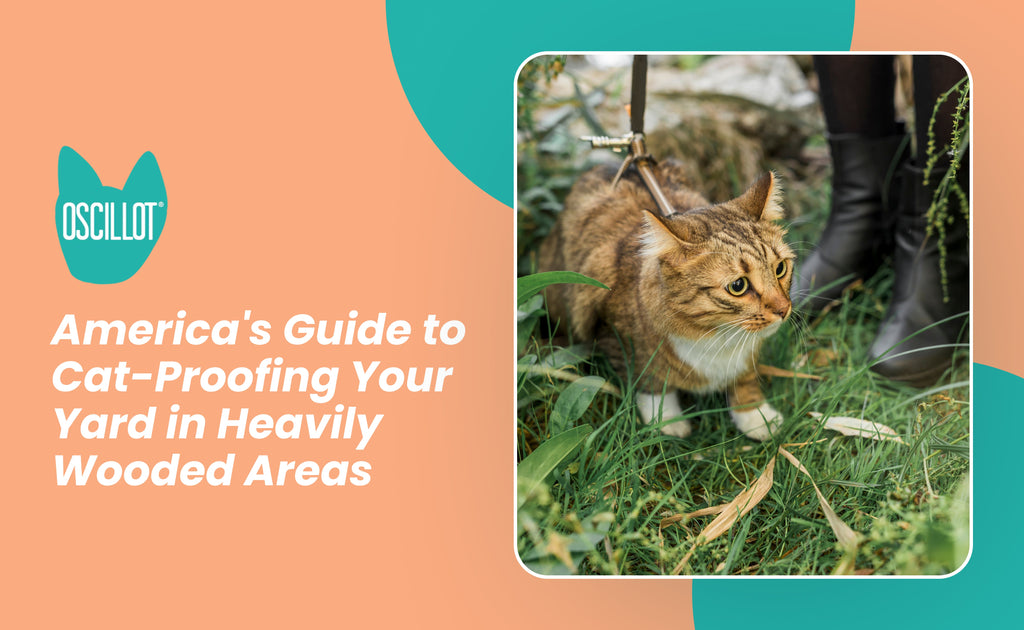
Over 45 million American households own cats — and millions of those homes are surrounded by heavily wooded terrain, from the dense forests of the Pacific Northwest to the wooded suburbs of New England and the tree-filled neighborhoods of the Southeast. Wooded yards are a joy for cats and owners alike, but they present a specific and serious cat containment challenge that simpler suburban yards don’t.
The core problem: trees. A cat near a tree that overhangs or stands close to the fence line can use the tree as a launch point to bypass your fence entirely — climbing the tree, moving along a branch, and dropping down on the other side. Oscillot’s paddle system stops fence climbing perfectly, but the system must be combined with cat tree guards to address this specific escape route.
This guide from Oscillot covers the complete wooded-yard cat containment strategy: fence perimeter planning that accounts for tree positions, how to assess which trees are close enough to pose an escape risk, the tree guard system for blocking trunk access, and how to manage large trees within the contained zone safely. It also addresses the heightened wildlife encounter risk in wooded areas — in heavily wooded American neighborhoods, coyote, raptor, and even black bear encounters are real possibilities that make containment a genuine life-safety priority.
Regional considerations cover the Pacific Northwest, New England, Mid-Atlantic wooded suburbs, the Ozarks, and other heavily forested zones. Kit selection guidance for typical wooded property perimeter sizes completes the picture.
Read the full article: America’s Guide to Cat-Proofing Your Yard in Heavily Wooded Areas