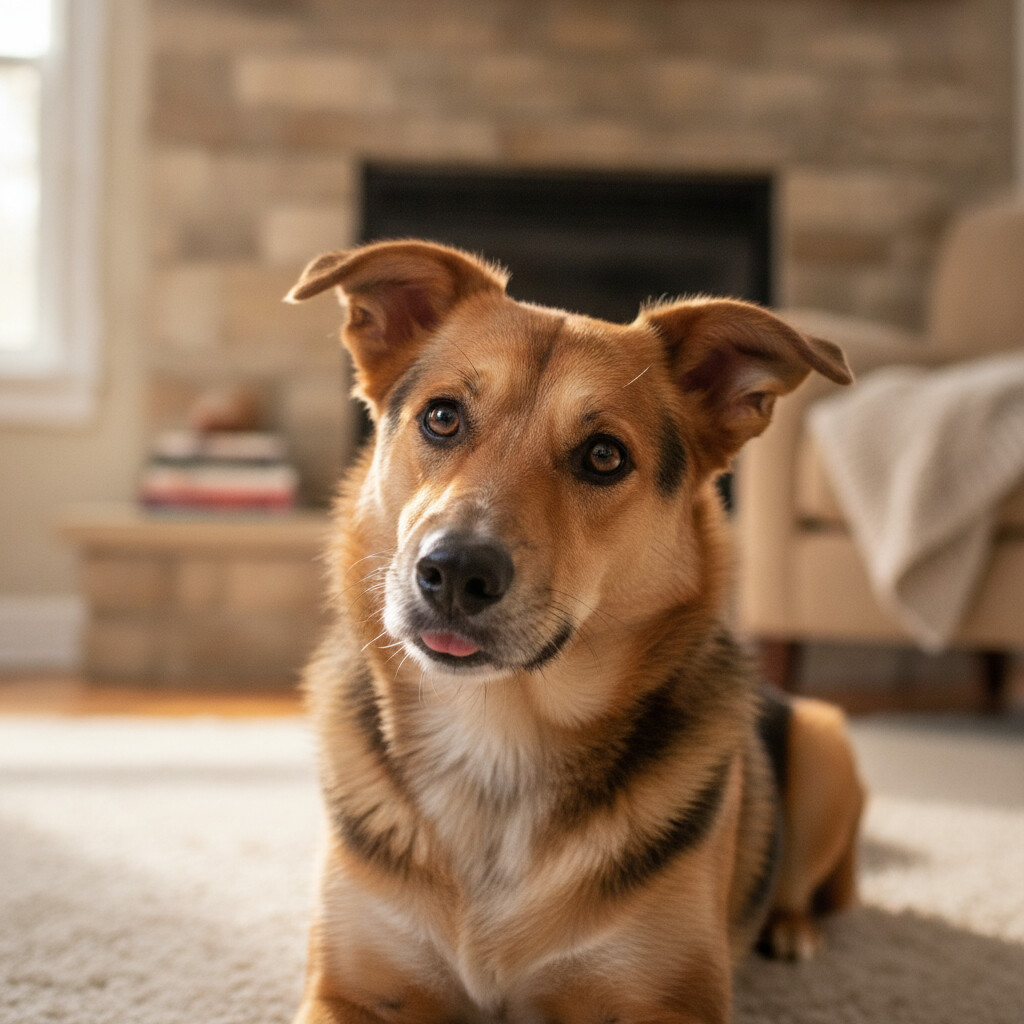
Your dog tilts their head because it helps them hear and see you better — it’s a hearing-and-attention behavior, not evidence of deep comprehension, however much it looks that way. Most of the time it’s completely normal and even a good sign: it means your dog is engaged and trying to make sense of what you’re saying. But head tilting that’s new, one-sided, or paired with stumbling is a different story, and worth paying attention to.
The Hearing and Sound-Location Theory
Dogs’ ears are remarkably good at localizing sound — better than ours, and far better than most people realize. Part of how they do it is by moving their ears and head to adjust the angle sound waves hit each ear canal, which helps the brain triangulate exactly where a noise is coming from and, to some extent, what it means. A head tilt shifts the position of the pinna (the outer ear) relative to the sound source, and some researchers believe it also gets a dog’s muzzle out of the way, widening their field of view so they can watch your mouth and face for additional cues while listening.
This is closely tied to how dogs process human speech generally. Veterinary behaviorists have long noted that dogs pay attention to tone, pitch, and specific word sounds far more than sentence structure — and a head tilt often shows up most reliably when you use a higher-pitched, question-like tone, or say a word your dog associates strongly with something (their name, “walk,” “treat”). The tilt isn’t really about the word’s meaning; it’s about the dog working to extract more acoustic information from a sound that just became interesting or unclear.
Breed and anatomy play a role too. Dogs with longer muzzles tend to tilt their heads more often than flat-faced breeds, likely because a longer snout more effectively blocks part of their visual field, so tilting gains them more of a clear sightline to your face. This lines up with the sound-and-sight theory better than any explanation involving comprehension.
Does It Mean They Understand You?
It’s tempting to read a head tilt as your dog “getting” what you said, and it’s not entirely wrong — dogs do learn to associate specific sounds and words with outcomes, sometimes an impressively large vocabulary of them. But the tilt itself is a mechanical response to processing an ambiguous or attention-grabbing sound, not proof of language comprehension in the way we experience it. A dog can tilt their head at a squeaky door hinge, a phone notification, or a word they’ve never heard before — none of which they “understand” in any meaningful sense. It’s curiosity and active listening, which is exactly what makes it endearing, even without the sentimental gloss.
When Head Tilting Becomes a Red Flag
A quick, situational head tilt in response to your voice or a sound is normal dog behavior and nothing to worry about. A persistent head tilt — one that doesn’t go away, sits at an unusual constant angle, or appears out of nowhere without an obvious sound trigger — is a different problem entirely, and it points toward the vestibular system (the balance system centered in the inner ear and brainstem) rather than hearing.
Watch for these alongside a head tilt:
- The tilt stays constant, rather than a brief tilt-and-release
- Stumbling, circling, or a loss of balance
- Rapid, flicking eye movements (nystagmus)
- Head shaking, pawing at one ear, or visible ear discharge and odor
- Reluctance to eat, or vomiting
These can point to an inner or middle ear infection, idiopathic vestibular disease (sometimes called “old dog vestibular syndrome,” which is more common in older dogs and often resolves on its own but still needs veterinary evaluation to rule out other causes), or in rarer cases, a brainstem or neurological issue. Ear infections are especially common triggers and are very treatable when caught early — left alone, they can progress to affect balance and, occasionally, hearing.
When to see a vet: any head tilt that’s constant rather than momentary, appears suddenly, or comes with stumbling, circling, unusual eye movement, ear odor, pain when you touch the ear, or a change in appetite needs a veterinary exam. Don’t wait this one out — vestibular and ear problems are far easier to treat early, and what looks like “just balance issues” in an older dog is worth ruling out for anything more serious.
How to Respond When Your Dog Tilts Their Head
For the normal, brief kind of head tilt, there’s honestly not much to “do” — it’s not a behavior that needs correcting or encouraging, and trying to trigger it on cue for entertainment is harmless but won’t teach your dog anything new. If you want to keep your dog engaged and responsive to your voice generally, consistent, distinct words for specific things (rather than long sentences) makes it easier for them to pick out and respond to the sounds that matter, which is part of why short cues work better in training than a running commentary.
If you’re seeing anything from the red-flag list, the only real move is a vet visit rather than home monitoring — ear and vestibular issues rarely resolve faster by waiting, and catching an infection before it’s chronic makes treatment considerably simpler. Bring a note of when the tilt started and whether it’s constant or comes and goes; that timeline is often the most useful piece of information for your vet in narrowing down the cause. For more on reading what your dog’s body is telling you more broadly, see our complete guide to dog body language, and if the staring-and-tilting combination sounds familiar, why dogs stare at their owners covers the related behavior in more depth.