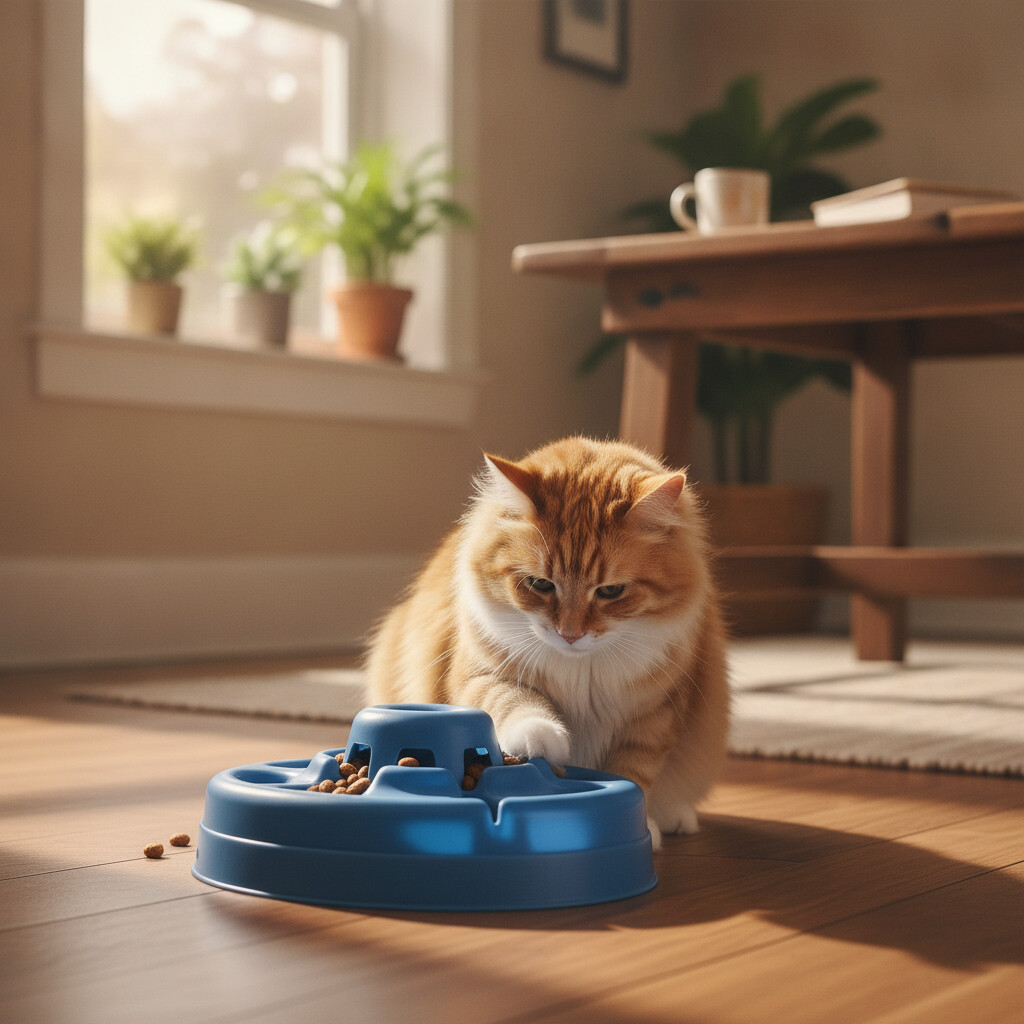
Most cats who eat too fast are doing it for one of three reasons: competition (real or perceived), long gaps between meals, or a medical problem that makes them genuinely hungrier. The first two are fixed by changing how you feed. The third needs a vet. Here’s how to tell which one you’re dealing with, and what actually slows a speed-eater down.
Why Do Cats Eat So Fast?
Cats are built to eat small and often. Classic feeding studies on cats with free access to food (Kane, Rogers and Morris, Nutrition Research, 1981) found they chose to eat many small meals spread across the day and night — roughly the size of a mouse each time. Most pet cats get the opposite: two big bowls, morning and evening. That gap alone can turn a cat into a gulper.
The common non-medical causes:
- Long gaps between meals. A cat who’s been waiting 10–12 hours since breakfast arrives at the bowl very motivated.
- Competition with other pets. In multi-cat homes, a cat doesn’t need to be chased off the bowl to feel rushed. Just having another cat nearby at mealtime can be enough. It’s subtle — you’ll often see one cat eat fast and then hover near the other cat’s bowl.
- A history of scarcity. Cats who were strays, came from hoarding situations, or went hungry as kittens often keep a “eat it before it’s gone” habit for years. Vets and shelter staff see this pattern all the time. It’s hard to study formally, so treat it as a likely factor rather than a proven one.
- Highly palatable food. Some wet foods and many treats are simply very tasty. A cat who eats dry food at a normal pace may wolf down a pouch of something richer.
- Boredom. An indoor cat with little to do may treat meals as the main event of the day.
Is It a Problem if My Cat Eats Too Fast?
Sometimes. The most common consequence is what owners call “scarf and barf”: the cat eats quickly, then brings the food back up a few minutes later, looking almost exactly as it did in the bowl.
That’s usually regurgitation, not true vomiting. Regurgitation is passive — no heaving, no retching — and the cat often walks off unbothered. Vomiting involves visible abdominal effort and partly digested food. The difference matters to your vet, and our guide to why cats vomit and when to worry covers it in more detail.
Beyond the mess, fast eating can:
- Contribute to weight gain, because the “I’m full” signal lags behind a fast meal
- Lead to food stealing and tension in multi-cat homes
- Make a cat seem permanently hungry, which can look like begging for food right after eating
When Fast Eating Is a Medical Sign
A cat who has always eaten fast is usually a behavior case. A cat whose appetite has changed is a different story. Increased appetite (polyphagia, in vet terms) is a recognized sign of several conditions:
- Hyperthyroidism — very common in cats over about 10. The classic picture is a cat who eats ravenously but loses weight, often with more thirst, more vocalizing, or restlessness. See our hyperthyroidism guide.
- Diabetes mellitus — increased hunger and thirst, more urine in the litter box, and sometimes weight loss.
- Intestinal parasites or poor absorption — conditions such as inflammatory bowel disease can leave a cat hungry because nutrients aren’t being absorbed properly.
- Some medications — steroids such as prednisolone commonly increase appetite.
If fast eating comes with weight loss, more drinking or peeing, diarrhea, or vomiting more than about once a week, don’t assume it’s a habit. Get it checked.
How to Slow Down a Cat Who Eats Too Fast
The good news: once medical causes are ruled out, the fixes are cheap and mostly work quickly.
1. Feed smaller meals, more often
This tackles the root problem. Splitting the same daily amount into three or four meals (or more) shrinks the hunger gap. If you work long hours, a timed automatic feeder can serve a midday meal. The AAFP/ISFM consensus statement on feeding cats (Sadek et al., Journal of Feline Medicine and Surgery, 2018) specifically recommends multiple small meals as closer to how cats naturally eat. Our piece on free-feeding vs. scheduled meals walks through how to set this up without overfeeding.
2. Use a puzzle feeder or slow-feed bowl
Puzzle feeders force a cat to work for each bite. A 2016 review in the Journal of Feline Medicine and Surgery (Dantas et al.) found food puzzles linked with weight loss, less food-related attention-seeking, and lower stress in many cats. Start easy — a ball that drops kibble when rolled, or a flat mat with shallow wells — and increase the difficulty once your cat gets it. For wet food, a lick mat or a ridged slow-feed plate works better than a ball.
A homemade option works too: a DIY snuffle mat or an egg carton with kibble in each cup.
3. Spread the food out
The simplest trick of all: put the food on a large flat plate or baking tray instead of a deep bowl. Spreading wet food thinly, or scattering kibble, means the cat can only take a few bites at a time.
4. Separate cats at mealtime
If you have more than one cat, feed them in different rooms or at least out of each other’s line of sight. Close the door for 20–30 minutes, then pick up anything left. This removes the competition and also tells you exactly how much each cat is eating. Microchip-activated feeders are another option if one cat raids the other’s diet.
5. Don’t punish or rush it
Shooing a cat away from the bowl, or hovering over them, tends to make them eat faster next time. Calm, predictable mealtimes help.
Will My Cat Grow Out of It?
Kittens usually settle as they mature and learn food is reliable. Former strays often improve over months once meals become predictable, though some keep the habit for life — in which case you manage it with the feeding setup rather than expecting the cat to change. A cat who suddenly starts eating fast in later life should be seen by a vet rather than waited out.
When to See a Vet
Book a vet visit if your cat:
- Has started eating faster or seems hungrier than usual, especially if they’re over 8–10 years old
- Is losing weight despite eating well
- Is drinking or peeing noticeably more
- Regurgitates or vomits more than about once a week, or brings up food even after you’ve slowed meals down
- Has diarrhea, a dull coat, or seems lethargic
- Coughs, gags, or struggles to swallow
Go the same day if your cat is vomiting repeatedly, can’t keep water down, or seems weak or in pain.
The Bottom Line
Fast eating is usually a feeding-setup problem, not a cat problem. Smaller, more frequent meals and a puzzle feeder solve most cases within a couple of weeks. The exception is a cat whose appetite has changed: increased hunger in an adult or senior cat is worth a vet check and some blood tests, because hyperthyroidism and diabetes are common and very treatable when caught early.