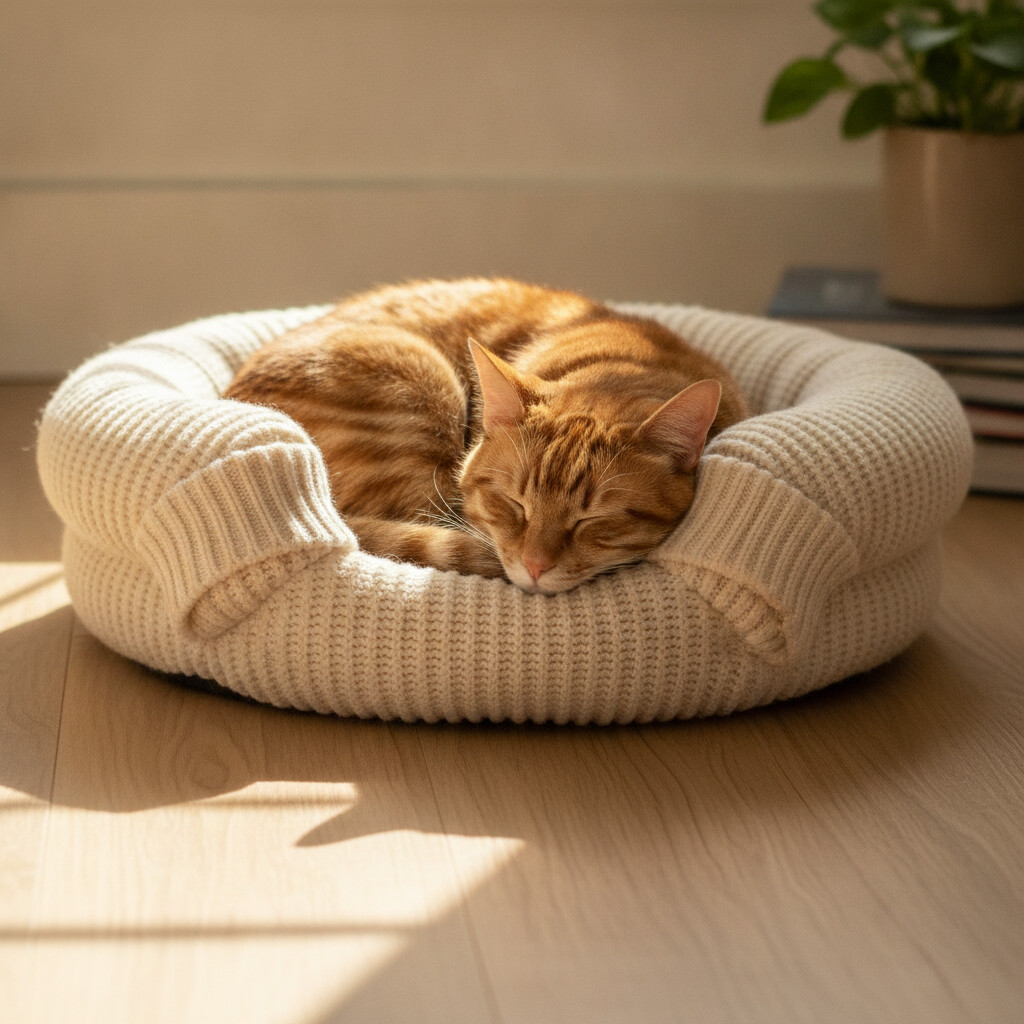
An old sweater, a cushion and about 20 minutes are all you need to make a warm, enclosed cat bed with no sewing at all. The finished bed is snug and soft, and it smells like you, which is often the reason a cat picks it over the bed you paid for.
Below: why cats take to these, the step-by-step build, and the safety checks that matter more than how neat it looks.
Why do cats like sweater beds so much?
Three reasons, and the research backs all of them.
Warmth. Cats like it warmer than we do. The thermoneutral zone for cats, the temperature range where they don’t have to spend energy keeping warm, is generally estimated at roughly 86–100°F (30–38°C), well above most living rooms. Knitted wool or acrylic traps body heat, and raised sides cut draughts. That’s why your cat rotates between the radiator, the laundry basket and the patch of sun on the floor.
Enclosure. Cats feel safer in spaces where their back and sides are covered. In a 2014 study in Applied Animal Behaviour Science, Vinke and colleagues found that newly arrived shelter cats given a hiding box had lower stress scores and settled faster than cats without one. A bed with sides gives a similar sense of cover in a lighter, more open form.
Your scent. Cats use smell to work out what’s familiar and safe. A sweater you’ve worn carries your scent, so the bed already feels like home before your cat has set foot in it.
What you’ll need
- One old sweater or sweatshirt, ideally crew neck, adult size. Chunky knits and fleece both work.
- A square cushion or pillow that fits snugly inside the body of the sweater (around 16–18 inches is right for most cats)
- Extra stuffing for the sleeves: another old T-shirt, a small towel, or polyester fibrefill
- 6–8 large safety pins, or fabric glue if you’d rather have nothing sharp anywhere near the bed
- Optional: a piece of cardboard or a thin foam mat for a firmer base
Avoid sweaters with sequins, beads, toggles, pompoms or anything else a cat could chew off. Don’t use one with lots of loose, snagged yarn either (more on why below).
How to make a no-sew sweater cat bed, step by step
1. Wash and check the sweater. Wash it in an unscented detergent. (If you want your scent on it, wear it for an evening after washing.) Turn it inside out and trim any long loose threads.
2. Close the neck hole. Lay the sweater flat, front side up. Fold the neckline down inside the body, or pull the two sides of the neck together and close them with two safety pins on the inside of the fabric. You want a closed top edge so the stuffing can’t escape.
3. Put the cushion in. Slide the cushion up inside the body of the sweater so it fills the chest area. It becomes the floor of the bed. If the bottom hem hangs below the cushion, tuck it under and pin it closed, or fold it in on itself.
4. Stuff the sleeves. Roll your spare T-shirt or towel into a long sausage and push it into one sleeve, or fill the sleeve evenly with fibrefill. Pack them firmly. Floppy sleeves collapse and lose the “walls” effect. Do both sleeves.
5. Build the walls. Bring both stuffed sleeves around the front of the cushion so they make a U-shape. Overlap the cuffs at the front, then pin them to each other and to the sweater body. Pin from the inside so the points face away from where your cat will lie, and close every pin fully.
6. Shape it and test it. Push the sleeves inward to form a rim. Press down in the middle with your hand to check that no pin can be felt through the fabric. If you can feel one, move it.
That’s it. You’ve got a round, walled bed with a soft floor.
No-pin version: Swap the safety pins for a line of fabric glue at each join and leave the bed to dry for 24 hours before your cat uses it. Or skip fixings altogether: tie the cuffs together in a tight knot and tuck the knot under the bed.
Is a homemade cat bed safe?
Mostly yes, as long as you check for the few things that can actually hurt a cat.
Loose yarn and threads. This is the big one. A long strand of string, yarn or thread that a cat swallows can cause a linear foreign body, where the strand anchors in the gut and the intestine bunches up along it. It’s one of the more serious foreign-body problems vets see in cats and often needs surgery. Trim loose ends before your cat gets the bed, and check the bed every week or so. If a knit starts unravelling, retire it. Our hair tie blockage story shows how quickly a small swallowed object can turn into an emergency.
Chewers. If your cat chews or sucks on fabric (wool-sucking is common in some breeds, particularly Siamese and Burmese), a knitted bed may not be a good idea at all. Fleece without loose fibres, or a bed with no soft stuffing, is safer. Our article on why cats eat plastic and fabric covers the causes of pica and when it needs a vet.
Stuffing. Fibrefill should stay fully enclosed. If a sleeve tears and stuffing starts coming out, repair or replace the bed.
Pins. Use proper locking safety pins, not straight pins. Count them going in, and check them when you wash the bed.
Heat. Don’t put a heating pad or hot-water bottle inside a homemade bed unless it’s a product designed for pets and you follow its instructions. If you’re thinking about adding warmth, read our guide to heated cat beds first.
How to get your cat to actually use it
Cats are famously ungrateful about new beds, so give it a fair trial before giving up.
- Put it where they already nap. Cats choose spots for warmth, height and a view. If your cat sleeps on the back of the couch, the bed goes there, not in a quiet corner they never visit.
- Try a sunny spot or a warm room. A bed near (not touching) a heater vent or in the afternoon sun has a head start.
- Add a familiar smell. Rub a cloth over your cat’s cheeks and wipe it on the bed, or put a used T-shirt in the middle.
- Use a treat or catnip. A few treats in the bed, or a sprinkle of catnip if your cat responds to it, can tempt a first visit. Our guide to catnip, silvervine and valerian explains which works for which cats.
- Don’t force it. Placing a cat in a new bed and holding them there tends to put them off it. Let them find it.
Give it a week. Plenty of cats ignore a new bed for days and then move in permanently.
Washing and replacing it
Unpin the bed, take out the cushion, and wash the sweater and sleeve stuffing on a gentle cycle with an unscented detergent. Wash it every couple of weeks, or straight away if there’s been a hairball or an accident. Before you put it back together, check again for loose threads, holes and stretched-out knit. Most sweater beds last a season or two before the knit gets too tired to be safe.
If you enjoyed this one, our cheap DIY enrichment ideas and DIY cat tunnels and hideaways use the same sort of things you already have at home.
Has your cat ever picked a sweater, a laundry basket or a box over a proper bed?