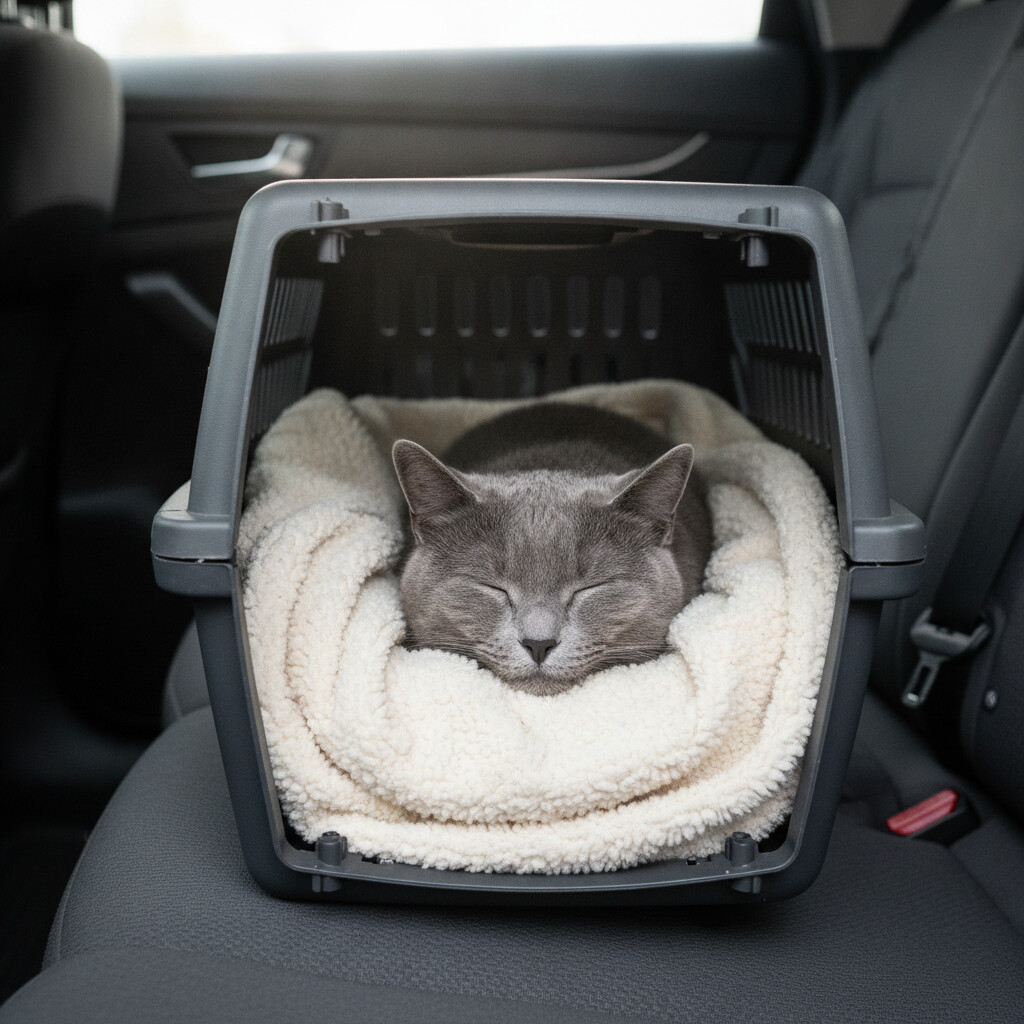
Cats get carsick and panic in cars for different reasons, and the fix depends on which one you’re dealing with. Drooling, yowling, and vomiting can come from motion sickness, fear, or both. Most cats improve with a secure carrier, a calmer drive, and gradual practice. If yours doesn’t, your vet has good options.
Is it motion sickness or fear?
The two overlap a lot, which is why many owners can’t tell them apart.
Motion sickness signs: drooling, lip-licking, repeated swallowing, vomiting, sometimes diarrhea. These usually start within a few minutes of the car moving and ease once it stops.
Fear and stress signs: loud, continuous yowling, panting, flattened ears, dilated pupils, trying to claw out of the carrier, or going silent and frozen. Cats can also urinate or defecate from fear.
Both can happen at once. Anxiety makes nausea worse, and nausea makes the car feel worse next time. Veterinary behaviorists often describe this as a learned association: the carrier means the car, the car means the vet, and the whole chain becomes a bad sign. If your cat reacts to the carrier before the car even starts, fear is a big part of the story. Our guide to signs your cat is stressed is a useful reference for reading the early cues.
Start with the carrier
The carrier does more work than anything else. A cat who feels secure is less likely to feel sick.
- Pick a hard-sided carrier with a top opening if you can. It’s easier to lift a cat in without a struggle. Our review of carriers that actually work for vet visits and travel covers the options.
- Leave it out at home. A carrier that lives in the living room with a blanket inside becomes furniture instead of a threat. Put treats or meals inside.
- Cover it with a light towel during the ride. Many cats settle when they can’t watch the world move past.
- Line it with something that smells like home, such as a T-shirt you’ve worn or a blanket from their bed. Absorbent bedding also helps if they vomit.
- Secure it. A carrier on the back seat floor or buckled into the seat with a seatbelt won’t slide around, and sliding makes motion sickness worse. Per general road-safety guidance, never leave a carrier loose or put it in the front seat near an airbag.
Make the drive itself easier
Small things matter more than people expect.
- Skip the big meal. Many vets suggest withholding food for a few hours before a drive (check with your own vet first, especially for kittens, seniors, or diabetic cats).
- Drive smoothly. Gentle turns, gradual braking, no sudden acceleration.
- Keep the car cool and ventilated. Heat makes nausea and panic worse. Never leave a cat in a parked car, even briefly.
- Keep it quiet. Low music or none. Talking in a calm voice is fine; loud noise isn’t.
- Try a pheromone product. Feliway-type sprays (a synthetic copy of a feline facial pheromone) have mixed evidence. Some studies show reduced stress in carriers and clinics, while others find little effect. They’re safe to try and cheap. Our look at whether calming products actually work goes through the evidence.
Train your cat to tolerate the car
If your cat travels more than once or twice a year, gradual desensitization is worth the effort. The principle is simple: expose them to a tiny, non-scary version of the trigger, reward them, and increase slowly.
- Carrier first. Feed meals in or beside the carrier for a week or two until your cat walks in on their own.
- Close the door for a few seconds, then a minute, then longer, with treats.
- Carry the carrier around the house, then out to the car and back, with no driving.
- Sit in the parked car with the engine off, then with the engine on.
- Drive to the end of the driveway and back. Then around the block. Then a short trip somewhere pleasant, not always the vet.
Go at your cat’s pace. If they vomit, yowl, or freeze, you’ve moved too fast, so step back one stage. The goal is to break the “car equals vet” association. This is the same approach the AAFP and ISFM recommend in their cat-friendly handling guidelines.
When medication helps
If training and a calm setup aren’t enough, talk to your vet. Two broad categories of drugs are used:
- Anti-nausea medication. Maropitant (Cerenia) is licensed in the US for motion sickness in dogs and is sometimes used in cats at your vet’s direction. It can help cats whose main problem is vomiting.
- Anti-anxiety medication. For cats whose main problem is fear, vets sometimes prescribe gabapentin or other drugs given before the trip. Gabapentin is widely used for this purpose, though it’s off-label.
Do not give your cat over-the-counter human motion sickness or sedative medication without veterinary advice. Some are dangerous to cats, and doses are not interchangeable. “Natural” calming supplements are a different question; the evidence for most is thin.
When to see a vet
Book an appointment if:
- Your cat vomits on every trip, even short ones, despite a good setup
- They show extreme distress such as open-mouth breathing, collapse, or self-injury in the carrier
- They’ve started drooling, hiding, or refusing to eat in situations that never bothered them before, since a health problem might be causing the change
- You’re planning a long trip, a flight (see flying with a cat), or a move (see moving house with a cat) and your cat is a poor traveler
Open-mouth breathing in a cat is never normal. If it happens in the car, pull over somewhere safe, give them air and quiet, and head to the nearest emergency vet.
The takeaway
Treat the carrier like a safe place, keep the drive smooth and cool, and practice short, pleasant trips before the stressful ones. Most cats get noticeably better with that alone. If yours doesn’t, it’s not a failure of training: ask your vet about medication so the next trip is less miserable for both of you.