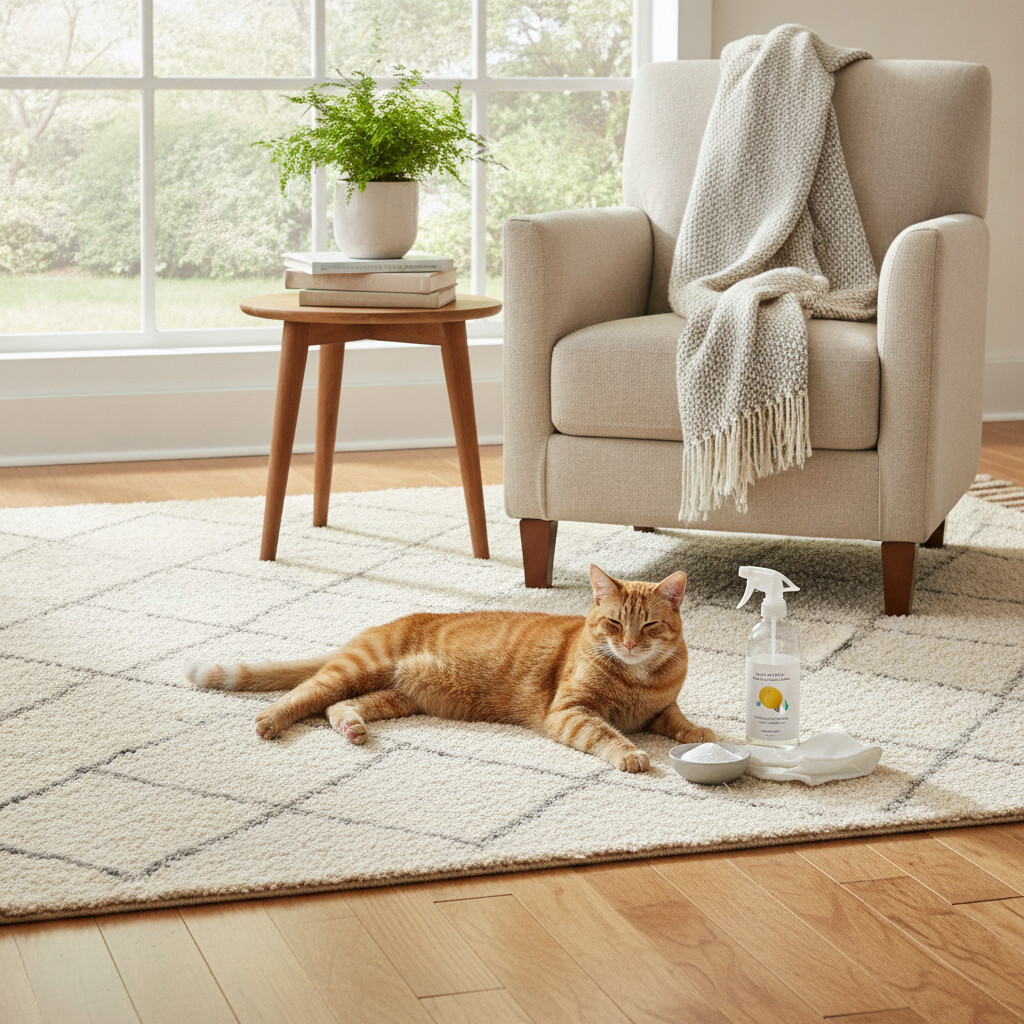
To get cat pee smell out for good, you need an enzymatic cleaner, plenty of dwell time, and patience — not more air freshener. Regular soap and most household sprays hide the smell for a day; enzymes actually break down what’s causing it. Here’s how to do it on carpet, upholstery, mattresses, and hard floors, and how to stop it happening again.
Why Cat Urine Smell Is So Hard to Get Rid Of
Cat urine is unusually concentrated. Cats evolved as desert animals and their kidneys are very good at conserving water, so what comes out is dense with urea, uric acid, and other compounds. As bacteria break the urea down, it releases ammonia — that sharp first-day smell. Later, sulphur-containing compounds (including felinine, which is particularly high in the urine of intact males) give old cat pee its distinctive musty stink.
The stubborn part is uric acid. It forms crystals that don’t dissolve well in water, so ordinary cleaning leaves them behind. When the room gets humid, those crystals can rehydrate and the smell comes back — which is why a spot you “cleaned” months ago can reek again on a muggy day.
That’s also why the smell matters beyond your nose. The AAFP/ISFM guidelines on house-soiling (Journal of Feline Medicine and Surgery, 2014) note that cats are drawn back to spots that smell of urine. If your cat can still smell it — and their nose is far better than yours — you’ve effectively marked that spot as a toilet.
Step by Step: Cleaning a Fresh Accident
The faster you get to it, the less soaks in.
- Blot, don’t rub. Press paper towels or an old towel firmly into the spot, swapping for dry ones until almost nothing comes up. Standing on the towel helps on carpet. Rubbing pushes urine sideways and deeper.
- Rinse lightly with cool water. Pour a small amount of cool water on the area and blot again. Avoid hot water and steam cleaners at this stage — heat can bond the proteins in urine to fibres and set the smell.
- Apply an enzymatic cleaner generously. Look for a product labelled “enzymatic” or “bio-enzymatic” that specifically mentions pet urine. Use enough to reach as deep as the urine went — for carpet, that usually means the pad underneath, not just the surface. A light mist won’t do it.
- Leave it alone. Enzymes need time and moisture to work. Follow the label, but most need at least 10–15 minutes and many work best if you cover the spot loosely with plastic wrap or a damp towel and leave it for several hours.
- Let it air-dry completely. Blot off the excess and let it dry naturally, which can take a day or two. Keep the cat off it — an upturned laundry basket over the spot works.
- Repeat if needed. If you can still smell it once dry, do a second round. Older or heavier accidents often need two or three.
What NOT to Use
A few common cleaning instincts make the problem worse:
- Ammonia-based cleaners. Ammonia is one of the compounds in urine. To a cat, a spot cleaned with ammonia can smell like someone else peed there — an invitation to go again. The AAFP/ISFM guidelines specifically advise against ammonia-based products.
- Bleach on urine. Mixing bleach with ammonia releases toxic chloramine gas, and urine contains ammonia compounds. Poison control centres warn against combining bleach with ammonia-containing substances, so skip bleach on urine spots entirely.
- Heavy fragrance. Air fresheners and scented sprays only mask the smell for you. Your cat can still smell the urine underneath — and strong perfumes may put some cats off the area for the wrong reasons.
- Steam cleaning first. Use steam or hot-water extraction only after the enzymes have done their job, if at all.
Vinegar-and-baking-soda is a popular home remedy. It can reduce surface odour and is unlikely to hurt anything, but it doesn’t break down uric acid crystals the way enzymes do, so on its own it often isn’t enough. Vinegar can also interfere with enzymes, so don’t mix the two — if you’ve already used vinegar, rinse with water and let it dry before applying an enzymatic product.
Carpet, Furniture, Mattresses, and Floors
Carpet. Urine almost always reaches the pad. Use enough cleaner to soak to the same depth — some people use a syringe or a needle-tip applicator bottle to inject cleaner into the pad. For an old, large, or repeatedly soiled patch, the honest answer is that sometimes the pad (or a section of carpet) needs replacing.
Upholstery and cushions. Remove cushion covers and machine-wash them on cold with an enzymatic laundry additive; air-dry rather than tumble-dry until you’re sure the smell is gone, as dryer heat can set it. For the foam inside, saturate with enzymatic cleaner and allow a long drying time — outdoors in the shade if possible.
Mattresses. Blot as much as you can, then apply enzymatic cleaner and let it dry fully before making the bed. A waterproof mattress protector afterwards saves a lot of grief if it happens again.
Hard floors. Sealed tile, vinyl, and laminate are easy — wipe, then enzymatic clean. Watch the grout and the gaps between boards, though: urine can seep in, and unsealed wood can absorb it. Badly soaked subfloor sometimes needs sealing with an odour-blocking primer.
Laundry. Wash on cold with your usual detergent plus an enzymatic additive, and check by smell before drying.
How to Find Old Spots You’ve Missed
If the room smells but you can’t find the source, a UV (black light) torch helps. Dried urine generally fluoresces under ultraviolet light, so turn the lights off and sweep the beam slowly across carpet edges, along walls, behind furniture, and on curtains. Mark each spot with tape and clean them all — missed spots keep drawing your cat back. (Other things glow too, from some detergents to old spills, so use your nose to confirm.)
Stopping It From Happening Again
Cleaning removes the evidence. It doesn’t tell you why your cat went outside the box, and without that, it tends to happen again.
The first job is working out whether it’s spraying (small amounts on vertical surfaces, usually territorial or stress-related) or urinating outside the box (larger puddles on flat surfaces). They have different causes and different fixes — our guide to spraying vs. inappropriate urination walks through how to tell them apart.
After that, the usual suspects are the box itself:
- Not enough boxes. The standard rule is one per cat, plus one extra, in different locations — see how many litter boxes you actually need.
- The wrong box or litter. Many cats dislike hoods, scented litter, or liners. Our piece on covered vs. open litter boxes covers what the research says cats prefer.
- Dirty boxes. Scoop at least once a day.
- Bad location. Next to a noisy washing machine, in a high-traffic hallway, or somewhere another cat can ambush them.
Once the spot is clean and dry, you can make it less appealing as a toilet by putting a food bowl, a bed, or a toy there for a few weeks — most cats don’t like to eliminate where they eat or sleep.
When to See a Vet
Before you assume it’s behavioural, rule out a medical cause. The AAFP/ISFM guidelines recommend a veterinary check as the first step for any house-soiling, because conditions like urinary tract inflammation, bladder stones, urinary tract infections, kidney disease, diabetes, and arthritis all commonly cause cats to pee outside the box.
Call your vet promptly if your cat:
- Is peeing outside the box suddenly when they never did before
- Strains, cries, or goes back to the box repeatedly passing little or nothing
- Has blood in their urine
- Is drinking or peeing noticeably more than usual
- Licks their genital area a lot
Treat it as an emergency if a cat — especially a male — is straining and producing no urine at all. A urinary blockage can become life-threatening within a day or two, and it needs a vet immediately, not tomorrow.
The Short Version
Blot, rinse with cool water, soak with an enzymatic cleaner, give it time, let it dry, and repeat if you can still smell it. Skip ammonia, bleach, and heat. Then work out why it happened — starting with a vet visit if anything about your cat’s peeing has changed.