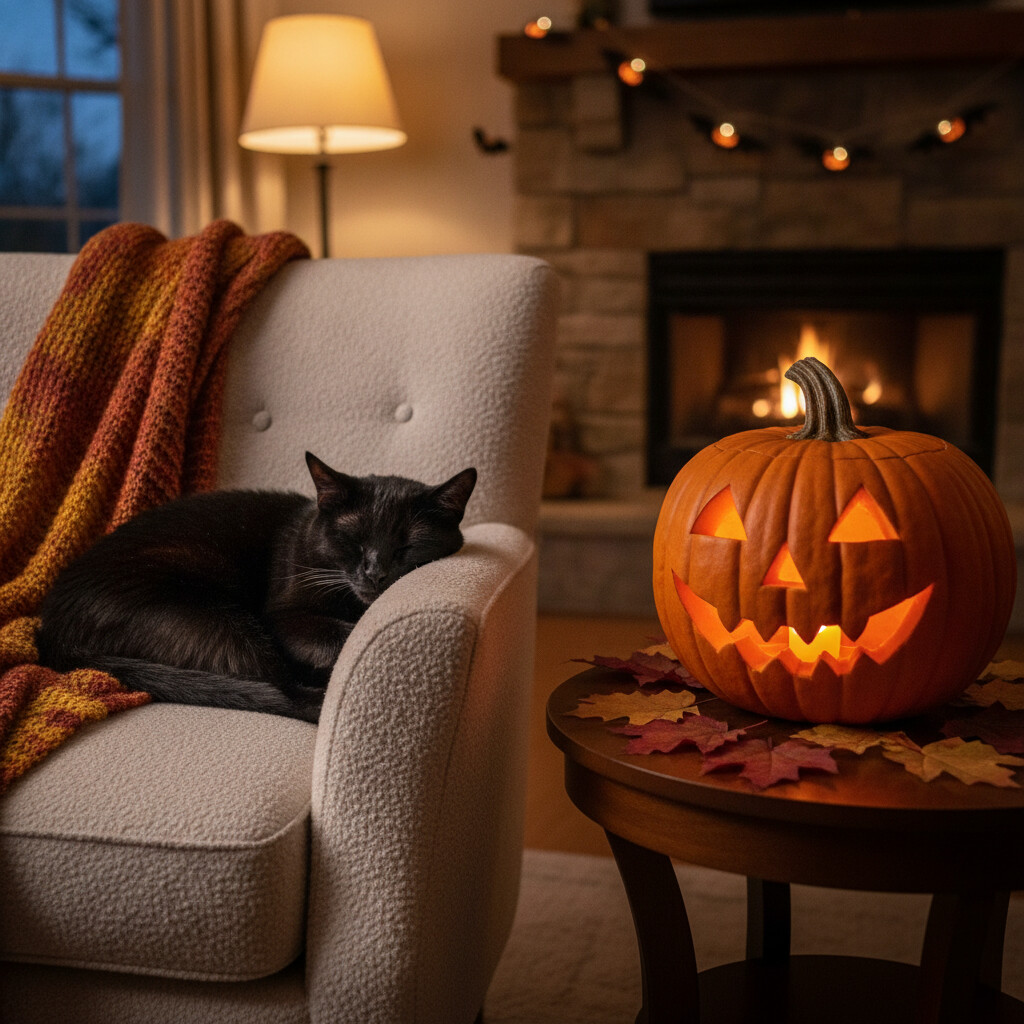
Halloween is riskier for cats than most owners realize. The main dangers aren’t spooky: they’re the front door opening a hundred times, candy wrappers on the floor, glow sticks and costumes. Fix those four and your cat will most likely sleep through the whole thing.
This guide covers what actually causes problems on October 31, what’s mostly hype, and what to do if something goes wrong.
The Biggest Risk: The Front Door
Most Halloween problems start with trick-or-treaters. A doorbell every few minutes, strangers in masks, kids shrieking, and the door opening again and again is about as stressful as an evening gets for a cat. A frightened cat does one of two things: hides, or bolts. If it bolts, the open door is right there.
Indoor cats that get out tend not to go far. They hide close to home and stay silent, which makes them hard to find in the dark. The simplest fix is to stop it happening in the first place:
- Shut your cat in a quiet room before trick-or-treating starts. A bedroom or office works. Give them a litter box, water, a bed and somewhere to hide. Close the door and put a sign on it so guests don’t let the cat out.
- Mask the noise. A fan, quiet music or a white-noise machine softens the doorbell. If your cat already struggles with loud noises, the tips in our guide to helping a cat scared of fireworks or thunder work here too.
- Or skip the doorbell entirely. Sitting outside with the candy bowl, or leaving it on the porch, means the door stays shut.
- Check their ID before the night. Make sure the collar fits, the tag is readable and the microchip is registered to your current phone number. Shelters say outdated chip details are one of the most common reasons found cats can’t be returned. Our microchipping guide explains how to check yours.
If your cat does get out, start searching right away and close to home. Our step-by-step guide on what to do if your cat gets out covers exactly how to look.
Is Halloween Candy Dangerous for Cats?
Some of it, yes. But the risk is different from dogs, and it helps to know why.
Chocolate contains theobromine and caffeine, both toxic to cats. The darker the chocolate, the more dangerous it is: baking chocolate and dark chocolate carry far more theobromine than milk chocolate. The good news is that cats rarely eat much of it. They lack a working sweet-taste receptor (Li et al., PLoS Genetics, 2005), so a chocolate bar doesn’t tempt them the way it tempts a Labrador. The bad news is that a cat is small, so even a little dark chocolate matters. Signs include vomiting, restlessness, a racing heart, tremors and, in severe cases, seizures.
Xylitol, a sweetener in sugar-free gum and some candies, is famously dangerous for dogs. The evidence for cats is much thinner. One small study (Jerzsele et al., Acta Veterinaria Hungarica, 2018) found cats didn’t show the dangerous insulin spike that dogs do. That’s reassuring, but it’s one study, and the ASPCA still lists xylitol as a pet toxin. Treat it as a “keep away” item, not a reason to panic.
Raisins, and the chocolate-covered kind, are known to cause kidney injury in dogs. Reports in cats are fewer and less well documented. The ASPCA advises keeping grapes and raisins away from cats as well, which is the sensible line.
Wrappers are often the bigger problem. Foil, cellophane and lollipop sticks don’t poison a cat, but they can get stuck in the gut. Cats that like to chew plastic or crinkly things are most at risk. Pick up candy bags at the end of the night. Don’t leave a bowl where a curious cat can bat wrappers off the table.
Glow Sticks, Candles, and Decorations
Glow sticks and glow jewelry are a Halloween classic for pet poison lines. The ASPCA Animal Poison Control Center has noted a spike in calls about cats chewing them every October. The liquid inside (usually dibutyl phthalate) has low toxicity but tastes extremely bitter. A cat that bites one will drool heavily, foam at the mouth, and may run around or act oddly. It looks alarming but is usually short-lived. Gently wipe any liquid off the fur so they don’t groom more of it off. A small amount of food or a lick of tuna water can help clear the taste. If symptoms continue or your cat seems unwell, call a poison line or your vet.
Candles in jack-o’-lanterns are a real fire and burn risk. Cats investigate them, and a swishing tail can catch the flame. Battery-powered LED candles look the same and remove the risk.
Fake cobwebs, string, and tinsel matter more than they look. Long, thin materials can cause a linear foreign body, where the string anchors in the gut and the intestines bunch up along it. This is a surgical emergency. If you see string hanging from your cat’s mouth or bottom, do not pull it. Go to a vet. Hang fake webs where your cat can’t reach them, or skip them. Our Holiday Hazards for Cats guide covers more decoration risks for the rest of the season.
Pumpkins are fine. Plain, cooked pumpkin is safe for cats in small amounts. A carved jack-o’-lantern that has started to rot or go moldy should go in the compost, not near your cat.
Should You Put Your Cat in a Costume?
Honest answer: most cats don’t enjoy it. Cats depend on body language and freedom of movement to feel safe. A costume that covers their ears, tail or face, or that restricts how they move, can be stressful even if they’re sitting still. Freezing in place often means “I’m uncomfortable,” not “I’m fine with this.”
If you’d still like a photo:
- Choose something minimal. A bandana or a loose collar accessory is much easier on a cat than a full outfit.
- Watch for stress signals. Flattened ears, a twitching or thumping tail, dilated pupils, crouching, or trying to back out of the costume all mean it’s time to stop. Our cat body language guide explains how to read these.
- Keep it short and supervised. Take the photo, take it off. Never leave a costumed cat alone, as elastic and small parts can choke or tangle.
- Make sure they can breathe, see and hear. Nothing over the face, nothing tight around the neck.
If your cat clearly hates it, skip the costume. Nobody needs a cat in a pumpkin suit badly enough to make them miserable.
Black Cats and Halloween: Myth vs. Reality
You may have heard that shelters stop black cat adoptions around Halloween to protect them from cruelty. Some shelters did adopt that policy in the past. The ASPCA and other major welfare groups have since said there is little evidence that black cats adopted in October are at higher risk. Many shelters now run black cat adoption promotions instead, because black cats tend to wait longer for homes all year round. Our story about the black cat everyone passed over for eight months shows how that plays out.
What is worth taking seriously is that Halloween night has more people, more traffic and more chaos outdoors. If your cat normally goes outside, bringing them in before dusk on October 31 is a low-cost precaution, whatever color they are.
When to Call the Vet
Call your vet, an emergency clinic, or a pet poison line if your cat:
- Ate dark or baking chocolate, or an unknown amount of any chocolate
- Ate a candy wrapper, foil, lollipop stick, or string, especially if they then vomit, stop eating, or seem lethargic
- Has string or thread hanging from the mouth or bottom (don’t pull it)
- Is vomiting repeatedly, shaking, panting, or has a racing heart
- Has a burn from a candle, or singed fur and red skin
- Is still drooling heavily or acting strangely an hour after biting a glow stick
Keep these numbers handy (both may charge a consultation fee): ASPCA Animal Poison Control: (888) 426-4435, and Pet Poison Helpline: (855) 764-7661. If possible, have the packaging ready when you call. Knowing the product and the rough amount eaten makes their advice much more precise.
The Short Version
For most cats, Halloween goes fine with a little preparation. A closed door, candy and glow sticks out of reach, LED candles instead of real ones, and an up-to-date microchip cover nearly all the real risks. Do those, and the only thing your cat will notice about Halloween is that the doorbell was annoying for a few hours.