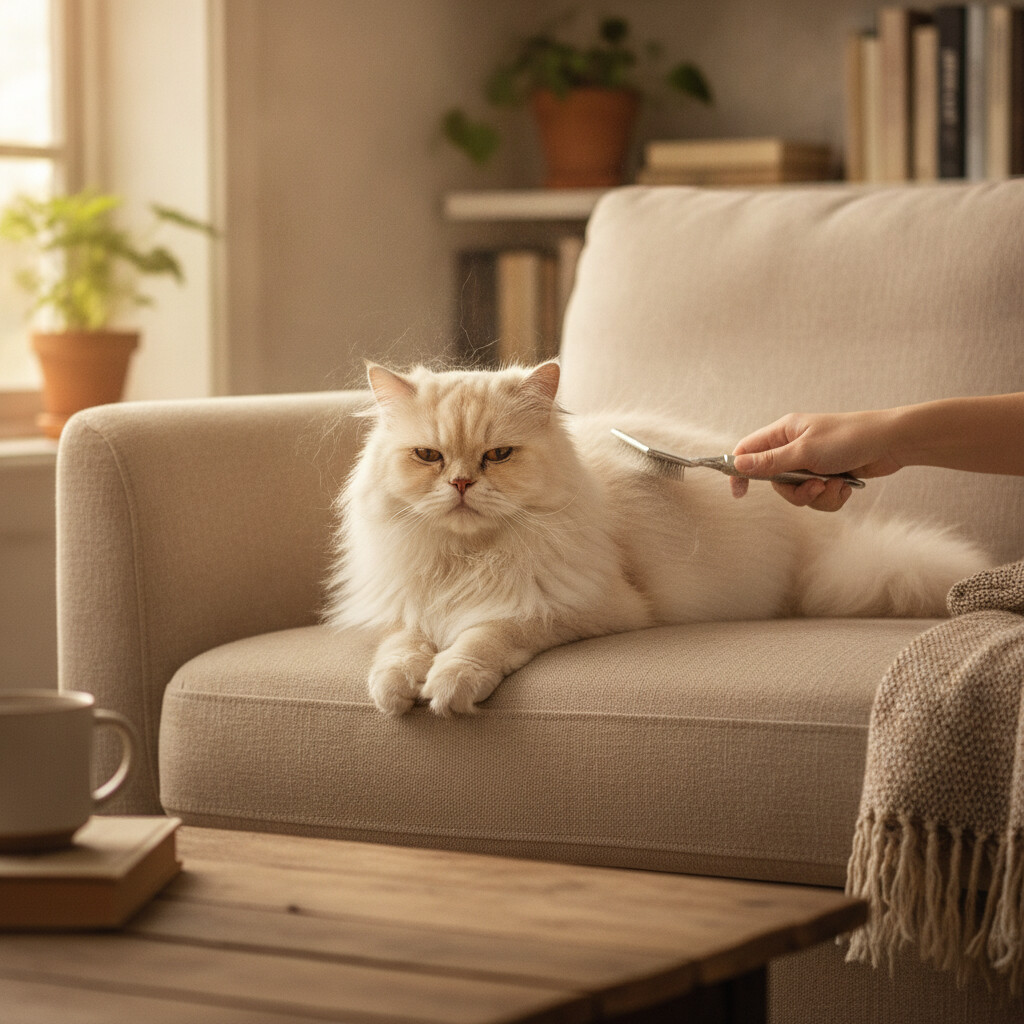
Occasional hairballs are common and usually harmless. A cat who brings one up every few weeks is typically fine. But frequent hairballs, repeated retching with nothing coming up, or a cat who stops eating are worth taking seriously. Here’s how to tell the difference.
What a hairball actually is
When a cat grooms, the tiny backward-facing barbs on their tongue (papillae) catch loose fur, which they swallow. Most hair passes through the digestive tract and ends up in the litter box. A hairball forms when hair accumulates in the stomach instead of moving along, and the cat eventually vomits it up.
The name is misleading. Hairballs are usually cylinder-shaped, because they take the shape of the esophagus on the way out. That’s normal.
How often is normal?
There’s no universal number. Many vets consider one every few weeks to a few months acceptable for a long-haired cat, and less often for a short-haired one. Some cats never produce one.
A better rule than a fixed number: a hairball should be an occasional event, and your cat should act completely normal before and after it.
Veterinary sources, including reviews in feline gastroenterology, note that frequent vomiting is not a normal part of being a cat, and that hairballs are sometimes blamed for vomiting that has another cause. If your cat is producing them weekly, that’s a reason to look further rather than accept it.
Why some cats get more hairballs
- Long or thick coats. More hair means more swallowed hair.
- Shedding seasons. Spring and autumn often bring more.
- Over-grooming. Stress, boredom, skin allergies, fleas or pain can drive a cat to groom excessively (see our guide to why your cat is losing hair).
- Slow gut movement. Digestive disease can let hair collect instead of passing through. Inflammatory conditions such as inflammatory bowel disease are one example vets consider.
- Age. Older cats often groom differently and may have slower digestion.
What helps
Brush more
This is the single most effective step because it removes hair before it’s swallowed. Brush short-haired cats a couple of times a week and long-haired cats daily if they tolerate it. Our cat grooming routine guide has tools and schedules.
Consider diet
Some veterinary diets are formulated for hairball control, generally with added fibre. Evidence for their effect is modest but positive in some studies, and they’re often worth a trial. Ask your vet before changing food, especially for cats with other health conditions.
Hairball gels and lubricants
Petroleum-based laxative gels are widely sold. They’re generally considered safe for short-term occasional use, but ask your vet about frequency, and never use them as a substitute for finding out why a cat is vomiting often. Don’t give oils or human laxatives without veterinary advice.
Keep them hydrated and moving
Water helps move things through. Wet food adds fluid, and play keeps the gut active. If your cat drinks little, our piece on why cats don’t drink enough water may help.
When it isn’t a hairball
Many cats are said to have “hairball problems” when something else is going on. Retching without producing anything can be a sign of an obstruction, asthma or heart disease. Feline asthma in particular can look like a cat trying to cough up a hairball; see our guide to feline asthma.
Frequent vomiting more generally is covered in why is my cat vomiting.
When to see a vet
Call your vet promptly if you see:
- Repeated retching or gagging with nothing coming up, especially for more than a day
- Vomiting that happens more than about once a week
- Loss of appetite, lethargy or hiding
- Straining in the litter box or constipation (see cat constipation)
- Abdominal swelling or obvious pain
- Coughing or laboured breathing
A cat that stops eating or can’t keep anything down needs urgent care. A blocked digestive tract can become an emergency, and cats that skip meals can develop serious liver problems. If in doubt, call.
The takeaway
An occasional hairball is normal. Brush regularly, keep water and play available, and treat a change in frequency as information. If your cat’s “hairballs” are frequent, or they seem unwell in between, ask your vet to look for the underlying cause rather than assuming it’s just fur.
A note on hairball remedies you may see online
Pumpkin, butter and olive oil turn up in home advice. Small amounts of plain pumpkin are unlikely to hurt some cats (see is pumpkin good for cats), but there’s little evidence they prevent hairballs, and butter or oil can cause stomach upset. Brushing remains the best-supported home measure.