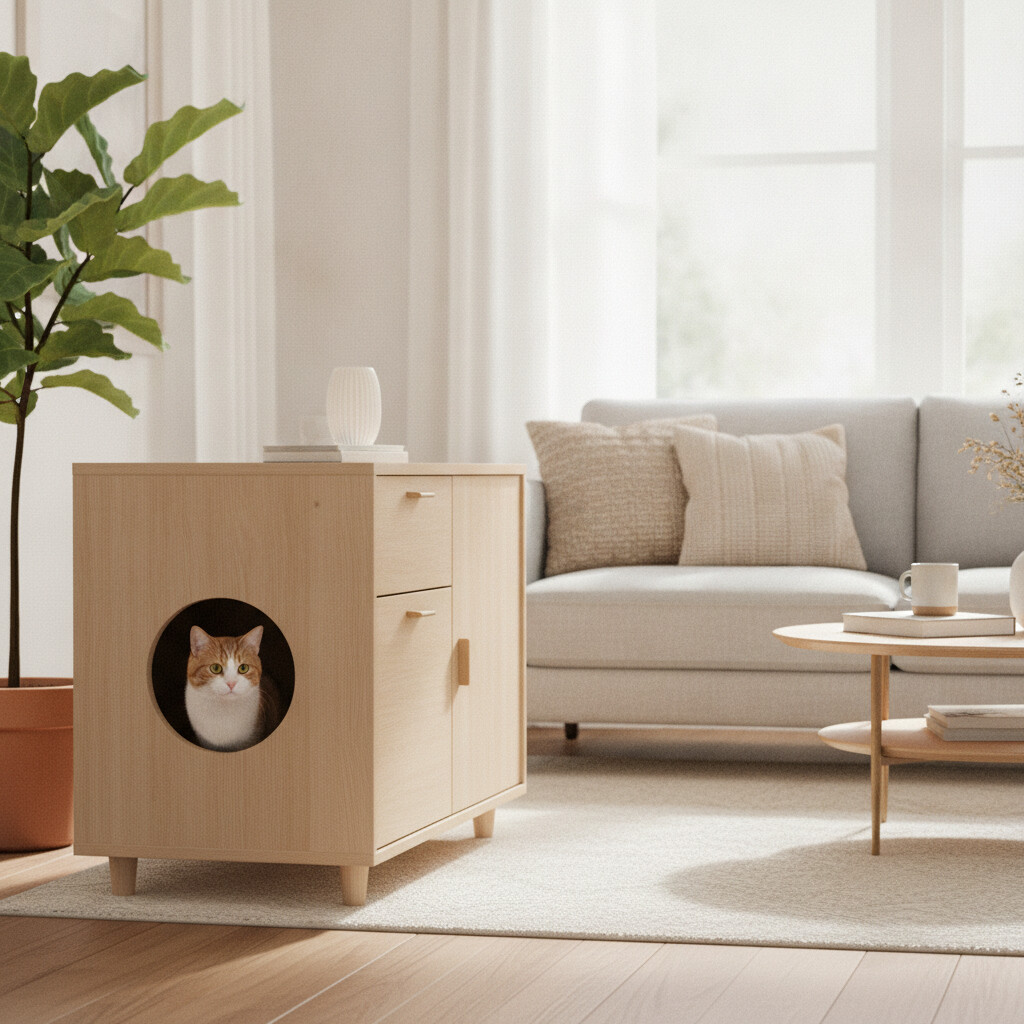
A DIY litter box enclosure hides the box, keeps litter off your floor and gives your cat a bit of privacy, and you can build a good one from a cheap cabinet or a few sheets of plywood in an afternoon. The catch: plenty of enclosures look great to people and terrible to cats. Size, airflow and a clear way in and out matter far more than the finish.
Here’s how to build one your cat will actually use.
Do cats like enclosed litter boxes?
It depends on the cat, and the research is mixed. A study by Grigg and colleagues (Journal of Feline Medicine and Surgery, 2013) found that, as a group, cats showed no strong preference between covered and uncovered boxes, but individual cats often had a clear preference one way or the other. The AAFP/ISFM guidelines on feline house-soiling (Carney et al., JFMS, 2014) list a box that’s too small, too dirty or in a stressful spot among the common reasons cats stop using it.
So an enclosure isn’t good or bad in itself. It’s a covered box with extra features, and it works when it keeps the things cats care about: space, cleanliness, smell, and an escape route. If you’re not sure where your cat stands, our comparison of covered vs. open litter boxes is worth a read before you start cutting.
Quick test: if your cat already uses a hooded box happily, an enclosure will almost certainly be fine. If they’ve only ever had an open tray, introduce the enclosure gradually (more on that below).
What a good litter box enclosure needs
Before you pick a design, check it against this list:
- Room for a big box. The house-soiling guidelines suggest a box at least 1.5 times the length of your cat from nose to base of tail. Many store-bought cabinets only fit a small tray. Measure the box first, then the cabinet. Leave at least 2 to 3 inches of clearance on each side and above the box rim so your cat can turn around and dig.
- Headroom. Your cat should be able to stand fully upright and squat without crouching. For most adult cats, that’s an interior height of 16 to 20 inches or more above the litter.
- Ventilation. An enclosed box traps odor. That’s great for your living room and less pleasant for the cat inside. Add vent holes or a gap at the back, and never seal the box in a tight cupboard.
- An entrance that doesn’t trap them. Cats like to see who’s coming. An opening on the side or front, ideally wide enough that they can see out while they’re in there, beats a narrow tunnel.
- Easy access for you. A hinged lid, a door at the back or a pull-out tray. If scooping is a hassle, you’ll scoop less, and dirty boxes are one of the top reasons cats go elsewhere.
- Cleanable surfaces. Urine soaks into raw wood and MDF. Seal the inside or line it.
Option 1: Convert a cabinet or side table (easiest)
This is the most popular DIY route and needs only a jigsaw and a drill.
You’ll need: a cabinet, sideboard or bench with doors (secondhand is fine), a jigsaw, a drill with a large hole-saw bit, sandpaper, a waterproof sealant or a removable plastic liner, and optionally a cat flap or a curtain.
Steps:
- Measure your litter box and your cat. Check the box fits inside with clearance on all sides, and that the interior height works.
- Remove any internal shelves that sit in the way.
- Mark the entrance on the side panel, not the front doors. Aim for an opening of about 7 to 9 inches wide and 8 to 10 inches high for an average adult cat, starting 3 to 4 inches above the floor so litter doesn’t spill straight out. Round the corners.
- Cut the opening with a jigsaw, then sand the edges smooth so there are no splinters.
- Add ventilation. Drill a row of 1- to 2-inch holes near the top of the back panel, or remove a section of the back entirely if the cabinet sits against a wall.
- Waterproof the inside. Seal the base and lower walls, or put a plastic boot tray or a thin sheet of acrylic under the litter box. If you paint or seal, use a water-based, low-VOC product and let it cure fully (check the label; often several days) with the doors open before your cat moves in.
- Place the litter box so the entrance lines up with the open side of the tray, and add a litter mat just outside the opening.
The front doors stay as your access point for scooping. Magnetic catches or soft-close hinges stop them banging, which matters more than people think. A loud bang is enough to put some cats off a box.
Option 2: Build a simple plywood box
If you can’t find a cabinet that’s big enough, a basic open-backed box is easy to build.
You’ll need: 1/2-inch plywood (or melamine board, which wipes clean), wood screws or pocket screws, wood glue, a jigsaw, a hinge set for the top, and sealant.
- Cut a base, two sides, a front and a hinged top, sized to your litter box plus clearance.
- Cut the entrance in one side panel, as above.
- Leave the back open or partly open if the unit will sit against a wall. This is the simplest way to guarantee airflow.
- Assemble with glue and screws, sand everything and seal the interior.
- Fit the top with hinges so you can lift it to scoop, and add a lid stay so it can’t fall on you or your cat.
Bonus: a solid, flat top gives your cat a lookout or a sunny perch, especially near a window. If you like that idea, our guide to DIY cat shelves pairs nicely with it.
Where to put the enclosure
Placement matters as much as the build. The AAFP/ISFM guidelines recommend litter boxes in quiet, easily reached spots, away from food and water and away from loud appliances. A few practical points:
- Avoid the laundry room if the washer or dryer kicks off while your cat is using the box.
- Don’t put it in a dead end where another cat or a dog can corner them on the way out.
- Keep it on the cat’s level of the house, especially for older cats with stiff joints.
- Don’t replace your only box with it in one go. If you have more than one cat, keep the right number of boxes; our article on how many litter boxes you actually need has the rule of thumb.
How to get your cat to use it
Most cats accept an enclosure in a few days if you don’t rush them:
- Put the enclosure next to the current box first, with the doors open or the top lifted, so it’s just a new piece of furniture.
- Move the old box inside, using the same litter they’re used to. Changing the box location and the litter at the same time is asking for trouble.
- Leave the doors or top open for a few days, then close them once your cat is going in and out happily.
- Add a flap last, if at all. Some cats hate pushing through a flap. A fabric curtain or simply an open hole is often better.
If your cat starts going elsewhere, go back a step. Peeing or pooping outside a box that used to be fine can also be a sign of a medical problem, such as a urinary issue or arthritis, so if it doesn’t settle quickly, talk to your vet. Our article on why senior cats have litter box accidents covers the common medical causes in older cats.
The bottom line
The best DIY litter box enclosure is roomy, ventilated, easy to clean and has an entrance your cat can see out of. Start with a cabinet if you want a quick weekend job, or build a plywood box if you need more space. Then introduce it gradually, keep scooping daily, and let your cat’s behavior tell you whether it’s working.
Have you hidden your cat’s litter box in a piece of furniture, and how did your cat take to it?